
Validation Data Gallery
Filter:
Tested Applications
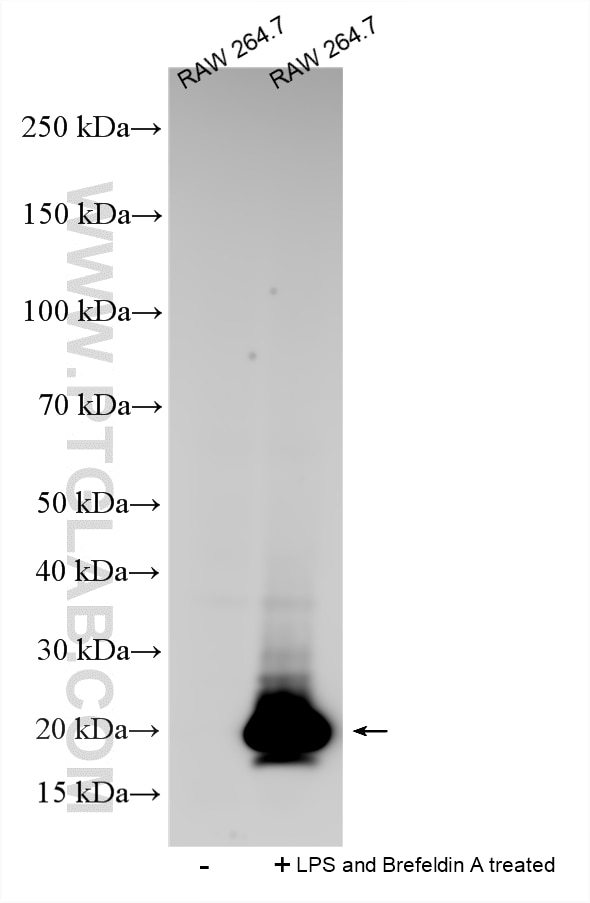
| Positive WB detected in | LPS and Brefeldin A treated RAW 264.7 cells |
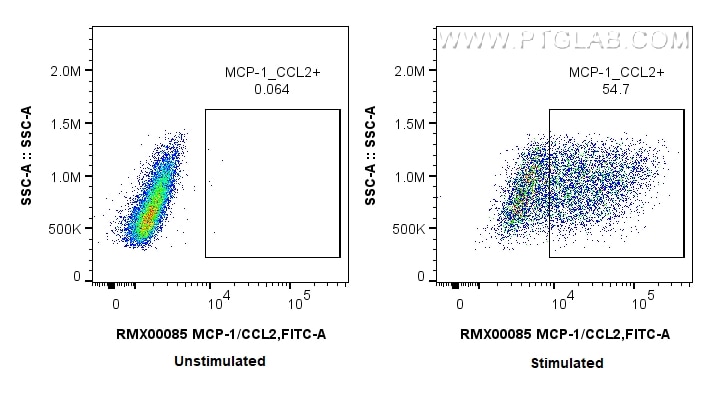
| Positive FC (Intra) detected in | LPS and Brefeldin A treated RAW 264.7 cells |
Recommended dilution
| Application | Dilution |
|---|---|
| Western Blot (WB) | WB : 1:500-1:3600 |
| Flow Cytometry (FC) (INTRA) | FC (INTRA) : 0.2 ug per 10^6 cells in a 100 µl suspension |
| It is recommended that this reagent should be titrated in each testing system to obtain optimal results. | |
| Sample-dependent, Check data in validation data gallery. | |
Product Information
RMX00085 targets MCP-1/CCL2 in WB, FC (Intra), ELISA applications and shows reactivity with mouse samples.
| Tested Reactivity | mouse |
| Host / Isotype | Rabbit / IgG |
| Class | Multi-Recombinant |
| Type | Antibody |
| Immunogen |
Recombinant protein 相同性解析による交差性が予測される生物種 |
| Full Name | chemokine (C-C motif) ligand 2 |
| Observed molecular weight | 16-20 kDa |
| GenBank accession number | NM-011333 |
| Gene Symbol | MCP-1/CCL2 |
| Gene ID (NCBI) | 20296 |
| Conjugate | Unconjugated |
| Form | |
| Form | Liquid |
| Purification Method | N/A |
| UNIPROT ID | P10148 |
| Storage Buffer | PBS with 0.02% sodium azide and 50% glycerol{{ptg:BufferTemp}} |
| Storage Conditions | Store at -20°C. Stable for one year after shipment. Aliquoting is unnecessary for -20oC storage. |
Background Information
Monocyte chemotactic protein 1 (MCP-1), also known as CCL2, is chemotactic for monocyte/macrophage, B cell, and T cell, and belongs to the CC subfamily of chemokines. Chemokines are a superfamily of secreted proteins involved in immunoregulatory and inflammatory processes. The human ortholog has been implicated in the pathogenesis of diseases characterized by monocytic infiltrates, such as psoriasis, rheumatoid arthritis, and atherosclerosis.
Protocols
| Product Specific Protocols | |
|---|---|
| FC protocol for MCP-1/CCL2 antibody RMX00085 | Download protocol |
| WB protocol for MCP-1/CCL2 antibody RMX00085 | Download protocol |
| Standard Protocols | |
|---|---|
| Click here to view our Standard Protocols |