
Validation Data Gallery
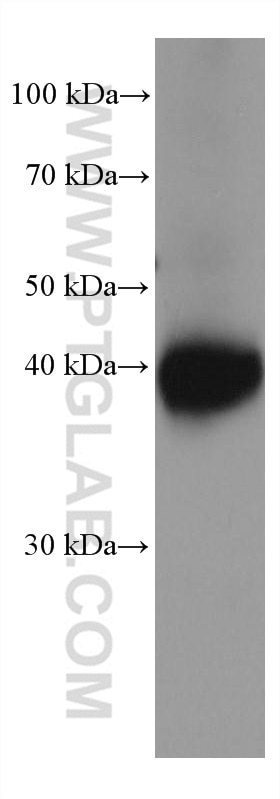
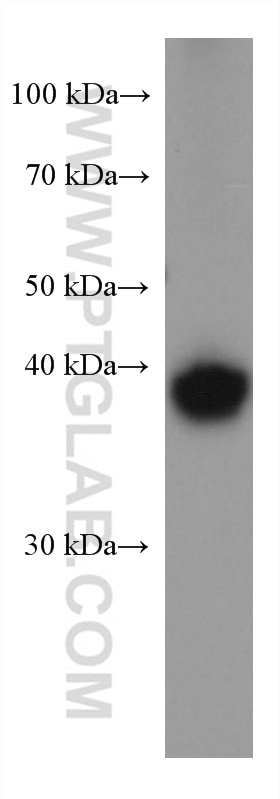
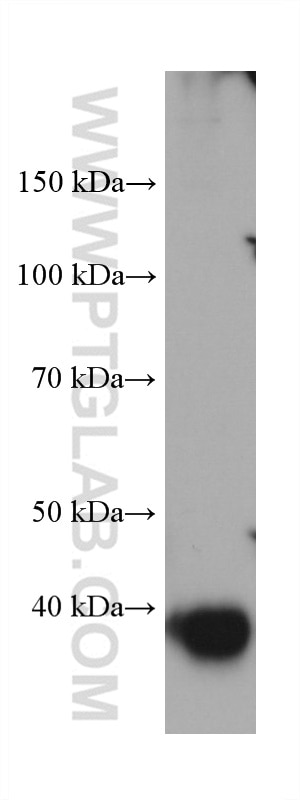
Tested Applications
Recommended dilution
| Application | Dilution |
|---|---|
| It is recommended that this reagent should be titrated in each testing system to obtain optimal results. | |
Product Information
66931-1-PBS targets Kir4.1 in WB, Indirect ELISA applications and shows reactivity with human, mouse samples.
| Tested Reactivity | human, mouse |
| Host / Isotype | Mouse / IgG1 |
| Class | Monoclonal |
| Type | Antibody |
| Immunogen |
CatNo: Ag16785 Product name: Recombinant human KCNJ10 protein Source: e coli.-derived, PET28a Tag: 6*His Domain: 224-426 aa of BC034036 Sequence: ETIRFSQHAVVASHNGKPCLMIRVANMRKSLLIGCQVTGKLLQTHQTKEGENIRLNQVNVTFQVDTASDSPFLILPLTFYHVVDETSPLKDLPLRSGEGDFELVLILSGTVESTSATCQVRTSYLPEEILWGYEFTPAISLSASGKYIADFSLFDQVVKVASPSGLRDSTVRYGDPEKLKLEESLREQAEKEGSALSVRISNV 相同性解析による交差性が予測される生物種 |
| Full Name | potassium inwardly-rectifying channel, subfamily J, member 10 |
| Calculated molecular weight | 379 aa, 41 kDa |
| Observed molecular weight | 40 kDa |
| GenBank accession number | BC034036 |
| Gene Symbol | Kir4.1 |
| Gene ID (NCBI) | 3766 |
| RRID | AB_2882257 |
| Conjugate | Unconjugated |
| Form | |
| Form | Liquid |
| Purification Method | Protein G purification |
| UNIPROT ID | P78508 |
| Storage Buffer | PBS only{{ptg:BufferTemp}}7.3 |
| Storage Conditions | Store at -80°C. |
Background Information
ATP-sensitive inward rectifier potassium channel 10 (KCNJ10, also known as Kir4.1) is an inwardly rectifying K⁺ channel predominantly expressed in glial cells within the central nervous system. In glial cells, Kir4.1 participates in multiple physiological processes, including the maintenance of extracellular K⁺ homeostasis, preservation of astrocyte resting membrane potential, regulation of cell volume, and promotion of glutamate uptake (PMID: 26961251). Kir4.1 can assemble into Kir4.1/Kir5.1 heteromeric channels, which mediate basolateral K⁺ recycling in renal distal tubules. This activity is essential for tubular Na⁺ reabsorption. Pathogenic mutations in Kir4.1 are associated with EAST/SeSAME syndrome, a genetic disorder marked by renal salt wasting (PMID: 24561201; 8995301).