
Validation Data Gallery
Filter:
Tested Applications
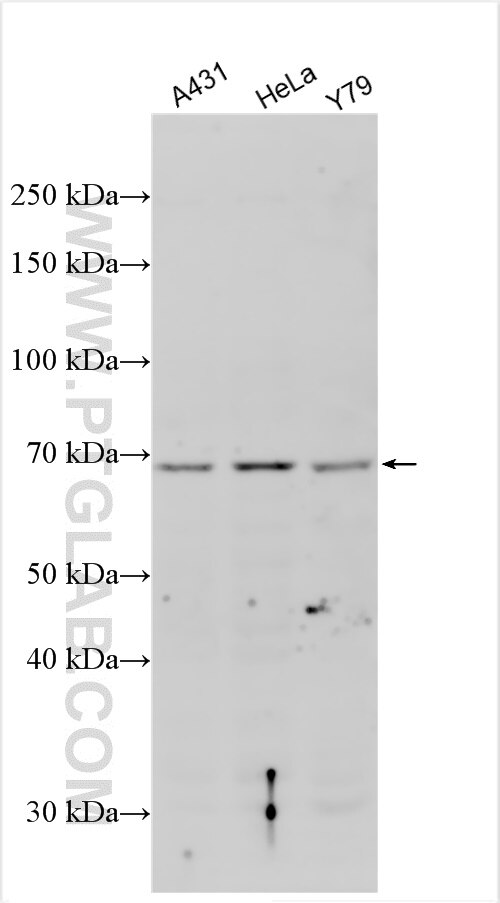
| Positive WB detected in | A431 cells, HeLa cells, Y79 cells |
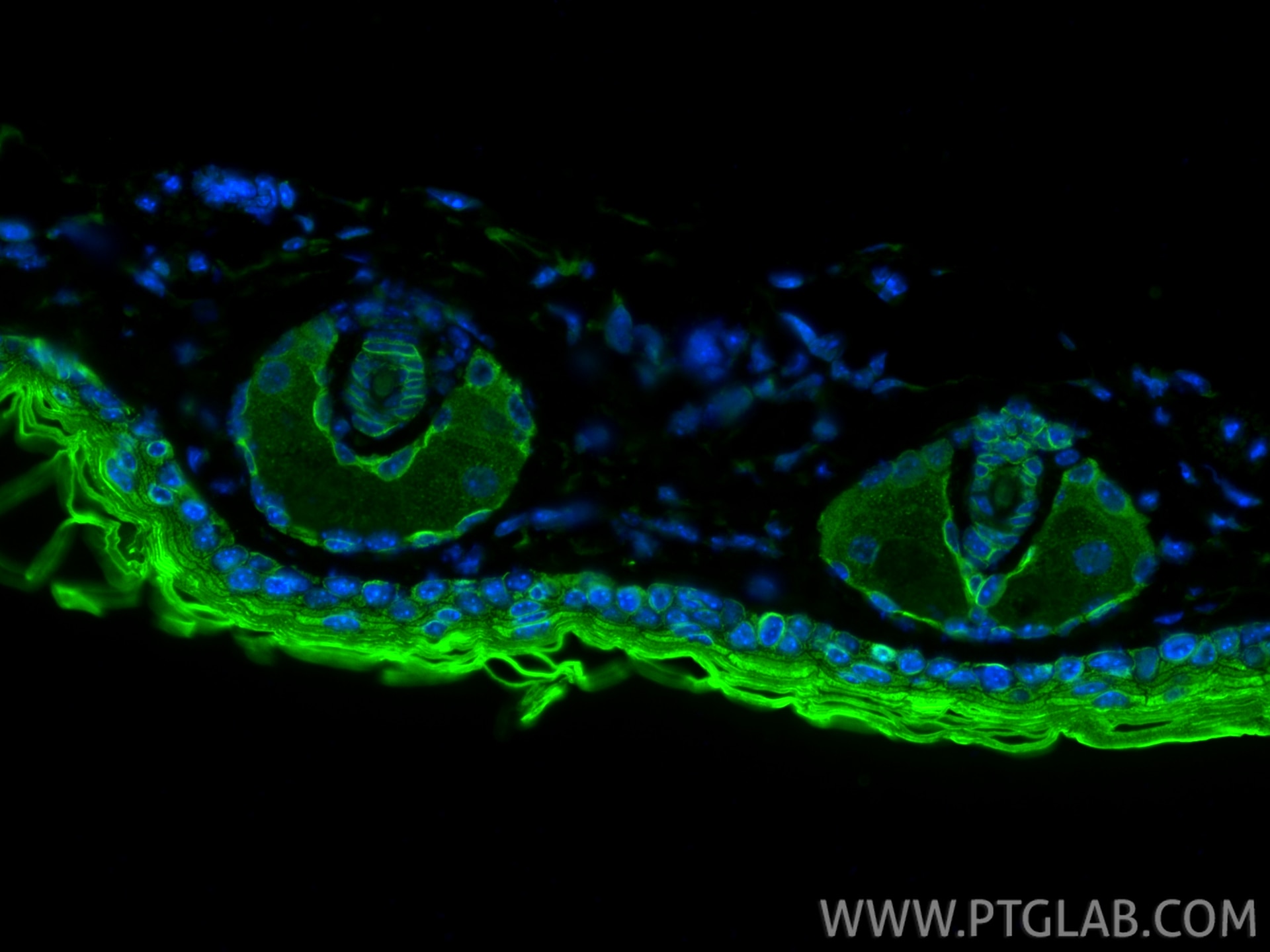
| Positive IF-P detected in | mouse skin tissue |
Recommended dilution
| Application | Dilution |
|---|---|
| Western Blot (WB) | WB : 1:500-1:2000 |
| Immunofluorescence (IF)-P | IF-P : 1:200-1:800 |
| It is recommended that this reagent should be titrated in each testing system to obtain optimal results. | |
| Sample-dependent, Check data in validation data gallery. | |
Published Applications
| IF | See 1 publications below |
Product Information
16850-1-AP targets Cytokeratin 3 in WB, IF-P, ELISA applications and shows reactivity with human samples.
| Tested Reactivity | human |
| Cited Reactivity | rat |
| Host / Isotype | Rabbit / IgG |
| Class | Polyclonal |
| Type | Antibody |
| Immunogen |
Peptide 相同性解析による交差性が予測される生物種 |
| Full Name | keratin 3 |
| Calculated molecular weight | 64 kDa |
| Observed molecular weight | 68 kDa |
| GenBank accession number | NM_057088 |
| Gene Symbol | Cytokeratin 3 |
| Gene ID (NCBI) | 3850 |
| RRID | AB_3669258 |
| Conjugate | Unconjugated |
| Form | |
| Form | Liquid |
| Purification Method | Antigen affinity purification |
| UNIPROT ID | P12035 |
| Storage Buffer | PBS with 0.02% sodium azide and 50% glycerol{{ptg:BufferTemp}}7.3 |
| Storage Conditions | Store at -20°C. Stable for one year after shipment. Aliquoting is unnecessary for -20oC storage. |
Background Information
Keratins are a large family of proteins that form the intermediate filament cytoskeleton of epithelial cells, which are classified into two major sequence types. Type I keratins are a group of acidic intermediate filament proteins, including K9-K23, and the hair keratins Ha1-Ha8. Type II keratins are the basic or neutral courterparts to the acidic type I keratins, including K1-K8, and the hair keratins, Hb1-Hb6. As a member of the type II cytokeratin subfamily, KRT3 is expressed together with KRT12 during 'corneal-type' differentiation.
Protocols
| Product Specific Protocols | |
|---|---|
| IF protocol for Cytokeratin 3 antibody 16850-1-AP | Download protocol |
| WB protocol for Cytokeratin 3 antibody 16850-1-AP | Download protocol |
| Standard Protocols | |
|---|---|
| Click here to view our Standard Protocols |
Publications
| Species | Application | Title |
|---|---|---|
J Dent Metformin's mechanism in reducing oxidative stress and promoting bone regeneration in T2DM rat BMMSCs: a focus on NRF2-GPX7 signaling pathway | ||
J Biol Chem Lactate-fueled H3K18 lactylation sustains ΔNp63α-dependent self-renewal in limbal epithelial stem cells. |