
Validation Data Gallery
Tested Applications
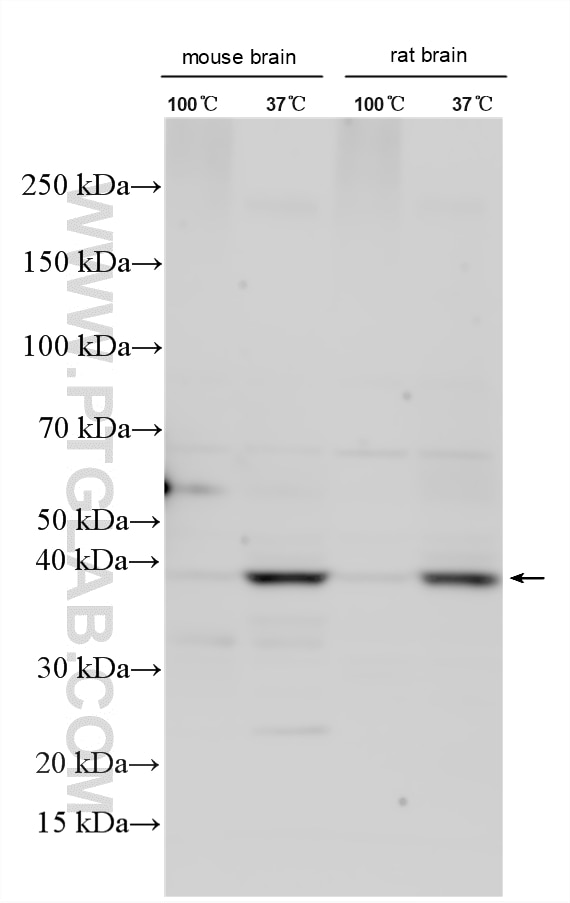
| Positive WB detected in | mouse brain tissue, rat brain tissue |
Recommended dilution
| Application | Dilution |
|---|---|
| Western Blot (WB) | WB : 1:1000-1:4000 |
| It is recommended that this reagent should be titrated in each testing system to obtain optimal results. | |
| Sample-dependent, Check data in validation data gallery. | |
Product Information
31742-1-AP targets KCNJ9 in WB, ELISA applications and shows reactivity with human, mouse, rat samples.
| Tested Reactivity | human, mouse, rat |
| Host / Isotype | Rabbit / IgG |
| Class | Polyclonal |
| Type | Antibody |
| Immunogen |
CatNo: Ag35873 Product name: Recombinant human KCNJ9 protein Source: e coli.-derived, PGEX-4T Tag: GST Domain: 157-395 aa of BC167777 Sequence: MFVKISQPNKRAATLVFSSHAVVSLRDGRLCLMFRVGDLRSSHIVEASIRAKLIRSRQTLEGEFIPLHQTDLSVGFDTGDDRLFLVSPLVISHEIDAASPFWEASRRALERDDFEIVVILEGMVEATGMTCQARSSYLVDEVLWGHRFTSVLTLEDGFYEVDYASFHETFEVPTPSCSARELAEAAARLDAHLYWSIPSRLDEKVEEEGAGEGAGGEAGADKEQNGCLPPPESESKV 相同性解析による交差性が予測される生物種 |
| Full Name | potassium inwardly-rectifying channel, subfamily J, member 9 |
| Observed molecular weight | 38-44 kDa |
| GenBank accession number | BC167777 |
| Gene Symbol | KCNJ9 |
| Gene ID (NCBI) | 3765 |
| RRID | AB_3742469 |
| Conjugate | Unconjugated |
| Form | |
| Form | Liquid |
| Purification Method | Antigen affinity Purification |
| UNIPROT ID | Q92806 |
| Storage Buffer | PBS with 0.02% sodium azide and 50% glycerol{{ptg:BufferTemp}}7.3 |
| Storage Conditions | Store at -20°C. Stable for one year after shipment. Aliquoting is unnecessary for -20oC storage. |
Background Information
KCNJ9, also known as GIRK3 (G protein-activated inwardly rectifying potassium channel 3), is a crucial subunit that forms inwardly rectifying potassium channels. These channels are primarily activated by inhibitory G proteins (Gi/o) downstream of various G protein-coupled receptors (GPCRs), such as those for neurotransmitters like GABA, acetylcholine, and adenosine. Upon activation, KCNJ9 facilitates potassium efflux, leading to membrane hyperpolarization and a reduction in neuronal excitability. It is widely expressed in the brain, where it plays a key role in regulating synaptic transmission and neuronal circuits, influencing processes ranging from pain perception to reward and motivation.
Protocols
| Product Specific Protocols | |
|---|---|
| WB protocol for KCNJ9 antibody 31742-1-AP | Download protocol |
| Standard Protocols | |
|---|---|
| Click here to view our Standard Protocols |