
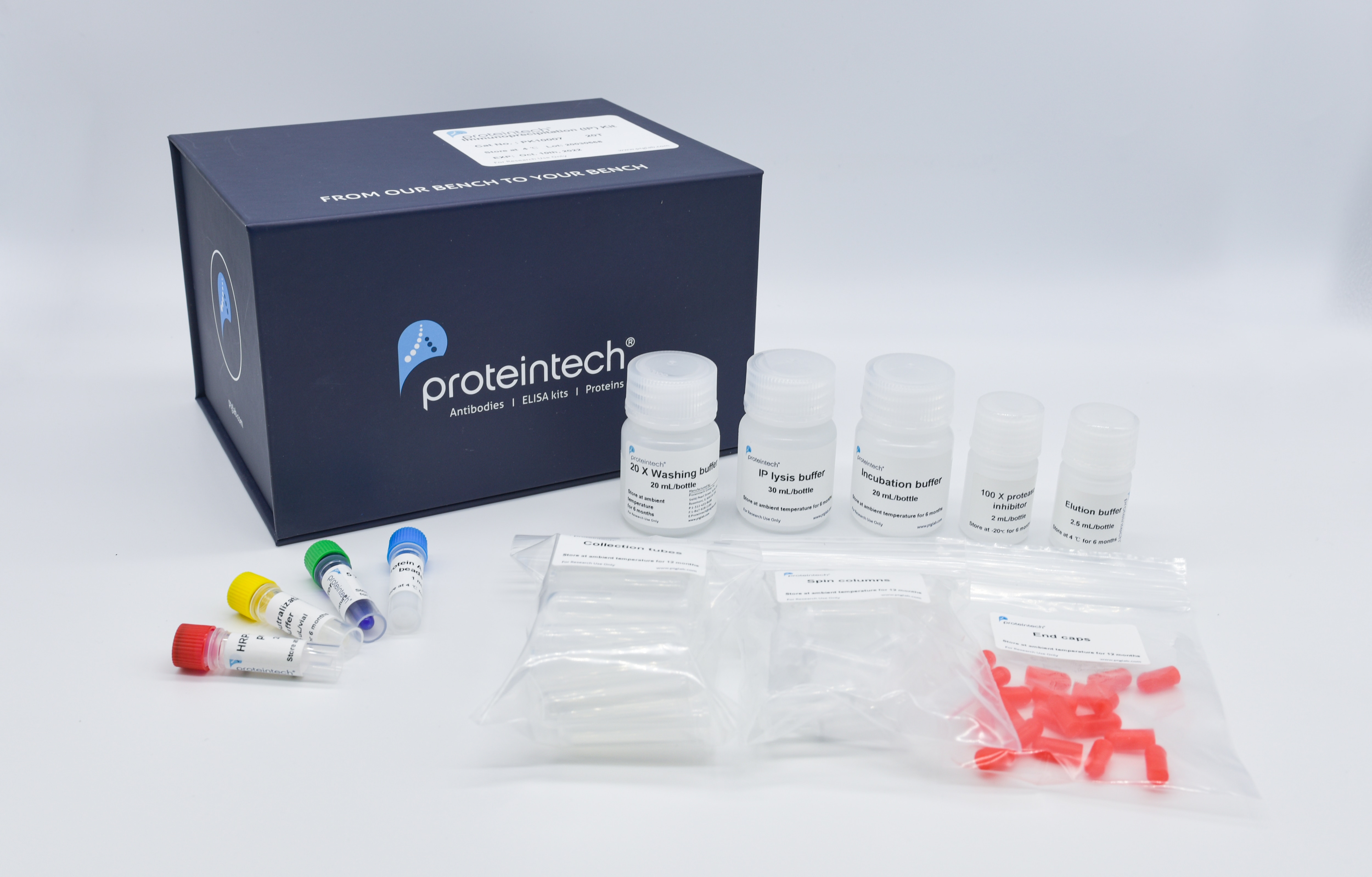
Product Information
Immunoprecipitation (IP) is an experimental technique that can purify and separate target proteins by utilizing the affinity-binding properties of antigens and antibodies. The kit contains all reagents for immunoprecipitation and subsequent Western blotting detection. It provides the best solution for immunoprecipitation experiments by efficiently and rapidly separating the concentrated target proteins. Meanwhile, the kit also has the advantages of time saving, high efficiency, and low antibody dosage and so on.
About the Kit
(1) IP lysis buffer can effectively extract total protein of cells or tissues for subsequent experiments.
(2) rProtein A/G beads slurry is used to separate antigen-antibody complexes by precipitation.
(3) Elution buffer with high salt and low pH is effectively for the dissociation of antigen-antibody complexes and rProtein A/G beads.
(4) The use of spin columns makes the operation more convenient and faster, and reduces the loss of target proteins, while reducing the influence of non-specific proteins.
(5) HRP-conjugated Protein A secondary antibody is used for the detection of Western blotting, which can effectively eliminate the influence of the light chain signal of the antibody and reduce the heavy chain signal of the antibody.
(6) The kit can be widely used in immunoprecipitation (IP) and immunocoprecipitation (CoIP) experiments.
Components
| Components | 20 times | Storage |
IP lysis buffer: 20 mL/bottle | 1 bottle | 6 months at RT |
Incubation buffer: 15 mL/bottle | 1 bottle | 6 months at RT |
100 × Protease inhibitor: 2 mL/vial | 1 vial | 6 months at -20 ℃ |
20 × Washing buffer: 10 mL/bottle | 1 bottle | 6 months at RT |
rProtein A/G beads slurry: 1 mL/vial | 1 vial | 6 months at 4 ℃ |
Elution buffer: 2.5 mL/vial | 1 vial | 6 months at 4 ℃ |
Alkali neutralization buffer: 250 uL/vial | 1 vial | 6 months at 4 ℃ |
5 × Sample buffer: 800 uL/vial | 1 vial | 6 months at RT |
HRP-conjugated Protein A: 200 uL/vial | 1 vial | 6 months at 4 ℃ |
Spin columns: 1 mL | 20 units | 12 months at RT |
Collection tubes: 2 mL | 20 units | 12 months at RT |
End caps | 20 units | 12 months at RT |
*The customer must provide the following:
Cells or tissue for immunoprecipitation, antibodies for immunoprecipitation, 1x PBS buffer, vertical rotary mixer, low-temperature centrifuge, adjustable pipette and pipette tips, deionised water, and homogeniser (for tissue samples).
*It is recommended not to use the kit after expiration.
Cautions
*The kit is only used for IP and CoIP experiments of cell or tissue lysates.
*Unless otherwise specified, all operations were done on ice.
*Avoid skin and eyes contact with the Alkali neutralizing solution.
Questions and Answers
Questions 1: Target protein not obtained ?
Reason a: High concentration of detergent affects the antigen-antibody binding.
Solution a: Prepare high-concentration cell or tissue lysates and dilute with incubation buffer before use.
Reason b: Low expression or degradation of target protein in lysates.
Solution b: Increase the amount of total protein of lysates used; Verify target protein expression in the lysate by Western blotting; Replace with fresh protease inhibitors.
Reason c: The antibody does not bind to the corresponding antigen.
Solution c: Replace antibodies that recognize different epitopes and increase the amount of antibodies used.
Reason d: Antigen-antibody complexes are not precipitated by rProtein A/G beads.
Solution d: Antibodies belong to IgM subtype, and antigen-antibody complexes are precipitated using anti-IgM-conjugated microparticles.
Questions 2: Antibody signal of eluate affects the signal of target protein ?
Reason: The molecular weight of target protein is around 45-55 kDa.
Solution: Choose to use HRP-conjugated Mouse Anti-Rabbit IgG Light Chain Specific secondary antibody (when both capture and detection antibodies are rabbit antibodies); Two different species of antibodies were used for IP and subsequent Western blotting analysis respectively.
How to choose a secondary antibody for immunoprecipitation
Capture Antibody Types for IP | Primary Antibody Types for WB | Secondary Antibody Types for WB |
Mouse McAb/PcAb | Mouse McAb | HRP-conjugated Protein A or HRP-conjugated anti-Mouse IgG secondary antibody |
Mouse PcAb | ||
Rabbit antibody | HRP-conjugated anti-Rabbit IgG secondary antibody | |
Rabbit antibody | Mouse McAb | HRP-conjugated anti-Mouse IgG secondary antibody |
| Mouse PcAb | ||
Rabbit antibody | HRP-conjugated Protein A; HRP-conjugated anti-rabbit IgG light chain specific antibody |
Cited in Article as
pk10007, Immunoprecipitation Kit (With HRP-conjugated protein A), Proteintech, IL, USA
Documentation
| Datasheet |
|---|
| Immunoprecipitation Kit (With HRP-conjugated protein A) Datasheet |
Publications
| Application | Title |
|---|---|
Signal Transduct Target Ther Interaction between CDC6 and Tmod3 accelerates resistance to paclitaxel through focal adhesion assembly. | |
Int J Oral Sci Regulation of FN1 degradation by the p62/SQSTM1-dependent autophagy-lysosome pathway in HNSCC. | |
J Adv Res Negative pressure mechanical signal increases the phosphorylation of eNOS Ser1177 by upregulating HSP90 expression to promote wound angiogenesis | |
Redox Biol p38α in macrophages aggravates arterial endothelium injury by releasing IL-6 through phosphorylating megakaryocytic leukemia 1. | |
Adv Sci (Weinh) Overcoming the Tumor Collagen Barriers: A Multistage Drug Delivery Strategy for DDR1-Mediated Resistant Colorectal Cancer Therapy | |
Cell Death Dis AnnexinA7 promotes epithelial-mesenchymal transition by interacting with Sorcin and contributes to aggressiveness in hepatocellular carcinoma. |