
Recombinant Human TSLP protein (His Tag)
Species
Human
Purity
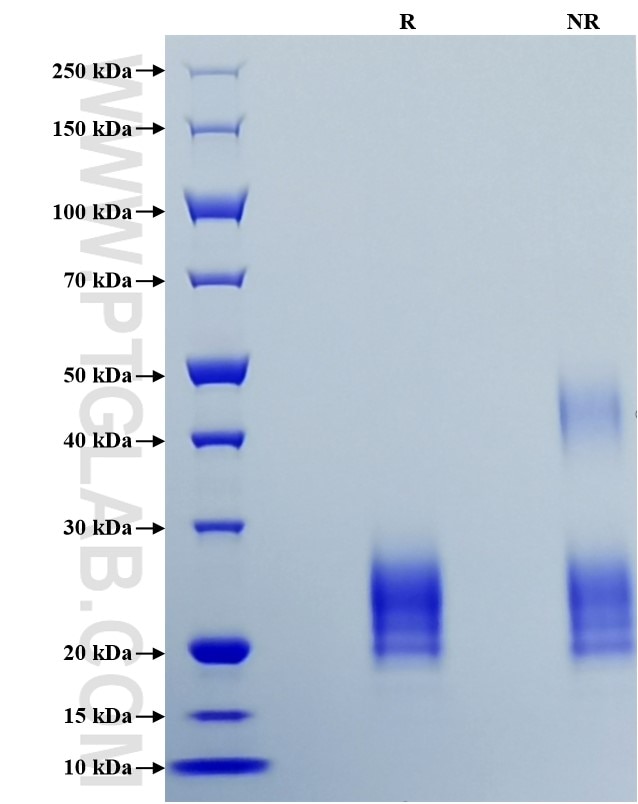
>90 %, SDS-PAGE
Tag
His Tag
Activity
not tested
Cat no : Eg1238
Validation Data Gallery
Product Information
| Purity | >90 %, SDS-PAGE |
| Endotoxin | <0.1 EU/μg protein, LAL method |
| Activity |
Not tested |
| Expression | HEK293-derived Human TSLP protein Tyr29-Gln159 (Accession# Q969D9-1, Arg127Ala and Arg130Ala) with a his tag at the C-terminus. |
| GeneID | 85480 |
| Accession | Q969D9-1 |
| PredictedSize | 16.4 kDa |
| SDS-PAGE | 20-28 kDa, reducing (R) conditions |
| Formulation | Lyophilized from 0.22 μm filtered solution in PBS, pH 7.4. Normally 5% trehalose and 5% mannitol are added as protectants before lyophilization. |
| Reconstitution | Briefly centrifuge the tube before opening. Reconstitute at 0.1-0.5 mg/mL in sterile water. |
| Storage Conditions |
It is recommended that the protein be aliquoted for optimal storage. Avoid repeated freeze-thaw cycles.
|
| Shipping | The product is shipped at ambient temperature. Upon receipt, store it immediately at the recommended temperature. |
Background
Thymic stromal lymphopoietin (TSLP) is a 24 kDa monomeric glycoprotein that was originally identified as a product of a thymic stromal cell line. TSLP mainly impacts myeloid cells and induces the release of T cell-attracting chemokines from monocytes and enhances the maturation of CD11c+ dendritic cells. It can induce allergic inflammation by directly activating mast cells. TSLP is expressed in a number of tissues including heart, liver and prostate. Human TSLP shares only 38% aa sequence identity with mouse TSLP in the mature region. TSLP has been shown to expand the CD4+ subset of lymphocytes and thymocytes and thus regulate CD4+ homeostasis. Overexpression of TSLP causes imbalances in lymphopoiesis and myelopoiesis.
References:
1. Sims J E. et al. (2000) J Exp Med. 192:671.
2. Reche P A. et al.(2001) J Immunol. 167:336-343.
3. Quentmeier H. et al. (2001) Leukemia. 15:1286-1292.
4. Allakhverdi Z. et al. (2007)J Exp Med. 204:253-258.
5. Quentmeier H. et al. (2001) Leukemia. 15:1286-1292.
6. Reche P A. et al. (2001) J Immunol. 167:336.
7. Al-Shami A. et al. (2004) J Exp Med. 200:159.
8. Osborn M J. et al. (2004) Blood. 103:843.