
Recombinant Human TIMP4 protein (rFc Tag)
Species
Human
Purity
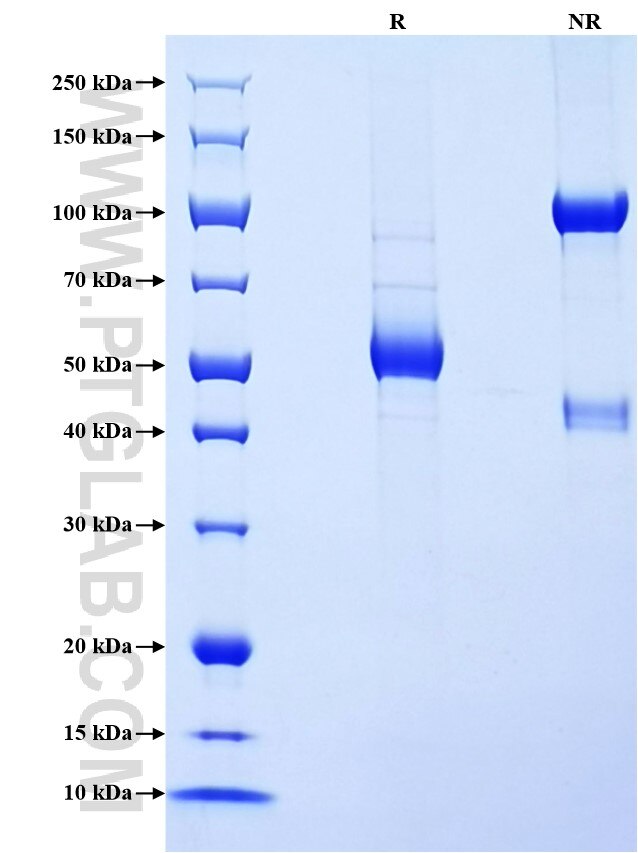
>90 %, SDS-PAGE
Tag
rFc Tag
Activity
not tested
Cat no : Eg3334
Validation Data Gallery
Product Information
| Purity | >90 %, SDS-PAGE |
| Endotoxin | <0.1 EU/μg protein, LAL method |
| Activity |
Not tested |
| Expression | HEK293-derived Human TIMP4 protein Cys30-Pro224 (Accession# Q99727) with a rabbit IgG Fc tag at the C-terminus. |
| GeneID | 7079 |
| Accession | Q99727 |
| PredictedSize | 48.7 kDa |
| SDS-PAGE | 48-60 kDa, reducing (R) conditions |
| Formulation | Lyophilized from 0.22 μm filtered solution in PBS, pH 7.4. Normally 5% trehalose and 5% mannitol are added as protectants before lyophilization. |
| Reconstitution | Briefly centrifuge the tube before opening. Reconstitute at 0.1-0.5 mg/mL in sterile water. |
| Storage Conditions |
It is recommended that the protein be aliquoted for optimal storage. Avoid repeated freeze-thaw cycles.
|
| Shipping | The product is shipped at ambient temperature. Upon receipt, store it immediately at the recommended temperature. |
Background
Endogenous inhibitors of matrix metalloproteinases (MMPs) called tissue inhibitors of matrix metalloproteinases (TIMPs) form a family of four members,TIMP1-4. Although possessing many similarities, TIMPs show several structural and biochemical differences, and their expression patterns differ. TIMP4 is characterized by being primarily restricted to cardiovascular structures. Experimental studies have suggested a role for TIMP4 in cardiovascular disorders exhibiting an inflammatory component. Overexpression of TIMP4 has been observed within the arterial wall in rats after a balloon injury. TIMP4 has been shown to suppress vascular smooth muscle cell migration and induce cell apoptosis and to inhibit capillary endothelial cell migration.
References:
1. Baker AH.et al. (2002)J Cell Sci.115:3719-3727.
2. SpinaleFG.et al.(2002) Circ Res.90:520-530.
3.LiYY.et al. (1999) Cardiovasc Res.42:162-72.
4. Schulze CJ.et al. (2003) Circulation.107:2487-92.
5. Guo YH.et al. (2004)Life Sci.75:2483-93.