
Recombinant Human Tie1 protein (mFc Tag)
Species
Human
Purity
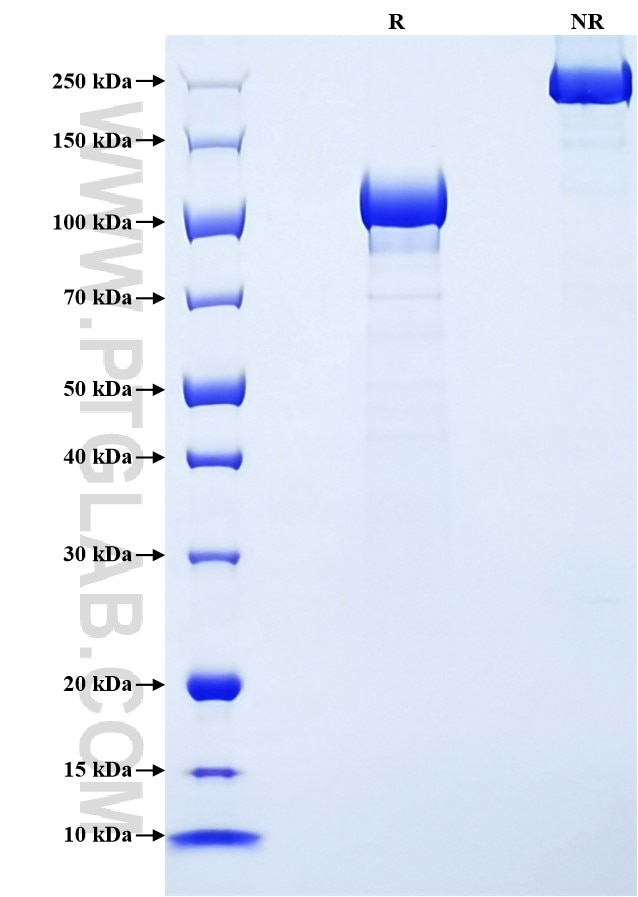
>90 %, SDS-PAGE
Tag
mFc Tag
Activity
not tested
Cat no : Eg3964
Validation Data Gallery
Product Information
| Purity | >90 %, SDS-PAGE |
| Endotoxin | <0.1 EU/μg protein, LAL method |
| Activity |
Not tested |
| Expression | HEK293-derived Human Tie1 protein Ala22-Gln760 (Accession# P35590-1) with a mouse IgG Fc tag at the C-terminus. |
| GeneID | 7075 |
| Accession | P35590-1 |
| PredictedSize | 106.6 kDa |
| SDS-PAGE | 110-120 kDa, reducing (R) conditions |
| Formulation | Lyophilized from 0.22 μm filtered solution in PBS, pH 7.4. Normally 5% trehalose and 5% mannitol are added as protectants before lyophilization. |
| Reconstitution | Briefly centrifuge the tube before opening. Reconstitute at 0.1-0.5 mg/mL in sterile water. |
| Storage Conditions |
It is recommended that the protein be aliquoted for optimal storage. Avoid repeated freeze-thaw cycles.
|
| Shipping | The product is shipped at ambient temperature. Upon receipt, store it immediately at the recommended temperature. |
Background
Tyrosine-protein kinase receptor Tie-1 (Tie1) is an endothelial cell-specific orphan receptor that plays a critical role in angiogenesis and vascular remodeling. It is involved in the modulation of angiopoietin function and is essential for the agonist activity of angiopoietin 1 (ANG1) and autocrine angiopoietin 2 (ANG2). Tie1 interacts with Tie2, and this interaction is modulated by integrin α5β1, which is crucial for the signaling pathways that control vascular stability and inflammation. It has been shown to localize with Tie2 at the cell surface and within the endothelial junctions, playing a role in the subcellular localization dynamics of the Ang-Tie signaling pathway. It also has been implicated in atherosclerosis, tumorigenesis, and inflammatory vascular remodeling.
References:
1.Korhonen EA. et al. (2016). J Clin Invest. 126(9):3495-3510.
2.Zhang Y. et al. (2021). NPJ Syst Biol Appl. 7(1):34.
3.Seegar TC. et al. (2010). Mol Cell. 37(5):643-655.
4.D'Amico G. et al. (2014). J Clin Invest. 124(2):824-834.