
Recombinant Human Siglec-7/CD328 protein (rFc Tag)
Species
Human
Purity
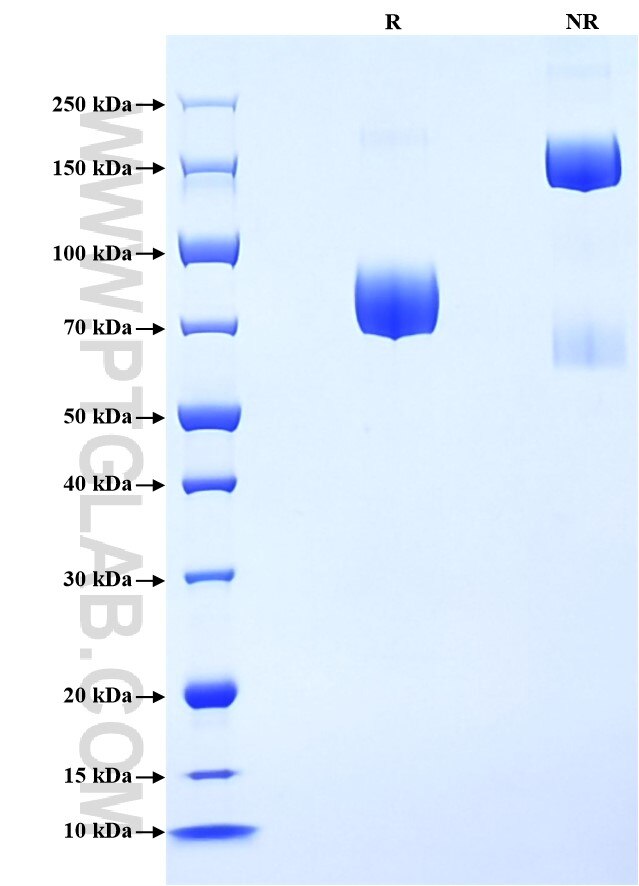
>90 %, SDS-PAGE
Tag
rFc Tag
Activity
not tested
Cat no : Eg1367
Validation Data Gallery
Product Information
| Purity | >90 %, SDS-PAGE |
| Endotoxin | <0.1 EU/μg protein, LAL method |
| Activity |
Not tested |
| Expression | HEK293-derived Human Siglec-7 protein Gln19-Leu353 (Accession# Q9Y286-1) with a rabbit IgG Fc tag at the C-terminus. |
| GeneID | 27036 |
| Accession | Q9Y286-1 |
| PredictedSize | 63.2 kDa |
| SDS-PAGE | 70-90 kDa, reducing (R) conditions |
| Formulation | Lyophilized from 0.22 μm filtered solution in PBS, pH 7.4. Normally 5% trehalose and 5% mannitol are added as protectants before lyophilization. |
| Reconstitution | Briefly centrifuge the tube before opening. Reconstitute at 0.1-0.5 mg/mL in sterile water. |
| Storage Conditions |
It is recommended that the protein be aliquoted for optimal storage. Avoid repeated freeze-thaw cycles.
|
| Shipping | The product is shipped at ambient temperature. Upon receipt, store it immediately at the recommended temperature. |
Background
Sialic acid binding Ig-like lectin 7 (Siglec-7), also known as CD328 or p75/AIRM-1, is a member of the Siglec family of glycan-recognition proteins. Siglec-7 is a type-I transmembrane protein consisting of three extracellular immunoglobulin-like domains that comprise an N-terminal V-set domain and two C2-set domains, a transmembrane region and a cytoplasmic tail containing two tyrosine residues embodied in immunoreceptor tyrosine-based inhibition motif-like motifs. It is mainly expressed on immune cells, with low levels on granulocytes, intermediate levels on monocytes, and relatively high levels on a major subset of natural killer cells and a minor subset of CD8+ T cells. Siglec-7 is an inhibitory receptor that negatively regulates the function of NK cells and modulates the immune response through the interaction of sialic acid-containing ligands.
References:
1. Zheng Y. et al. (2020). J Immunol Res. 2020:6243819.
2. Nicoll G. et al. (1999). J Biol Chem. 274(48):34089-95.
3. Shao JY. et al. (2016). Scand J Immunol. 84(3):182-90.