
Human SP3 ELISA Kit
Sensitivity
0.07 ng/mL
Range
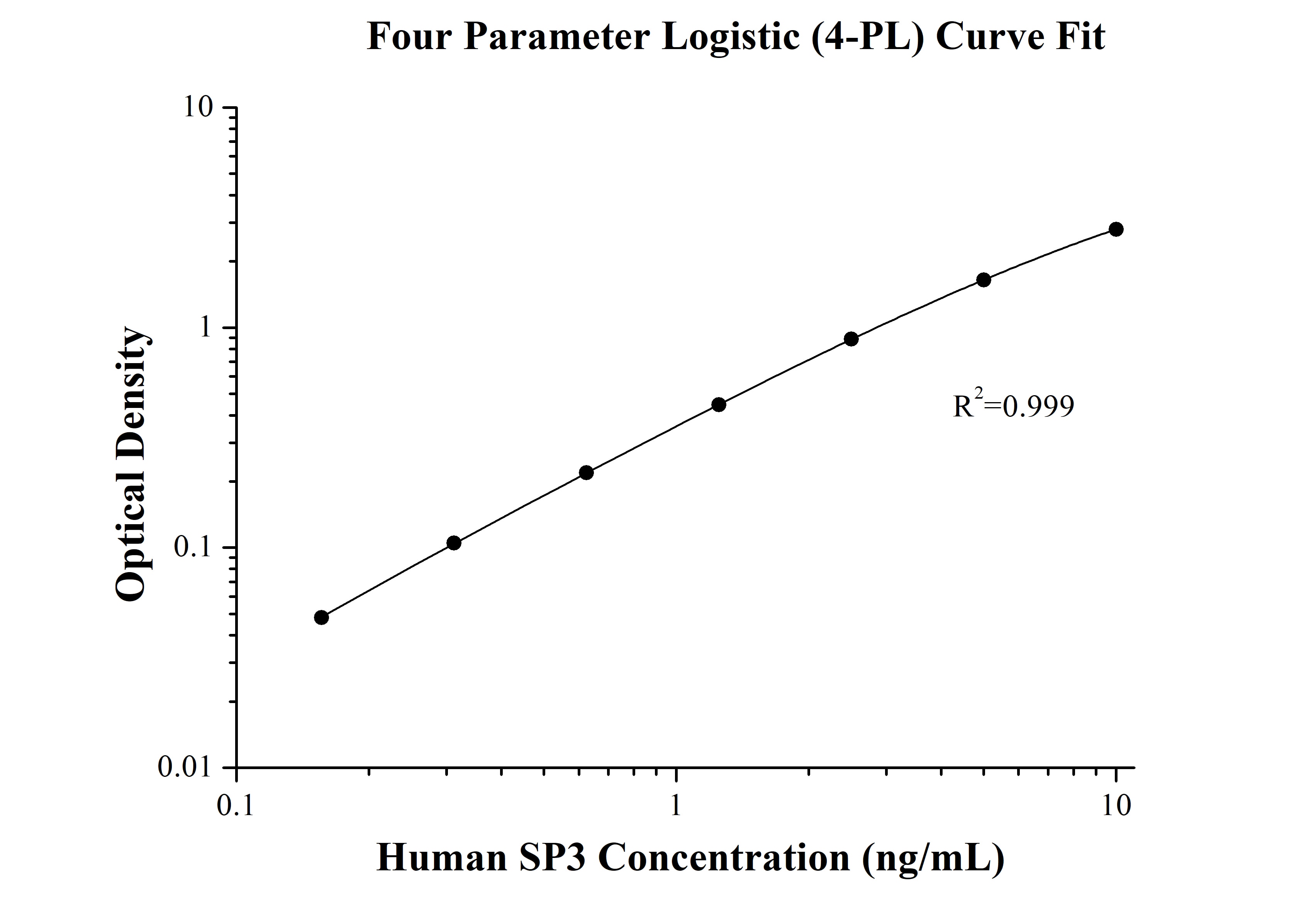
0.156-10 ng/mL
Reactivity
Human
Cat no : KE00859
Synonyms
SPR 2, SPR-2
Validation Data Gallery
Product Information
KE00859 is a solid phase sandwich Enzyme Linked-Immuno-Sorbent Assay (Sandwich ELISA). The human SP3 ELISA kit is to be used to detect and quantify protein levels of endogenous human SP3. The assay recognizes human SP3. An antibody specific for human SP3 has been pre-coated onto the microwells. The human SP3 protein in samples is captured by the coated antibody after incubation. Following extensive washing, another horseradish peroxidase (HRP)-conjugated antibody specific for human SP3 is added to detect the captured human SP3 protein. For signal development, followed by Tetramethyl-benzidine (TMB) reagent. Solution containing sulfuric acid is used to stop color development and the color intensity which is proportional to the quantity of bound protein is measurable at 450 nm with the correction wavelength set at 630 nm.
| Product name | Human SP3 ELISA Kit |
| Tests | 1 X 96 well plate |
| Sample type | Cell lysate |
| Assay type | Sandwich |
| Sensitivity | 0.07 ng/mL |
| Range | 0.156-10 ng/mL |
| Reactivity | Human |
| Tested applications | Sandwich ELISA |
| Gene ID (NCBI) | 6670 |
Recovery
| Sample Type | Average | Range |
|---|---|---|
| Cell lysate | 93% | 84%-99% |
IntraAssay
| Sample | n | mean ( ng/mL) | SD | CV% |
|---|---|---|---|---|
| 1 | 8 | 5.04 | 0.06 | 1.15 |
| 2 | 8 | 1.43 | 0.03 | 2.29 |
| 3 | 8 | 0.67 | 0.03 | 3.74 |
InterAssay
| Sample | n | mean ( ng/mL) | SD | CV% |
|---|---|---|---|---|
| 1 | 16 | 5.28 | 0.26 | 4.99 |
| 2 | 16 | 1.34 | 0.11 | 7.85 |
| 3 | 16 | 0.67 | 0.02 | 3.28 |
Background Information
Specificity Protein 3 (SP3) is a transcription factor belonging to the Sp1-related gene family. It regulates gene transcription by binding to GC and GT boxes in the regulatory elements of target genes. The SP3 protein contains a zinc-finger DNA-binding domain and multiple transcriptional activation domains, functioning as a dual-function transcription factor that can both activate and repress gene expression, depending on the cell type, target gene, and the presence of co-regulators. SP3 plays a crucial role in biological processes such as cell proliferation, differentiation, apoptosis, and embryonic development. Its abnormal expression is associated with various diseases, including Alzheimer's disease, breast cancer, and colorectal cancer. In some cases, SP3 may disrupt cell cycle regulation or inhibit apoptosis by competitively inhibiting the functions of other Sp family members (such as SP1). Additionally, SP3 is involved in the regulation of angiogenesis-related gene expression.
Properties
| Storage Instructions | All the reagents are stored at 2-8℃ for 6 months or -20℃ for 12 months. Refer to the protocol for further storage instructions. |
| Synonyms | SPR 2, SPR-2 |