
Recombinant Human PAPPA2 protein (rFc Tag)
Species
Human
Purity
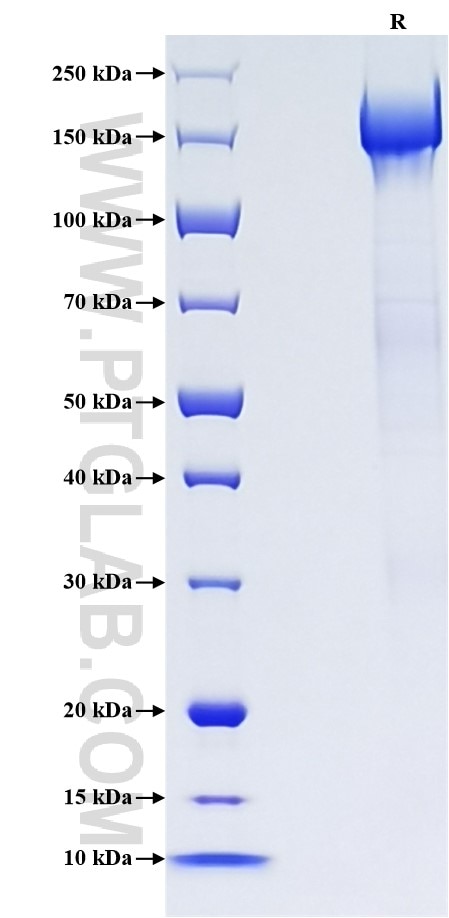
>90 %, SDS-PAGE
Tag
rFc Tag
Activity
not tested
Cat no : Eg2812
Validation Data Gallery
Product Information
| Purity | >90 %, SDS-PAGE |
| Endotoxin | <0.1 EU/μg protein, LAL method |
| Activity |
Not tested |
| Expression | HEK293-derived Human PAPPA2 protein Ser234-Cys1396 (Accession# Q9BXP8-1) with a rabbit IgG Fc tag at the C-terminus. |
| GeneID | 60676 |
| Accession | Q9BXP8-1 |
| PredictedSize | 155.2 kDa |
| SDS-PAGE | 140-220 kDa, reducing (R) conditions |
| Formulation | Lyophilized from 0.22 μm filtered solution in PBS, pH 7.4. Normally 5% trehalose and 5% mannitol are added as protectants before lyophilization. |
| Reconstitution | Briefly centrifuge the tube before opening. Reconstitute at 0.1-0.5 mg/mL in sterile water. |
| Storage Conditions |
It is recommended that the protein be aliquoted for optimal storage. Avoid repeated freeze-thaw cycles.
|
| Shipping | The product is shipped at ambient temperature. Upon receipt, store it immediately at the recommended temperature. |
Background
PAPPA2 (pregnancy-associated plasma protein-A2) was discovered as a protease which specifically cleaves IGF-binding protein (IGFBP)-3 and -5. PAPPA2 is very highly expressed in the placenta relative to all other tissues. PAPPA2 mRNA and protein are increased in association with pre-eclampsia. PAPPA2 deficiency results in growth impairment in humans with expected derangements in biochemical parameters including increased levels of total IGF-1, IGFBP-3, ALS, and growth hormone.
References:
1. Sifakis S, et al. (2018). Mol Med Rep. May;17(5):6435-6440.
2. Fujimoto M, et al. (2020). Mol Cell Endocrinol. Dec 1;518:110967.
3. Andrew M, et al. (2018). J Endocr Soc. May 28;2(7):646-656.