
Recombinant Human MPIG6B protein (rFc Tag)
Species
Human
Purity
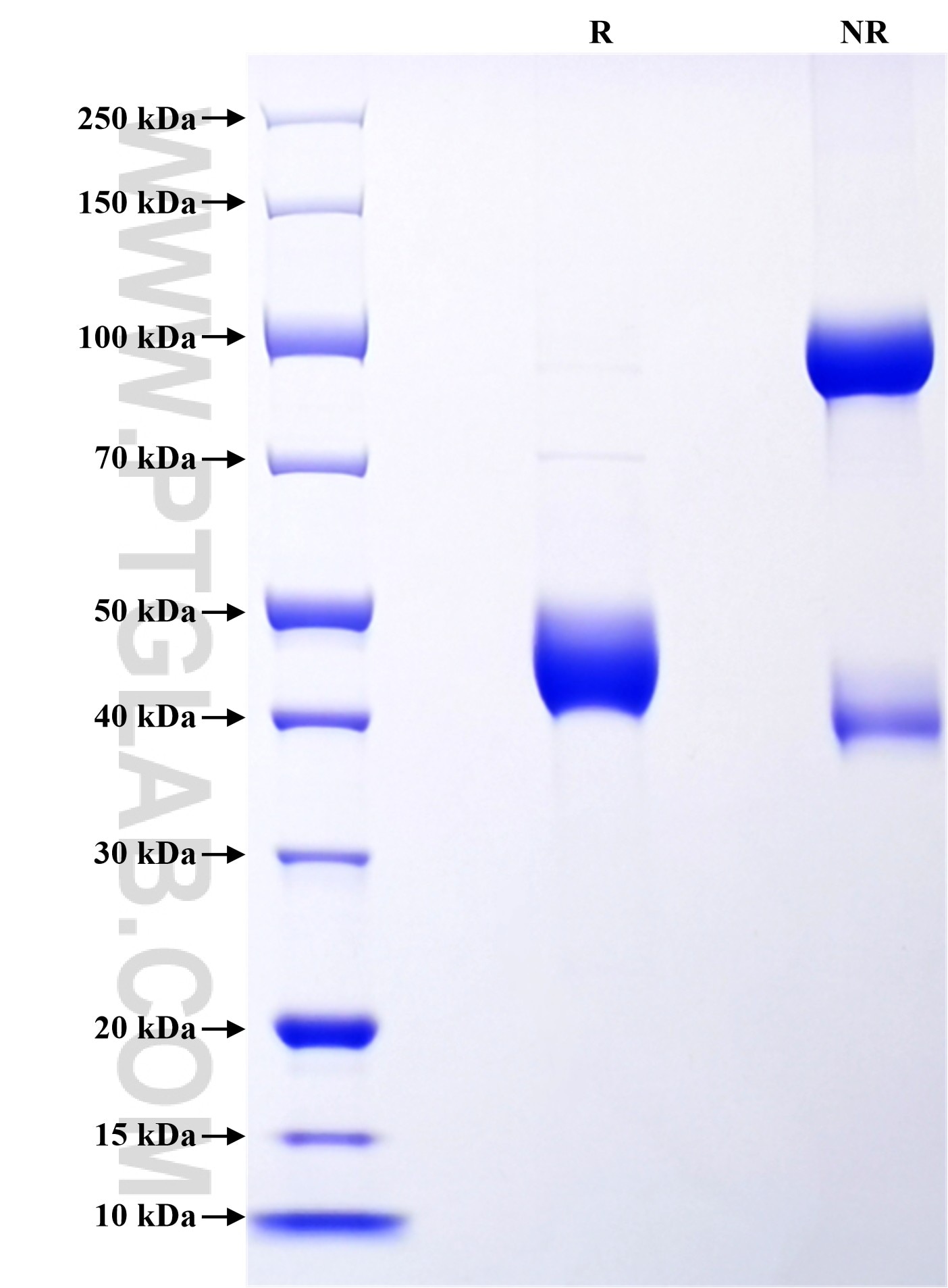
>90 %, SDS-PAGE
Tag
rFc Tag
Activity
not tested
Cat no : Eg5762
Validation Data Gallery
Product Information
| Purity | >90 %, SDS-PAGE |
| Endotoxin | <0.1 EU/μg protein, LAL method |
| Activity |
Not tested |
| Expression | HEK293-derived Human MPIG6B protein Asn18-Gln142 (Accession# O95866-1) with a rabbit IgG Fc tag at the C-terminus. |
| GeneID | 80739 |
| Accession | O95866-1 |
| PredictedSize | 39.0 kDa |
| SDS-PAGE | 40-50 kDa, reducing (R) conditions |
| Formulation | Lyophilized from 0.22 μm filtered solution in PBS, pH 7.4. Normally 5% trehalose and 5% mannitol are added as protectants before lyophilization. |
| Reconstitution | Briefly centrifuge the tube before opening. Reconstitute at 0.1-0.5 mg/mL in sterile water. |
| Storage Conditions |
It is recommended that the protein be aliquoted for optimal storage. Avoid repeated freeze-thaw cycles.
|
| Shipping | The product is shipped at ambient temperature. Upon receipt, store it immediately at the recommended temperature. |
Background
MPIG6B (megakaryocyte and platelet inhibitory receptor G6b), also known as G6b-B or C6orf25, is a lineage-specific immunoreceptor tyrosine-based inhibition motif (ITIM)-containing receptor belonging to the immunoglobulin superfamily. It is predominantly expressed on megakaryocytes and platelets, where it acts as a critical negative regulator of hematopoietic lineage differentiation, megakaryocyte maturation, and platelet production. G6b-B constitutively associates with the tyrosine phosphatases Shp1 and Shp2 to inhibit signaling from ITAM-containing receptors such as GPVI and CLEC-2, thereby attenuating platelet aggregation and activation. Loss-of-function mutations in MPIG6B in humans cause autosomal recessive congenital macrothrombocytopenia with focal myelofibrosis, characterized by severe thrombocytopenia, anemia, and bleeding diathesis.
References:
1. Mazharian, Alexandra et al. Science signaling vol. 5,248 ra78. 30 Oct. 2012,
2. Hofmann, Inga et al. Blood vol. 132,13 (2018): 1399-1412.
3. Newland, Stephen A et al. Blood vol. 109,11 (2007): 4806-9.
4. Becker, Isabelle C et al. Blood advances vol. 6,10 (2022): 3155-3161.