
Human LAMB3 ELISA Kit
Sensitivity
17.8 pg/mL
Range
39-2500 pg/mL
Reactivity
Human
Cat no : KE00884
Synonyms
Validation Data Gallery
Product Information
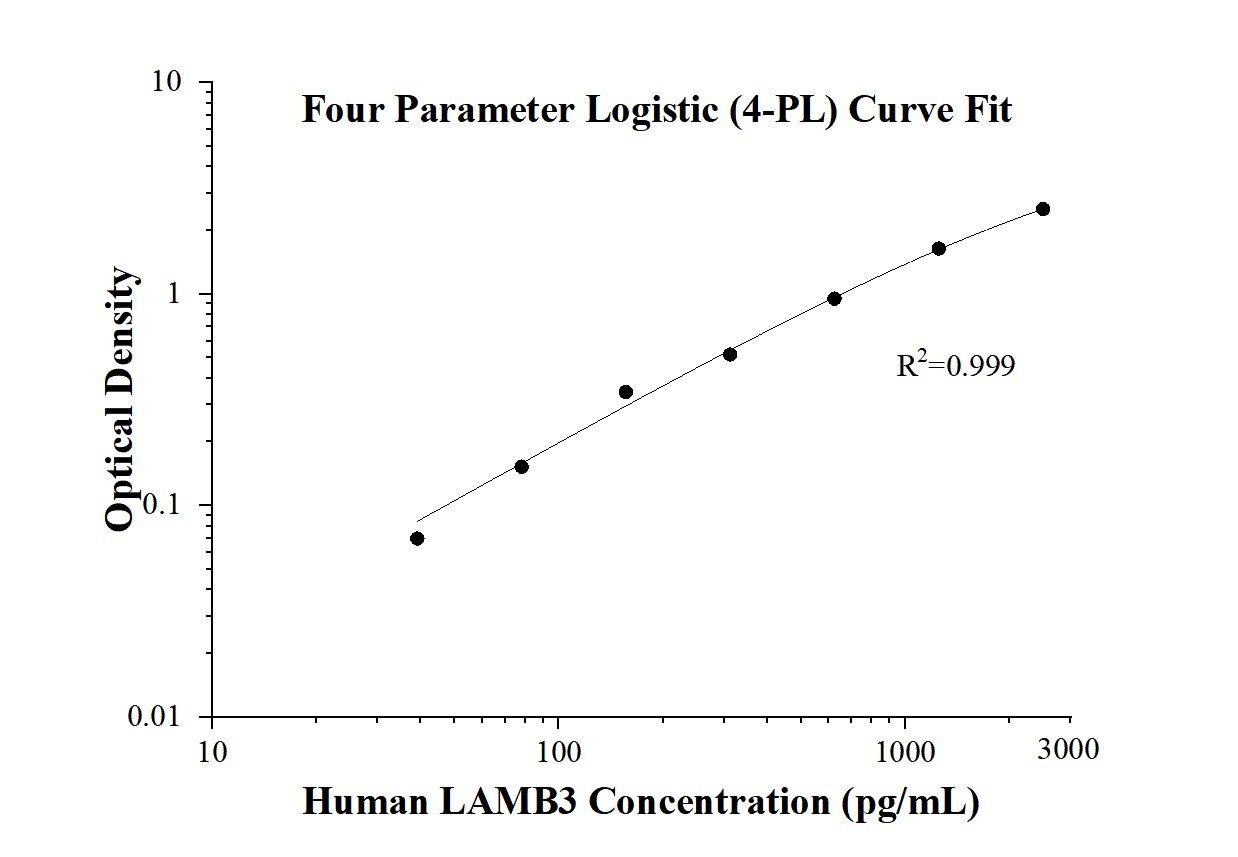
KE00884 is a solid phase sandwich Enzyme Linked-Immuno-Sorbent Assay (Sandwich ELISA). The human LAMB3 ELISA kit is to be used to detect and quantify protein levels of endogenous human LAMB3. The assay recognizes human LAMB3. An antibody specific for human LAMB3 has been pre-coated onto the microwells. The human LAMB3 protein in samples is captured by the coated antibody after incubation. Following extensive washing, another horseradish peroxidase (HRP)-conjugated antibody specific for human LAMB3 is added to detect the captured human LAMB3 protein. For signal development, followed by Tetramethyl-benzidine (TMB) reagent. Solution containing sulfuric acid is used to stop color development and the color intensity which is proportional to the quantity of bound protein is measurable at 450 nm with the correction wavelength set at 630 nm.
| Product name | Human LAMB3 ELISA Kit |
| Tests | 1 X 96 well plate |
| Sample type | Cell lysate |
| Assay type | Sandwich |
| Sensitivity | 17.8 pg/mL |
| Range | 39-2500 pg/mL |
| Reactivity | Human |
| Tested applications | Sandwich ELISA |
| Gene ID (NCBI) | 3914 |
Recovery
| Sample Type | Average | Range |
|---|---|---|
| Cell lysate | 108% | 104%-116% |
IntraAssay
| Sample | n | mean ( pg/mL) | SD | CV% |
|---|---|---|---|---|
| 1 | 8 | 1,135.5 | 32.9 | 2.9 |
| 2 | 8 | 352.4 | 7.4 | 2.1 |
| 3 | 8 | 116.2 | 5.2 | 4.5 |
InterAssay
| Sample | n | mean ( pg/mL) | SD | CV% |
|---|---|---|---|---|
| 1 | 16 | 1,138.8 | 30.3 | 2.7 |
| 2 | 16 | 351.5 | 7.6 | 2.2 |
| 3 | 16 | 115.6 | 7.3 | 6.3 |
Background Information
LAMB3 (β3 subunit of laminin) is an important extracellular matrix protein, which plays an important role in cell adhesion, migration, signal transduction and the formation and stability of basement membrane. LAMB3 plays a key role in the basement membrane of skin and mucosa, maintaining the adhesion between epidermis and dermis. Its abnormal function will lead to skin bullous disease (such as severe borderline epidermolaxis, sJEB), which is characterized by blisters and ulcers on skin and mucosa. LAMB3 is highly expressed in many cancers, including pancreatic ductal adenocarcinoma (PDAC), lung cancer, head and neck squamous cell carcinoma, etc. which is closely related to the proliferation, invasion and metastasis of tumor cells.
Properties
| Storage Instructions | All the reagents are stored at 2-8℃ for 6 months or -20℃ for 12 months. Refer to the protocol for further storage instructions. |
| Synonyms |