
Recombinant Human IL17-RC protein (rFc Tag)
Species
Human
Purity
>90 %, SDS-PAGE
Tag
rFc Tag
Activity
not tested
Cat no : Eg2835
Validation Data Gallery
Product Information
| Purity | >90 %, SDS-PAGE |
| Endotoxin | <0.1 EU/μg protein, LAL method |
| Activity |
Not tested |
| Expression | HEK293-derived Human IL17-RC protein Leu21-His465 (Accession# NP_703190.1) with a rabbit IgG Fc tag at the C-terminus. |
| GeneID | 84818 |
| Accession | NP_703190.1 |
| PredictedSize | 75.0 kDa |
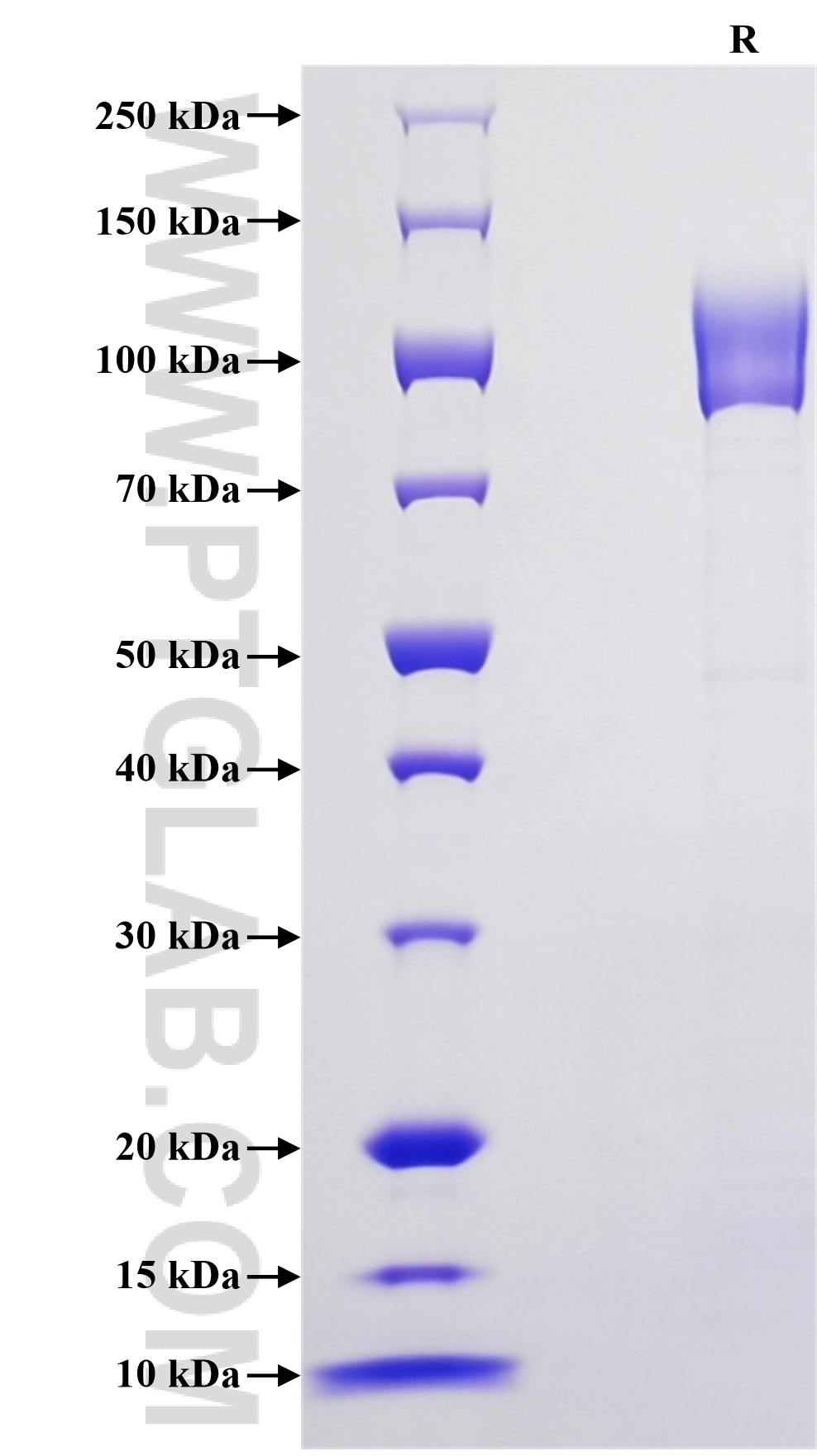
| SDS-PAGE | 87-125 kDa, reducing (R) conditions |
| Formulation | Lyophilized from 0.22 μm filtered solution in PBS, pH 7.4. Normally 5% trehalose and 5% mannitol are added as protectants before lyophilization. |
| Reconstitution | Briefly centrifuge the tube before opening. Reconstitute at 0.1-0.5 mg/mL in sterile water. |
| Storage Conditions |
It is recommended that the protein be aliquoted for optimal storage. Avoid repeated freeze-thaw cycles.
|
| Shipping | The product is shipped at ambient temperature. Upon receipt, store it immediately at the recommended temperature. |
Background
The IL-17 family has five receptors: IL-17RA (or IL-17R), IL-17RB (or IL-17Rh1), IL-17RC (or IL-17RL), IL-17RD and IL-17RE. IL-17RC is a 720-amino acid type I transmembrane protein with a 20-amino acid signal peptide, a 447-amino acid N-terminal extracellular domain, a 21-amino acid hydrophobic α-helical transmembrane domain, and a 232-amino acid intracellular domain. IL-17RC is expressed on several hematopoietic cells. It is found on CD4+ T helper 17 (TH17) cells, where it forms part of the IL-17RA/IL-17RC complex and participates in autoregulatory signaling. IL17RC is also widely expressed in nonleukocyte tissues and forms a heteromeric receptor for IL17 with IL17R. Its roles span from essential antifungal defense and the regulation of autoimmune T cells to influencing nervous system innervation and controlling tumor cell proliferation. The receptor's expression on both immune and non-immune stromal cells positions it as a central integrator of inflammatory and tissue-homeostatic signals.
References:
1.Ge, Dongxia et al. International archives of medicine vol. 1,1 (2008): 19.
2.Kugler, David et al. Journal of immunology (Baltimore, Md. : 1950) vol. 177,1 (2006): 36-9.
3.Luebbe J,Kilian C,Asada N, et al. J Am Soc Nephrol. 2021;32 (12):3081-3098.
4.Kang, Jee Hyun et al. Gastric cancer vol. 26,1 (2023): 82-94.
5.Gaffen SL,Ho AW,Gaffen SL, et al. Semin Immunopathol. 2010;32 (1):33-42.