
Human IFN-beta ELISA Kit
Cat no : KE00187
Synonyms
Fibroblast interferon, IFB, IFF, IFN beta, IFNB, IFNB1, IFN-beta, IFNβ, IFN-β, Interferon beta, Interferon β, interferon, beta 1, fibroblast, Interferon-beta, Interferon-β
Validation Data Gallery
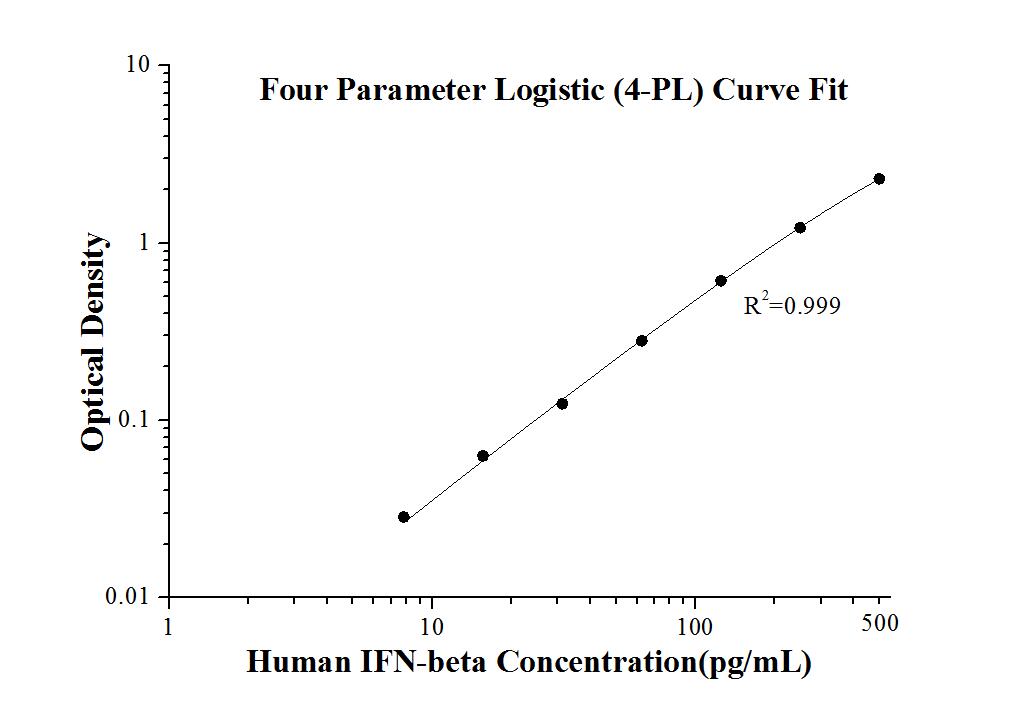
Product Information
KE00187 is a solid phase sandwich Enzyme Linked-Immuno-Sorbent Assay (Sandwich ELISA). The IFN-beta ELISA kit is to be used to detect and quantify protein levels of endogenous IFN-beta. The assay recognizes human IFN-beta. An antibody specific for IFN-beta has been pre-coated onto the microwells. The IFN-beta protein in samples is captured by the coated antibody after incubation. Following extensive washing, another antibody of biotinylated specific for human IFN-beta is added to detect the captured human IFN-beta protein. For signal development, Streptavidin-HRP is added, followed by Tetramethyl-benzidine (TMB) reagent. Solution containing sulfuric acid is used to stop color development and the color intensity which is proportional to the quantity of bound protein is measurable at 450 nm with the correction wavelength set at 630 nm.
| Product name | Human IFN-beta ELISA Kit |
| Tests | 1 X 96 well plate |
| Sample type | Serum, Plasma, Cell culture supernatants |
| Assay type | Sandwich |
| Sensitivity | 0.7 pg/mL |
| Range | 7.8-500 pg/mL |
| Reactivity | Human |
| Tested applications | Sandwich ELISA |
| Gene ID (NCBI) | 3456 |
Recovery
| Sample Type | Average | Range |
|---|---|---|
| Human serum | 91% | 75%-127% |
| Cell culture supernatants | 113% | 91%-125% |
IntraAssay
| Sample | n | mean ( pg/mL) | SD | CV% |
|---|---|---|---|---|
| 1 | 20 | 228.6 | 7.7 | 3.4 |
| 2 | 20 | 55.5 | 4.0 | 7.2 |
| 3 | 20 | 10.7 | 0.8 | 7.4 |
InterAssay
| Sample | n | mean ( pg/mL) | SD | CV% |
|---|---|---|---|---|
| 1 | 24 | 221.8 | 3.8 | 1.7 |
| 2 | 24 | 55.6 | 1.1 | 1.9 |
| 3 | 24 | 11.9 | 0.7 | 6.0 |
Background Information
Interferon beta (IFN-beta) is a cytokine that is naturally produced by the immune system in response to biological and chemical stimuli. It signals by binding to the heterodimeric type I IFN receptor composed of the IFNAR1 and IFNAR2 chains, and regulates the expression of a plethora of genes by means of the classical JAK/STAT and other pathways. Interferon beta (IFN-beta) has been shown in several clinical trials to have efficacy in multiple sclerosis. Interferon beta gene therapy is expected to become widely available for clinical use in cancer patients, and this new strategy might be extended to molecular targeting therapy, or used in combination with cell therapy or other therapies.
Properties
| Storage Instructions | All the reagents are stored at 2-8℃ for 6 months or -20℃ for 12 months. Refer to the protocol for further storage instructions. |
| Synonyms | Fibroblast interferon, IFB, IFF, IFN beta, IFNB, IFNB1, IFN-beta, IFNβ, IFN-β, Interferon beta, Interferon β, interferon, beta 1, fibroblast, Interferon-beta, Interferon-β |
Publications
| Species | Sample Type | Title |
|---|---|---|
Gastroenterology A-to-I RNA-Editing: an epigenetic hallmark cannot be ignored in silencing the tumor microenvironment and is promising in predicting immunotherapy response for esophageal squamous cell carcinoma | ||
Nat Aging The glycolytic metabolite phosphoenolpyruvate restricts cGAS-driven inflammation to promote healthy aging. | ||
Autophagy RNF144A inhibits autophagy by targeting BECN1 for degradation during L. monocytogenes infection | ||
Nat Commun Centromere defects, chromosome instability, and cGAS-STING activation in systemic sclerosis | ||
Oncogene Reciprocal regulation between ferroptosis and STING-type I interferon pathway suppresses head and neck squamous cell carcinoma growth through dendritic cell maturation | ||
Front Immunol SARS-CoV-2 Membrane Protein Inhibits Type I Interferon Production Through Ubiquitin-Mediated Degradation of TBK1. |