
Recombinant Human GPNMB protein (rFc Tag)
Species
Human
Purity
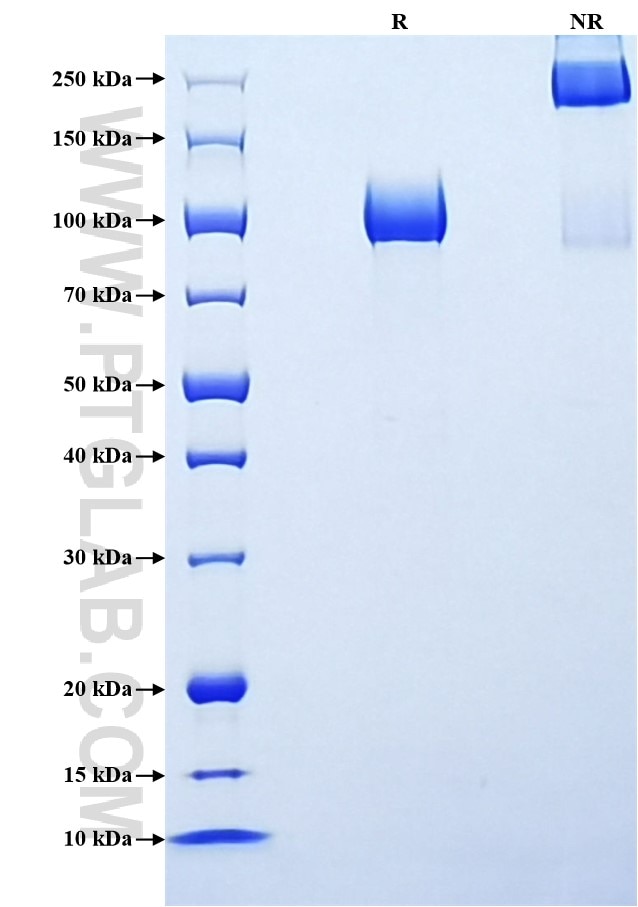
>90 %, SDS-PAGE
Tag
rFc Tag
Activity
not tested
Cat no : Eg2883
Validation Data Gallery
Product Information
| Purity | >90 %, SDS-PAGE |
| Endotoxin | <0.1 EU/μg protein, LAL method |
| Activity |
Not tested |
| Expression | HEK293-derived Human GPNMB protein Ala22-Pro486 (Accession# Q14956-1) with a rabbit IgG Fc tag at the C-terminus. |
| GeneID | 10457 |
| Accession | Q14956-1 |
| PredictedSize | 78.1 kDa |
| SDS-PAGE | 90-120 kDa, reducing (R) conditions |
| Formulation | Lyophilized from 0.22 μm filtered solution in PBS, pH 7.4. Normally 5% trehalose and 5% mannitol are added as protectants before lyophilization. |
| Reconstitution | Briefly centrifuge the tube before opening. Reconstitute at 0.1-0.5 mg/mL in sterile water. |
| Storage Conditions |
It is recommended that the protein be aliquoted for optimal storage. Avoid repeated freeze-thaw cycles.
|
| Shipping | The product is shipped at ambient temperature. Upon receipt, store it immediately at the recommended temperature. |
Background
GPNMB (Glycoprotein non-metastatic melanoma protein B), also known as osteoactivin, is a type I transmembrane glycoprotein that plays a role in various physiological processes including cell differentiation, migration, inflammation, metabolism, and neuroprotection. It is expressed in multiple tissues such as bone, kidney, and skeletal muscle, and is implicated in cell processes like tissue regeneration and tumor progression. GPNMB has also been identified within motor neurons and radial glia, most abundantly in microglia cells, suggesting its role in inflammatory processes in the central nervous system. Its role in inflammation and tissue regeneration makes it a potential therapeutic target in diseases like atherosclerosis.
References:
1.Tsou PS. et al. (2020). FASEB J. 34(7):8810-8823.
2.Hüttenrauch M. et al. (2018). Acta Neuropathol Commun. 6(1):108.
3.Yu X. et al. (2024). Biochem Biophys Res Commun. 732:150386.