
Recombinant Human Elastin protein (rFc Tag)
Species
Human
Purity
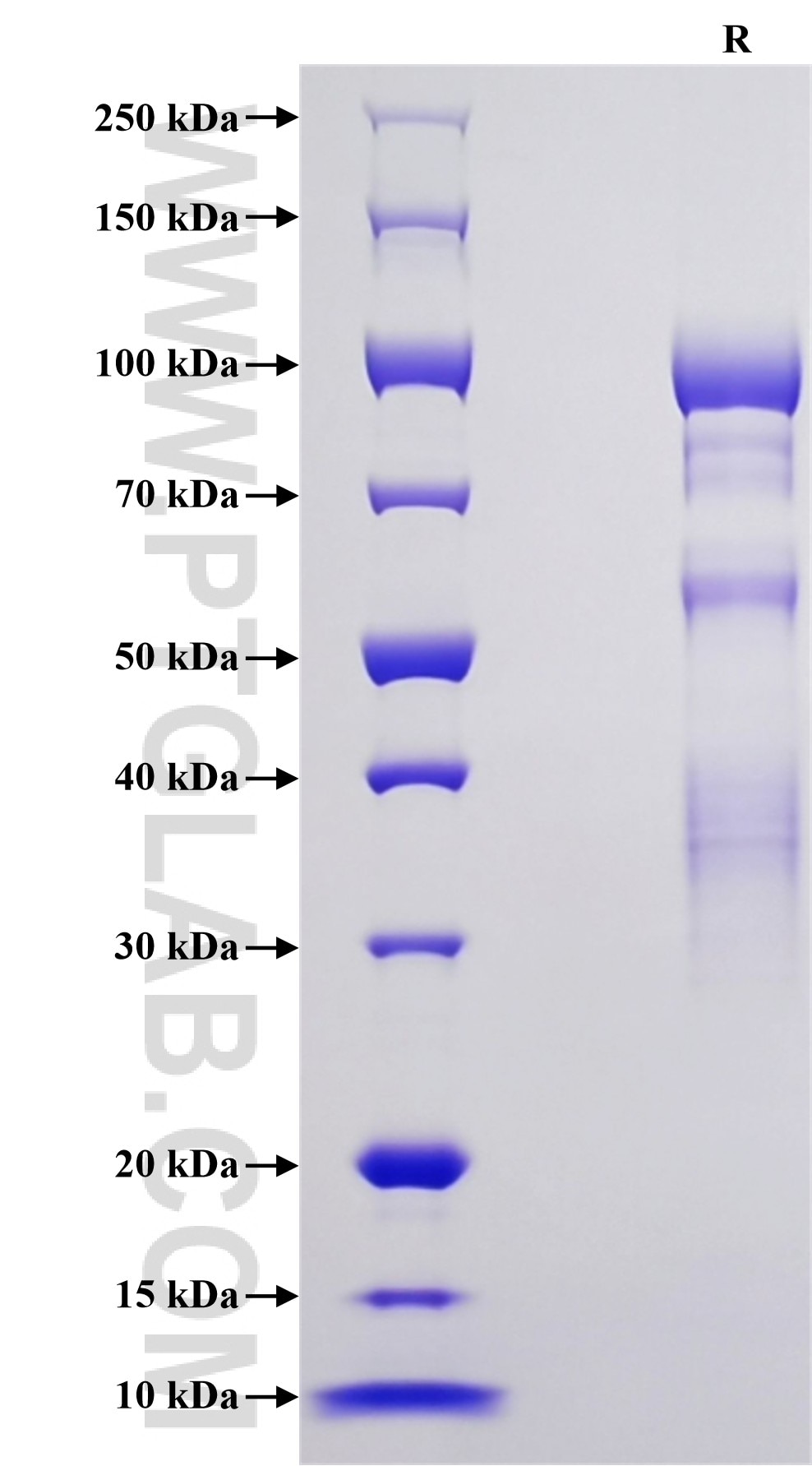
>90 %, SDS-PAGE
Tag
rFc Tag
Activity
not tested
Cat no : Eg2766
Validation Data Gallery
Product Information
| Purity | >90 %, SDS-PAGE |
| Endotoxin | <0.1 EU/μg protein, LAL method |
| Activity |
Not tested |
| Expression | HEK293-derived Human Elastin protein Gly27-Lys786 (Accession# P15502-3) with a rabbit IgG Fc tag at the C-terminus. |
| GeneID | 2006 |
| Accession | P15502-3 |
| PredictedSize | 91.3 kDa |
| SDS-PAGE | 90-110 kDa, reducing (R) conditions |
| Formulation | Lyophilized from 0.22 μm filtered solution in PBS, pH 7.4. Normally 5% trehalose and 5% mannitol are added as protectants before lyophilization. |
| Reconstitution | Briefly centrifuge the tube before opening. Reconstitute at 0.1-0.5 mg/mL in sterile water. |
| Storage Conditions |
It is recommended that the protein be aliquoted for optimal storage. Avoid repeated freeze-thaw cycles.
|
| Shipping | The product is shipped at ambient temperature. Upon receipt, store it immediately at the recommended temperature. |
Background
Elastic fibers are an abundant and integral part of many extracellular matrices, in which they provide the elastic properties to tissues such as arterial, lung, and skin. Elastic fibers are consisting of an elastin core surrounded by a mantle of fibrillin-rich microfibrils. Elastin is an extremely durable, insoluble biopolymer formed through the lysine-mediated crosslinking of its soluble precursor tropoelastin, which is an approximately 60-70 kDa protein. Deletions and mutations in the elastin gene (ELN) are associated with supravalvular aortic stenosis (SVAS) and autosomal dominant cutis laxa.
References:
1. Kielty, Cay M et al. Journal of cell science vol. 115,Pt 14 (2002): 2817-28.
2. Mithieux, Suzanne M, and Anthony S Weiss. Advances in protein chemistry vol. 70 (2005): 437-61.
3. Heinz, Andrea. Critical reviews in biochemistry and molecular biology vol. 55,3 (2020): 252-273.