
Human ECM1 ELISA Kit
Cat no : KE00334
Synonyms
extracellular matrix protein 1, Secretory component p85
Validation Data Gallery
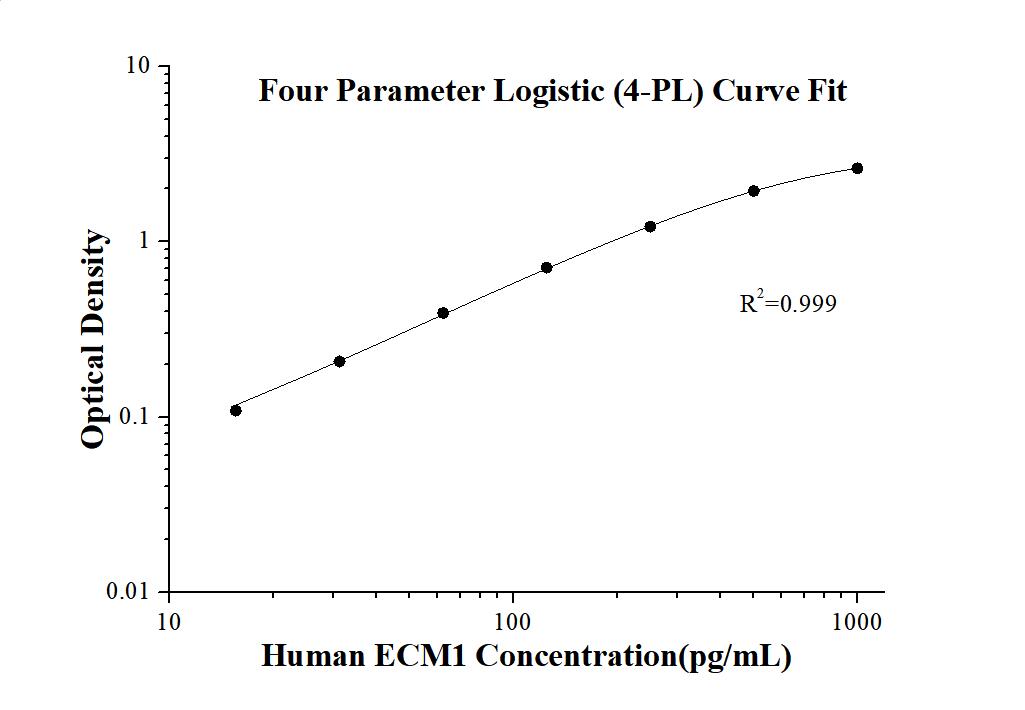
Product Information
KE00334 is a solid phase sandwich Enzyme Linked-Immuno-Sorbent Assay (Sandwich ELISA). The human ECM1 ELISA kit is to be used to detect and quantify protein levels of endogenous human ECM1. The assay recognizes human ECM1. An antibody specific for human ECM1 has been pre-coated onto the microwells. The human ECM1 protein in samples is captured by the coated antibody after incubation. Following extensive washing, another horseradish peroxidase (HRP)-conjugated antibody specific for human ECM1 is added to detect the captured human ECM1 protein. For signal development, followed by Tetramethyl-benzidine (TMB) reagent. Solution containing sulfuric acid is used to stop color development and the color intensity which is proportional to the quantity of bound protein is measurable at 450 nm with the correction wavelength set at 630 nm.
| Product name | Human ECM1 ELISA Kit |
| Tests | 1 X 96 well plate |
| Sample type | Serum, Plasma, Cell culture supernatant |
| Assay type | Sandwich |
| Sensitivity | 9.6 pg/mL |
| Range | 15.6-1000 pg/mL |
| Reactivity | Human |
| Tested applications | Sandwich ELISA |
| Gene ID (NCBI) | 1893 |
Recovery
| Sample Type | Average | Range |
|---|---|---|
| Human plasma | 104% | 87%-121% |
| Cell culture supernatant | 110% | 98%-123% |
IntraAssay
| Sample | n | mean ( pg/mL) | SD | CV% |
|---|---|---|---|---|
| 1 | 20 | 455.1 | 8.8 | 1.9 |
| 2 | 20 | 105.4 | 1.9 | 1.8 |
| 3 | 20 | 21.4 | 0.8 | 3.5 |
InterAssay
| Sample | n | mean ( pg/mL) | SD | CV% |
|---|---|---|---|---|
| 1 | 24 | 426.9 | 11.0 | 2.6 |
| 2 | 24 | 104.3 | 2.9 | 2.7 |
| 3 | 24 | 23.7 | 1.1 | 4.8 |
Background Information
ECM1 (extracellular matrix protein 1), also known as URBWD. It is located in secreted, extracellular space, and extracellular matrix, which is mainly expressed in esophagus and gall bladder. The gene encodes a soluble protein that is involved in endochondral bone formation, angiogenesis, and tumor biology. It also interacts with a variety of extracellular and structural proteins, contributing to the maintenance of skin integrity and homeostasis. Mutations in this gene are associated with lipoid proteinosis disorder (also known as hyalinosis cutis et mucosae or Urbach-Wiethe disease) that is characterized by generalized thickening of skin, mucosae and certain viscera.
Properties
| Storage Instructions | All the reagents are stored at 2-8℃ for 6 months or -20℃ for 12 months. Refer to the protocol for further storage instructions. |
| Synonyms | extracellular matrix protein 1, Secretory component p85 |
Publications
| Species | Sample Type | Title |
|---|---|---|
J Sci Med Sport Adaptations to endurance vs strength training in elite athletes revealed by serum proteomics. |