
Recombinant Human Decorin protein (His Tag)
Species
Human
Purity
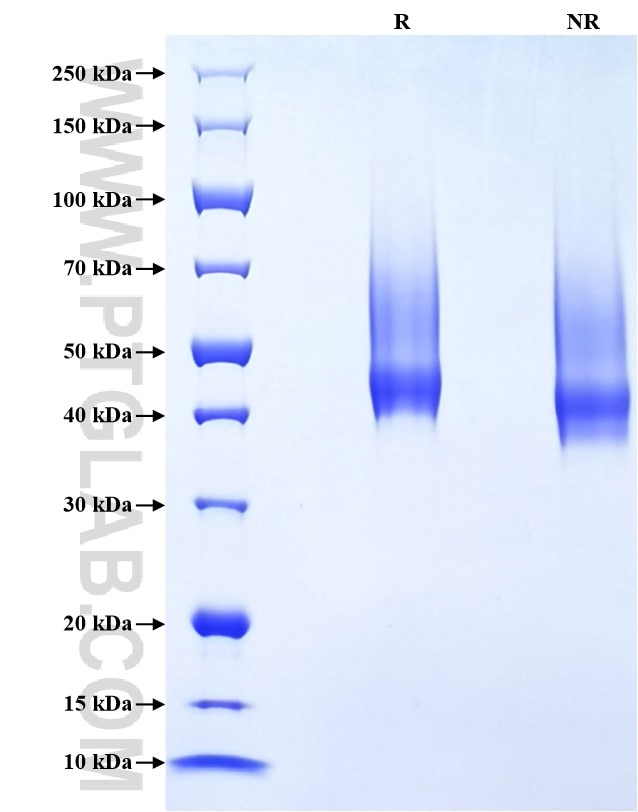
>90 %, SDS-PAGE
Tag
His Tag
Activity
not tested
Cat no : Eg1172
Validation Data Gallery
Product Information
| Purity | >90 %, SDS-PAGE |
| Endotoxin | <0.1 EU/μg protein, LAL method |
| Activity |
Not tested |
| Expression | HEK293-derived Human Decorin protein Gly17-Lys359 (Accession# P07585-1) with a His tag at the C-terminus. |
| GeneID | 1634 |
| Accession | P07585-1 |
| PredictedSize | 39.1 kDa |
| SDS-PAGE | 40-70 kDa, reducing (R) conditions |
| Formulation | Lyophilized from 0.22 μm filtered solution in PBS, pH 7.4. Normally 5% trehalose and 5% mannitol are added as protectants before lyophilization. |
| Reconstitution | Briefly centrifuge the tube before opening. Reconstitute at 0.1-0.5 mg/mL in sterile water. |
| Storage Conditions |
It is recommended that the protein be aliquoted for optimal storage. Avoid repeated freeze-thaw cycles.
|
| Shipping | The product is shipped at ambient temperature. Upon receipt, store it immediately at the recommended temperature. |
Background
Decorin, also known as DCN, is a small leucine-rich proteoglycan (SLRP) that plays a multifaceted role in the extracellular matrix (ECM) and various biological processes. Decorin is involved in a range of cellular processes including collagen fibrillogenesis, wound repair, angiogenesis, tumor growth, and autophagy. It interacts with various ligands such as ECM constituents, cellular receptors, growth factors, proteases, and other signaling molecules. Decorin has been shown to play a role in immune regulation. It can initiate aseptic inflammation and activate innate immune cells, making it relevant in autoimmune and inflammatory diseases. It can participate in the activation of innate immune cells through interaction with Toll-like receptors (TLRs) or other receptors.
References:
1. Yuanji Dong. et al. (2022). J Immunol Res. 2022:1283383.
2. Maria A Gubbiotti. et al. (2016). Matrix Biol. 55:7-21.