
Human DNAJC11 ELISA Kit
Sensitivity
0.01 ng/mL
Range
0.2-12.5 ng/mL
Reactivity
Human
Cat no : KE00794
Synonyms
Validation Data Gallery
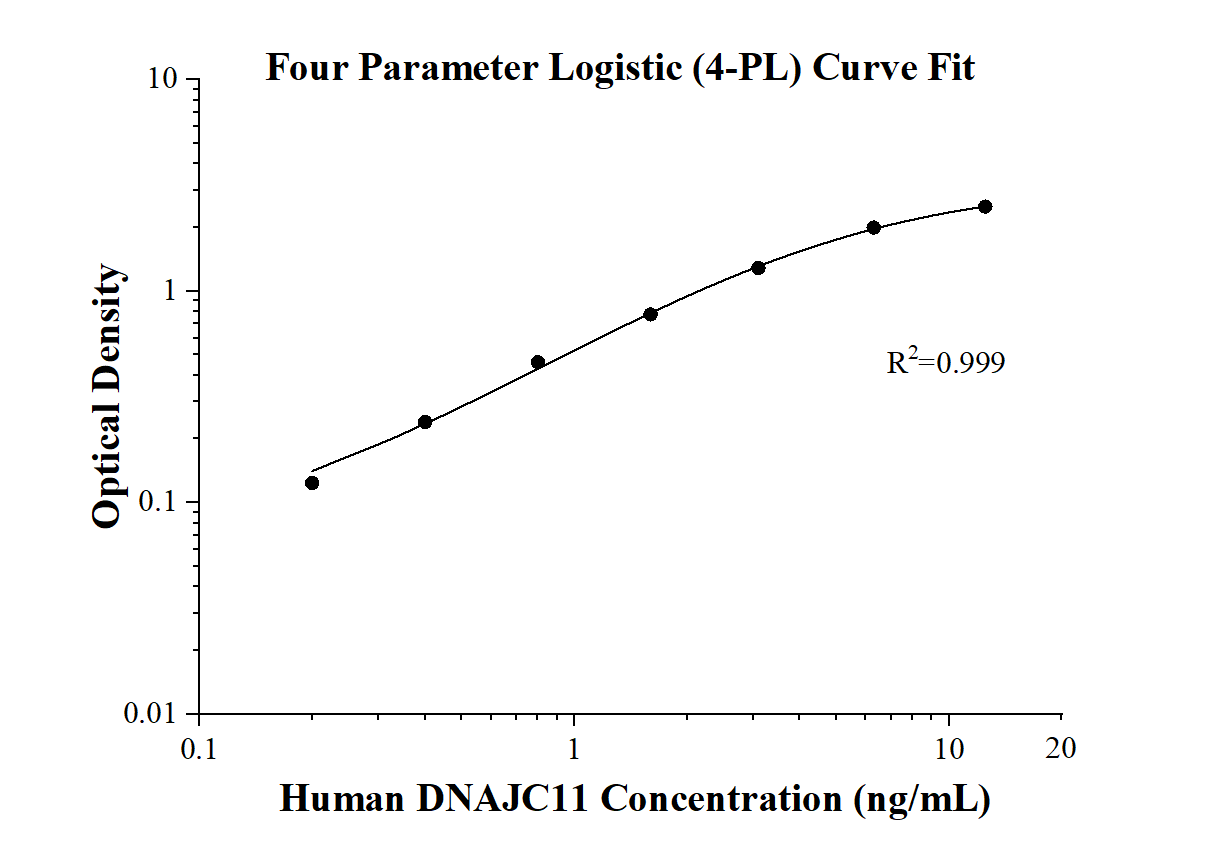
Product Information
KE00794 is a solid phase sandwich Enzyme Linked-Immuno-Sorbent Assay (Sandwich ELISA). The human DNAJC11 ELISA kit is to be used to detect and quantify protein levels of endogenous human DNAJC11. The assay recognizes human DNAJC11. An antibody specific for human DNAJC11 has been pre-coated onto the microwells. The human DNAJC11 protein in samples is captured by the coated antibody after incubation. Following extensive washing, another horseradish peroxidase (HRP)-conjugated antibody specific for human DNAJC11 is added to detect the captured human DNAJC11 protein. For signal development, followed by Tetramethyl-benzidine (TMB) reagent. Solution containing sulfuric acid is used to stop color development and the color intensity which is proportional to the quantity of bound protein is measurable at 450 nm with the correction wavelength set at 630 nm.
| Product name | Human DNAJC11 ELISA Kit |
| Tests | 1 X 96 well plate |
| Sample type | Cell lysate |
| Assay type | Sandwich |
| Sensitivity | 0.01 ng/mL |
| Range | 0.2-12.5 ng/mL |
| Reactivity | Human |
| Tested applications | Sandwich ELISA |
| Gene ID (NCBI) | 55735 |
Recovery
| Sample Type | Average | Range |
|---|---|---|
| Cell lysate | 89% | 86%-91% |
IntraAssay
| Sample | n | mean ( ng/mL) | SD | CV% |
|---|---|---|---|---|
| 1 | 8 | 6.83 | 0.30 | 4.46 |
| 2 | 8 | 1.62 | 0.06 | 3.46 |
| 3 | 8 | 0.42 | 0.02 | 3.86 |
InterAssay
| Sample | n | mean ( ng/mL) | SD | CV% |
|---|---|---|---|---|
| 1 | 16 | 6.97 | 0.30 | 4.33 |
| 2 | 16 | 1.65 | 0.06 | 3.77 |
| 3 | 16 | 0.44 | 0.03 | 5.96 |
Background Information
DnaJ homolog subfamily C member 11 (DNAJC11) is a member of the J protein family (DNAJ/Hsp40) of molecular cochaperones that interact with 70 kDa heat shock (Hsp70) proteins involved in protein folding and protein quality control. It is associated with the mitochondrial contact site and cristae organizing system (MICOS) complex and the mitochondrial outer membrane sorting assembly machinery (SAM) complex, playing a role in regulating mitochondrial morphology and cristae organization. Additionally, DNAJC11 is associated with mitochondrial dysfunction, which can lead to various diseases, including neurodegenerative disorders and metabolic diseases.
Properties
| Storage Instructions | All the reagents are stored at 2-8℃ for 6 months or -20℃ for 12 months. Refer to the protocol for further storage instructions. |
| Synonyms |