
Human Cryptochrome 1 ELISA Kit
Sensitivity
0.08 ng/mL
Range
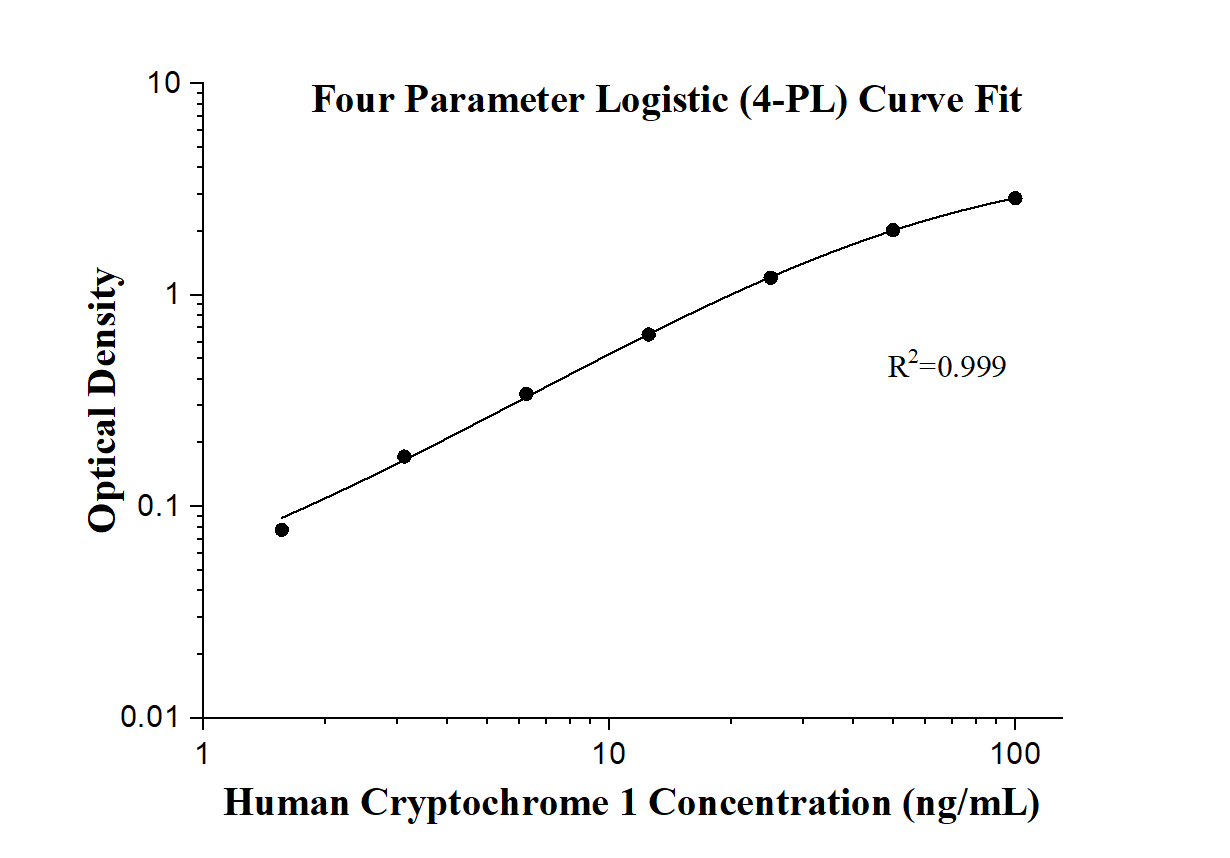
1.56-100 ng/mL
Reactivity
Human
Cat no : KE00533
Synonyms
CRY1, Cryptochrome 1, CRY 1, Cryptochrome-1
Validation Data Gallery
Product Information
KE00533 is a solid phase sandwich Enzyme Linked-Immuno-Sorbent Assay (Sandwich ELISA). The human Cryptochrome 1 ELISA kit is to be used to detect and quantify protein levels of endogenous human Cryptochrome 1. The assay recognizes human Cryptochrome 1. An antibody specific for human Cryptochrome 1 has been pre-coated onto the microwells. The human Cryptochrome 1 protein in samples is captured by the coated antibody after incubation. Following extensive washing, another horseradish peroxidase (HRP)-conjugated antibody specific for human Cryptochrome 1 is added to detect the captured human Cryptochrome 1 protein. For signal development, followed by Tetramethyl-benzidine (TMB) reagent. Solution containing sulfuric acid is used to stop color development and the color intensity which is proportional to the quantity of bound protein is measurable at 450 nm with the correction wavelength set at 630 nm.
| Product name | Human Cryptochrome 1 ELISA Kit |
| Tests | 1 X 96 well plate |
| Sample type | Cell lysate |
| Assay type | Sandwich |
| Sensitivity | 0.08 ng/mL |
| Range | 1.56-100 ng/mL |
| Reactivity | Human |
| Tested applications | Sandwich ELISA |
| Gene ID (NCBI) | 1407 |
Recovery
| Sample Type | Average | Range |
|---|---|---|
| Cell lysate | 92% | 82%-105% |
IntraAssay
| Sample | n | mean ( ng/mL) | SD | CV% |
|---|---|---|---|---|
| 1 | 8 | 40.01 | 2.64 | 6.59 |
| 2 | 8 | 11.01 | 0.84 | 7.66 |
| 3 | 8 | 6.54 | 0.35 | 5.40 |
InterAssay
| Sample | n | mean ( ng/mL) | SD | CV% |
|---|---|---|---|---|
| 1 | 16 | 41.47 | 2.87 | 6.91 |
| 2 | 16 | 11.36 | 0.78 | 6.90 |
| 3 | 16 | 6.28 | 0.55 | 8.77 |
Background Information
Cryptochrome 1 (CRY1) is a blue light-sensitive flavoprotein belonging to the cryptochrome/photolyase family, which plays a pivotal role in regulating circadian rhythms in mammals. Structurally, CRY1 contains a conserved photolyase homology region (PHR) that binds a flavin adenine dinucleotide (FAD) cofactor, enabling its light-dependent and light-independent functions. In mammals, CRY1 acts as a core component of the molecular circadian clock, forming negative feedback loops by interacting with CLOCK/BMAL1 heterodimers to repress their transcriptional activation of circadian target genes, such as Period (Per) and Cryptochrome (Cry) themselves. Beyond circadian regulation, CRY1 is implicated in DNA repair, cellular stress responses, and metabolic homeostasis. It also modulates light entrainment pathways in non-mammalian species (e.g., plants and insects), though its light-sensing role in mammals remains debated. Dysregulation of CRY1 is linked to sleep disorders, mood disturbances, and cancer, highlighting its broad physiological and pathological significance. Recent studies further explore its potential as a therapeutic target for circadian-related diseases and aging.
Properties
| Storage Instructions | All the reagents are stored at 2-8℃ for 6 months or -20℃ for 12 months. Refer to the protocol for further storage instructions. |
| Synonyms | CRY1, Cryptochrome 1, CRY 1, Cryptochrome-1 |