
Recombinant Human Component C9 protein (His Tag)
Species
Human
Purity
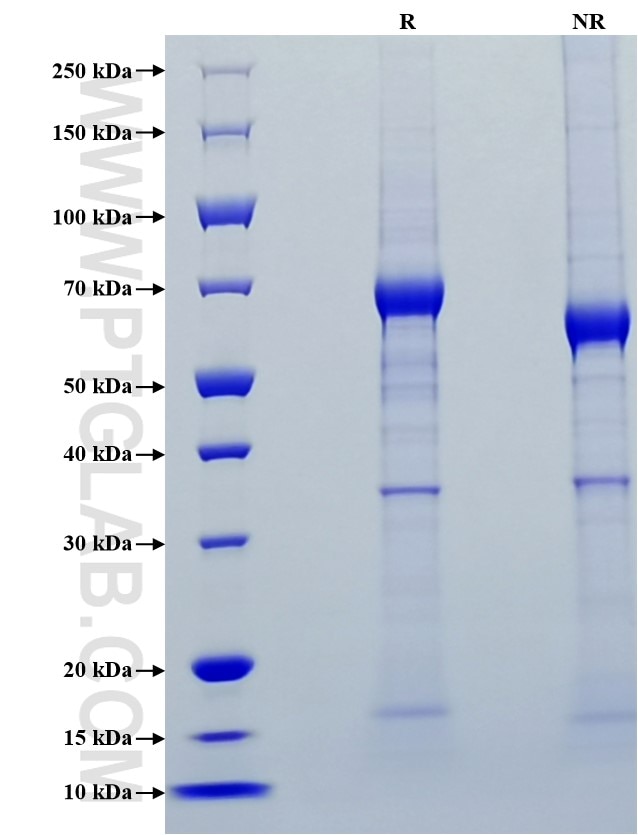
>80 %, SDS-PAGE
Tag
His Tag
Activity
not tested
Cat no : Eg1282
Validation Data Gallery
Product Information
| Purity | >80 %, SDS-PAGE |
| Endotoxin | <0.1 EU/μg protein, LAL method |
| Activity |
Not tested |
| Expression | HEK293-derived Human Component C9 protein Gln22-Lys559 (Accession# P02748) with a His tag at the C-terminus. |
| GeneID | 735 |
| Accession | P02748 |
| PredictedSize | 62.1 kDa |
| SDS-PAGE | 65-75 kDa, reducing (R) conditions |
| Formulation | Lyophilized from 0.22 μm filtered solution in PBS, pH 7.4. Normally 5% trehalose and 5% mannitol are added as protectants before lyophilization. |
| Reconstitution | Briefly centrifuge the tube before opening. Reconstitute at 0.1-0.5 mg/mL in sterile water. |
| Storage Conditions |
It is recommended that the protein be aliquoted for optimal storage. Avoid repeated freeze-thaw cycles.
|
| Shipping | The product is shipped at ambient temperature. Upon receipt, store it immediately at the recommended temperature. |
Background
Component C9 is the final pivotal protein in the membrane attack complex (MAC) of the complement system, an essential part of innate immunity. It is a pore-forming molecule that, upon sequential binding to the C5b-8 complex embedded in a pathogen's cell membrane, undergoes a profound conformational change. Multiple C9 monomers polymerize to form a cylindrical pore, which fully penetrates the lipid bilayer. This creates a functional channel that allows the uncontrolled flux of ions and water, leading to osmotic lysis and the direct destruction of targeted cells, such as bacteria. Thus, C9 acts as the critical executioner molecule in the complement's cytolytic pathway, providing a direct mechanism for eliminating microbial threats.
References:
1. Fu, Xiaoyan et al. Scientific reports vol. 6 (2016): 30239.
2. Chang, C P et al.The Journal of biological chemistry vol. 269,42 (1994): 26424-30.