
Recombinant Human Factor IX/PTC protein (His Tag)
Species
Human
Purity
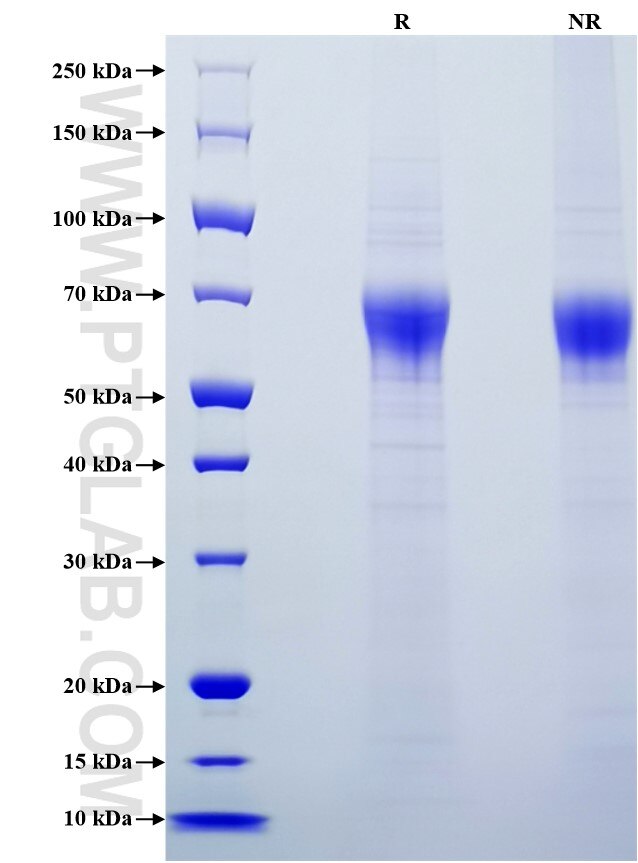
>90 %, SDS-PAGE
Tag
His Tag
Activity
not tested
Cat no : Eg1045
Validation Data Gallery
Product Information
| Purity | >90 %, SDS-PAGE |
| Endotoxin | <0.1 EU/μg protein, LAL method |
| Activity |
Not tested |
| Expression | HEK293-derived Human Factor IX protein Thr29-Thr461 (Accession# P00740-1) with a His tag at the C-terminus. |
| GeneID | 2158 |
| Accession | P00740-1 |
| PredictedSize | 49.8 kDa |
| SDS-PAGE | 55-70 kDa, reducing (R) conditions |
| Formulation | Lyophilized from 0.22 μm filtered solution in PBS, pH 7.4. Normally 5% trehalose and 5% mannitol are added as protectants before lyophilization. |
| Reconstitution | Briefly centrifuge the tube before opening. Reconstitute at 0.1-0.5 mg/mL in sterile water. |
| Storage Conditions |
It is recommended that the protein be aliquoted for optimal storage. Avoid repeated freeze-thaw cycles.
|
| Shipping | The product is shipped at ambient temperature. Upon receipt, store it immediately at the recommended temperature. |
Background
Factor IX, also known as PTC, circulates as an inactive zymogen until the proteolytic release of its activation peptide allows it to assume the conformation of an active serine protease. Upon activation by Factor XIa or Factor VIIa/tissue factor complex, Factor IXa forms a complex with Factor VIIIa, calcium ions, and phospholipids on the surface of activated platelets. This complex, known as the tenase complex, efficiently activates Factor X to Factor Xa, leading to thrombin generation and fibrin clot formation. Deficiencies or mutations in Factor IX result in Hemophilia B, an X-linked recessive bleeding disorder.
References:
1. Davie, E W et al. Biochemistry vol. 30,43 (1991): 10363-70.
2. Ahmad, S S et al. Journal of thrombosis and haemostasis : JTH vol. 1,11 (2003): 2348-55.
3. Girolami, Antonio et al. Seminars in thrombosis and hemostasis vol. 41,4 (2015): 359-65.