
Recombinant Human SLAMF7/CD319 protein (Myc Tag, His Tag)
Species
Human
Purity
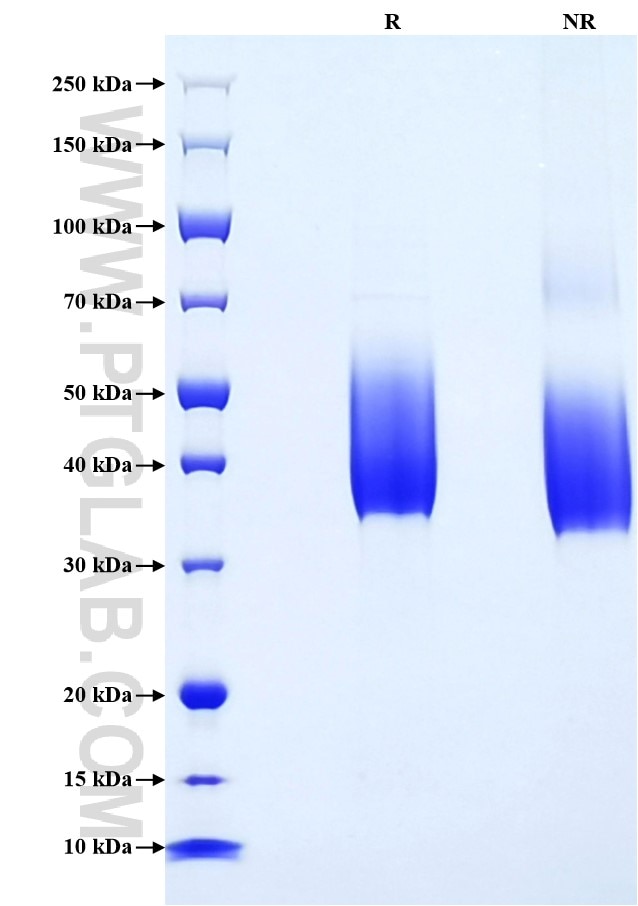
>90 %, SDS-PAGE
Tag
Myc Tag, His Tag
Activity
not tested
Cat no : Eg0145
Validation Data Gallery
Product Information
| Purity | >90 %, SDS-PAGE |
| Endotoxin | <0.1 EU/μg protein, LAL method |
| Activity |
Not tested |
| Expression | HEK293-derived Human SLAMF7 protein Ser23-Met226 (Accession# Q9NQ25-1) with a Myc tag and a His tag at the C-terminus. |
| GeneID | 57823 |
| Accession | Q9NQ25-1 |
| PredictedSize | 27.4 kDa |
| SDS-PAGE | 35-50 kDa, reducing (R) conditions |
| Formulation | Lyophilized from 0.22 μm filtered solution in PBS, pH 7.4. Normally 5% trehalose and 5% mannitol are added as protectants before lyophilization. |
| Reconstitution | Briefly centrifuge the tube before opening. Reconstitute at 0.1-0.5 mg/mL in sterile water. |
| Storage Conditions |
It is recommended that the protein be aliquoted for optimal storage. Avoid repeated freeze-thaw cycles.
|
| Shipping | The product is shipped at ambient temperature. Upon receipt, store it immediately at the recommended temperature. |
Background
Signaling lymphocyte activation molecule (SLAM) family receptors is a group of type I transmembrane receptors belonging to the immunoglobulin superfamily. The SLAM family contains nine members that contain an extracellular segment comprising two or four Ig-like domains (V-like variable and C2-like constant), a transmembrane region and a cytoplasmic tail. They are involved in various physiological and pathological processes, including the regulation of immunological responses and the route of viral entry. SLAMF7, also known as CS1, CRACC or CD319, is expressed on NK cells, CD8+ T lymphocytes, B lymphocytes, and mature dendritic cells. It exerts both activating and inhibitory effects depending on the expression status of SAP or EAT-2. SLAMF7 is overexpressed in multiple myeloma and makes it a target for immunotherapy.
References:
1. Joseph D Malaer, et al. (2017). Am J Cancer Res. 7(8):1637-1641.
2. Gregory Fouquet, et al. (2018). Oncotarget. 9(22):16248-16262.
3. Pooya Farhangnia, et al. (2023). Front Immunol. 14:1174138.