
Recombinant Human CD30/TNFRSF8 protein (rFc Tag)
Species
Human
Purity
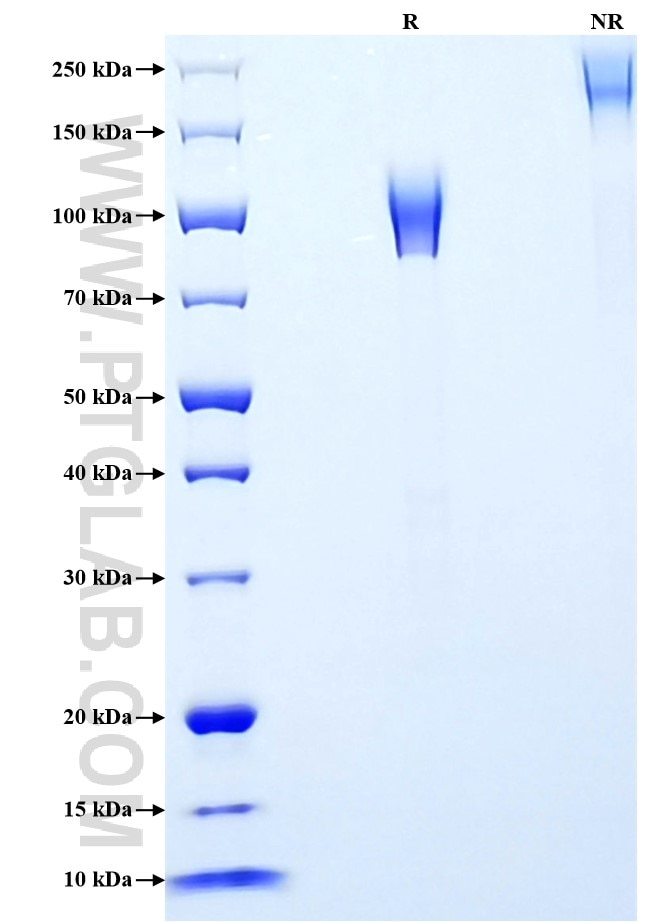
>90 %, SDS-PAGE
Tag
rFc Tag
Activity
not tested
Cat no : Eg1604
Validation Data Gallery
Product Information
| Purity | >90 %, SDS-PAGE |
| Endotoxin | <0.1 EU/μg protein, LAL method |
| Activity |
Not tested |
| Expression | HEK293-derived Human CD30 protein Phe19-Lys379 (Accession# NP_001234.2) with a rabbit IgG Fc tag at the C-terminus. |
| GeneID | 943 |
| Accession | NP_001234.2 |
| PredictedSize | 64.8 kDa |
| SDS-PAGE | 85-125 kDa, reducing (R) conditions |
| Formulation | Lyophilized from 0.22 μm filtered solution in PBS, pH 7.4. Normally 5% trehalose and 5% mannitol are added as protectants before lyophilization. |
| Reconstitution | Briefly centrifuge the tube before opening. Reconstitute at 0.1-0.5 mg/mL in sterile water. |
| Storage Conditions |
It is recommended that the protein be aliquoted for optimal storage. Avoid repeated freeze-thaw cycles.
|
| Shipping | The product is shipped at ambient temperature. Upon receipt, store it immediately at the recommended temperature. |
Background
CD30, also known as TNFRSF8 or Ki-1, is a transmembrane glycoprotein belonging to the tumor necrosis factor receptor superfamily. It is composed of an extracellular domain with six cysteine-rich repeats, a transmembrane segment, and an intracellular domain. CD30 is expressed on a small subset of activated T and B lymphocytes, and a variety of lymphoid neoplasms, with the highest expression in classical Hodgkin's lymphoma and anaplastic large cell lymphoma. The CD30 ligand (CD30L or CD153) is a type II transmembrane glycoprotein of the tumor necrosis factor ligand superfamily. Signal transduction of CD30/CD30L utilizes signal transducers, TNFR-associated factors (TRAF1, 2, 3 and 5).
References:
1. H Dürkop, et al. (1992) Cell. 68(3):421-7.
2. R Horie, et al. (1998) Semin Immunol. 10(6):457-70.
3. C A van der Weyden, et al. (2017) Blood Cancer J. 7(9):e603.
4. H J Gruss, et al. (1996) Am J Pathol. 149(2):469-81.