
Recombinant Human CCR6 protein (rFc Tag)
Species
Human
Purity
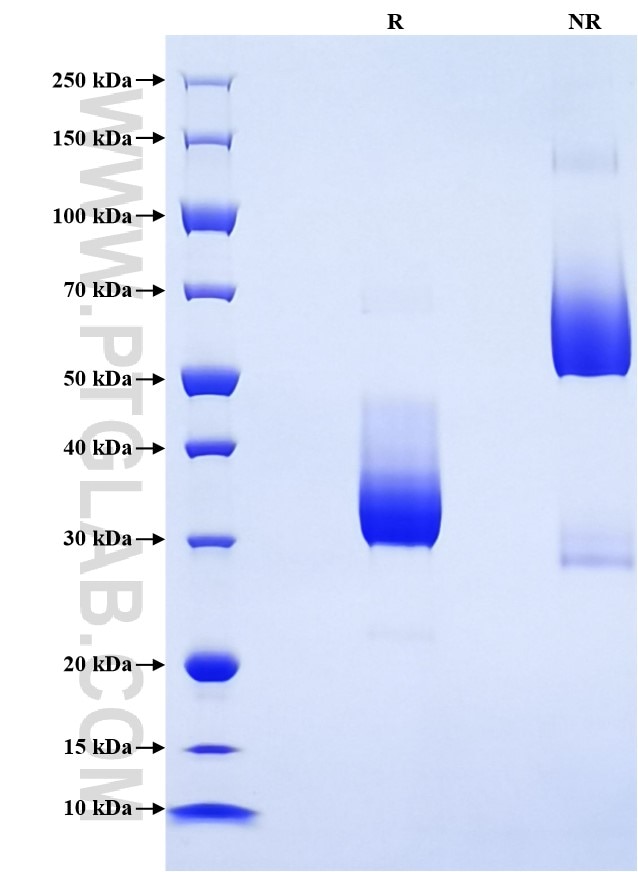
>90 %, SDS-PAGE
Tag
C-rFc
Activity
not tested
Cat no : Eg2351
Validation Data Gallery
Product Information
| Purity | >90 %, SDS-PAGE |
| Endotoxin | <0.1 EU/μg protein, LAL method |
| Activity |
Not tested |
| Expression | HEK293-derived Human CCR6 protein Ser181-Lys211 (Accession# P51684) with a rabbit IgG Fc tag at the C-terminus |
| GeneID | 1235 |
| Accession | P51684 |
| PredictedSize | 30.0 kDa |
| SDS-PAGE | 30-40 kDa, reducing (R) condition |
| Formulation | Lyophilized from 0.22 μm filtered solution in PBS, pH 7.4. Normally 5% trehalose and 5% mannitol are added as protectants before lyophilization. |
| Reconstitution | Briefly centrifuge the tube before opening. Reconstitute at 0.1-0.5 mg/mL in sterile water. |
| Storage Conditions |
It is recommended that the protein be aliquoted for optimal storage. Avoid repeated freeze-thaw cycles.
|
| Shipping | The product is shipped at ambient temperature. Upon receipt, store it immediately at the recommended temperature. |
Background
CCR6, also known CD196, is a C-C chemokine receptor that belongs to family A of G protein-coupled receptor superfamily. It is expressed on most B cells, memory T cells, and some subsets of dendritic cells (PMID: 17057190). CCR6 is a receptor for the C-C type chemokine CCL20 (PMID: 9169459). The ligand-receptor pair CCL20-CCR6 is responsible for the chemoattraction of immature dendritic cells, effector/memory T-cells and B-cells and plays a role at skin and mucosal surfaces under homeostatic and inflammatory conditions, as well as in pathology, including cancer and rheumatoid arthritis (PMID: 12948524). CCR6 polymorphism has been associated with rheumatoid arthritis susceptibility and CCR6 is involved in IL-17-driven autoimmunity in human diseases (PMID: 20453841).
References:
1. Williams IR. et al. (2006). Ann N Y Acad Sci. 1072:52-61.
2. Baba M. et al. (1997). J Biol Chem. 272(23):14893-14898.
3. Schutyser E. et al. (2003). Cytokine Growth Factor Rev. 14(5):409-426.
4. Kochi Y. et al. (2010). Nat Genet. 42(6):515-519.