
Recombinant Human CCL17/TARC protein (His Tag)
Cat no : Eg0379
Validation Data Gallery
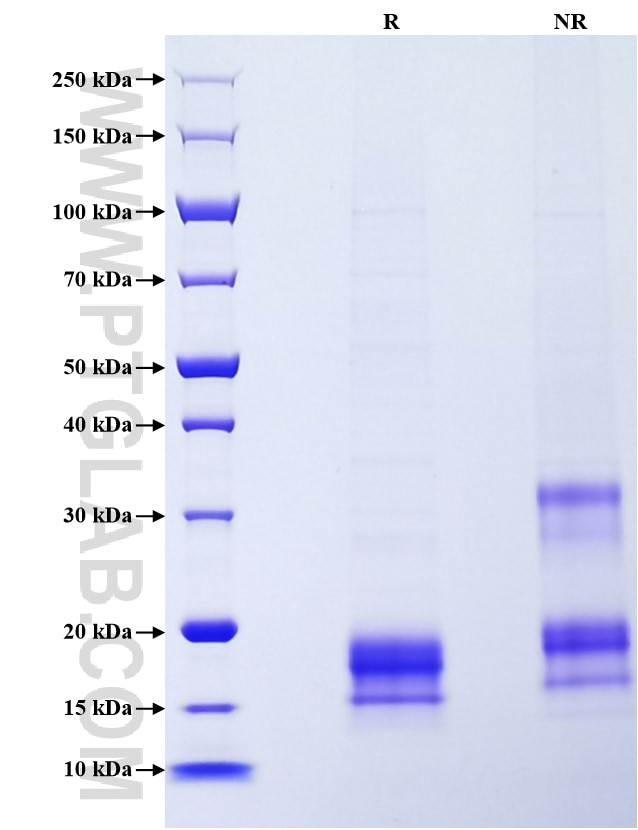
Product Information
| Purity | >90 %, SDS-PAGE |
| Endotoxin | <0.1 EU/μg protein, LAL method |
| Activity |
Not tested |
| Expression | HEK293-derived Human CCL17 protein Ala24-Ser94 (Accession# Q92583) with a His tag at the C-terminus. |
| GeneID | 6361 |
| Accession | Q92583 |
| PredictedSize | 11.9 kDa |
| SDS-PAGE | 15-19 kDa, reducing (R) conditions |
| Formulation | Lyophilized from 0.22 μm filtered solution in 20mM Tris, 150mM Nacl, pH7.4. Normally 5% trehalose and 5% mannitol are added as protectants before lyophilization. |
| Reconstitution | Briefly centrifuge the tube before opening. Reconstitute at 0.1-0.5 mg/mL in sterile water. |
| Storage Conditions |
It is recommended that the protein be aliquoted for optimal storage. Avoid repeated freeze-thaw cycles.
|
| Shipping | The product is shipped at ambient temperature. Upon receipt, store it immediately at the recommended temperature. |
Background
CCL17, also named as TARC, is a member of the CC chemokine family, and is highly expressed by thymus and other cells, including keratinocytes, endothelial cells, dendritic cells, bronchial epithelial cells and fibroblasts. CCL17 plays important roles in T cell development in thymus as well as in trafficking and activation of mature T cells. CCL17 induced chemotaxis and Ca2+ influx in the cells stably expressing CCR4, thereby demonstrating the ligand-receptor relationship between CCL17 and CCR4.
References:
1. Imai T. et al. (1996) J Biol Chem. 271:21514-1.
2. Sallusto F. et al. (1998) Eur J Immunol. 28:2760-9.
3. Campbell JJ. et al. (1999) Nature. 400:776-80.
4. Vestergaard C.et al. (1999) J Clin Invest. 104:1097-105.
5. Sekiya T.et al. (2000) J Immunol.165:2205-13.
6. Yu B.et al. (2000) J Dermatol Sci.30:29-36.
Publications
| Species | Title |
|---|---|
PLoS Negl Trop Dis Role of chemokines and their receptors in lesional CD8⁺ T cell homing in Indian Post-Kala-Azar Dermal Leishmaniasis. |