
Recombinant Human C-Reactive Protein/CRP protein (rFc Tag)
Species
Human
Purity
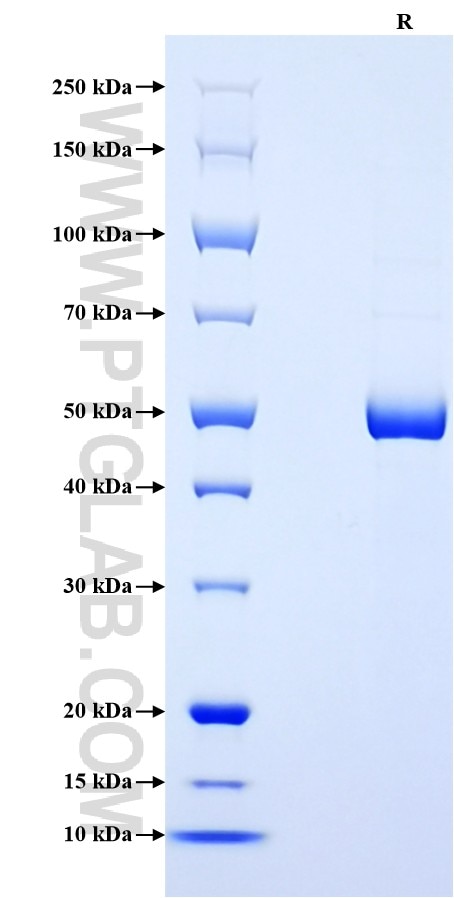
>90 %, SDS-PAGE
Tag
rFc Tag
Activity
not tested
Cat no : Eg2448
Validation Data Gallery
Product Information
| Purity | >90 %, SDS-PAGE |
| Endotoxin | <0.1 EU/μg protein, LAL method |
| Activity |
Not tested |
| Expression | HEK293-derived Human C-Reactive Protein protein Gln19-Pro224 (Accession# P02741-1) with a rabbit IgG Fc tag at the C-terminus. |
| GeneID | 1401 |
| Accession | P02741-1 |
| PredictedSize | 49.3 kDa |
| SDS-PAGE | 47-53 kDa, reducing (R) conditions |
| Formulation | Lyophilized from 0.22 μm filtered solution in 20 mM Tris, 1 M Nacl, pH 8.0. Normally 5% trehalose and 5% mannitol are added as protectants before lyophilization. |
| Reconstitution | Briefly centrifuge the tube before opening. Reconstitute at 0.1-0.5 mg/mL in sterile water. |
| Storage Conditions |
It is recommended that the protein be aliquoted for optimal storage. Avoid repeated freeze-thaw cycles.
|
| Shipping | The product is shipped at ambient temperature. Upon receipt, store it immediately at the recommended temperature. |
Background
C-reactive protein (CRP) is an acute-phase serum protein synthesized by the liver in response to interleukin-6 (IL-6) during inflammation. The name of CRP derives from its ability to react with the C polysaccharide of Streptococcus pneumoniae. CRP is an annular, pentameric protein that belongs to the pentraxin family of proteins. CRP displays several functions associated with host defense: it promotes agglutination, bacterial capsular swelling, phagocytosis and complement fixation through its calcium-dependent binding to phosphorylcholine. It is used mainly as a marker of inflammation.
References:
1. Rizo-Téllez, Salma A et al. Frontiers in immunology vol. 14 1237729. 26 Jul. 2023.
2. Black, Steven et al. The Journal of biological chemistry vol. 279,47 (2004): 48487-90.
3. Zhou, Hai-Hong et al. Frontiers in immunology vol. 15 1425168. 14 Jun. 2024.