
Recombinant Human Apolipoprotein AI protein (His Tag)
Species
Human
Purity
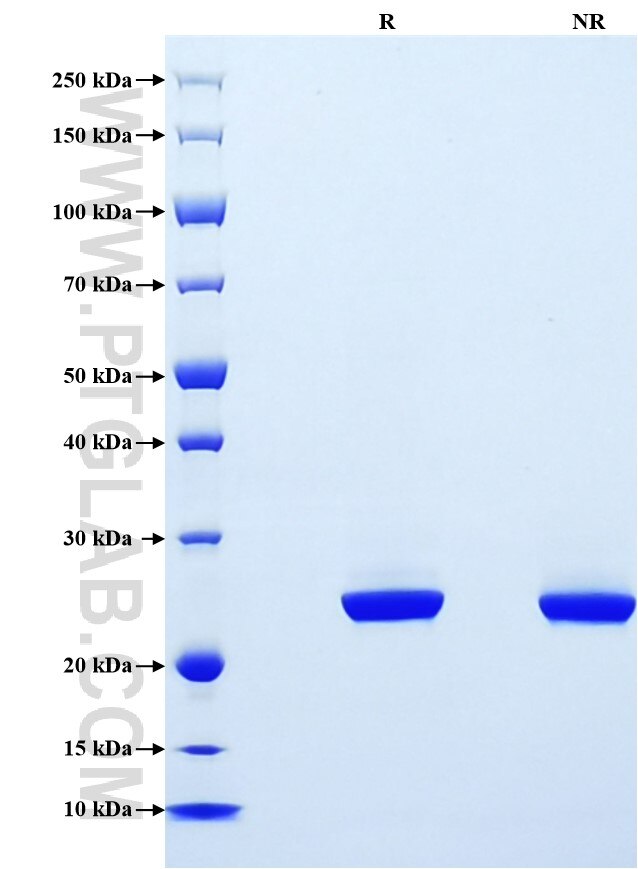
>90 %, SDS-PAGE
Tag
His Tag
Activity
not tested
Cat no : Eg0723
Validation Data Gallery
Product Information
| Purity | >90 %, SDS-PAGE |
| Endotoxin | <0.1 EU/μg protein, LAL method |
| Activity |
Not tested |
| Expression | HEK293-derived Human Apolipoprotein AI protein Asp25-Gln267 (Accession# P02647) with a His tag at the N-terminus. |
| GeneID | 335 |
| Accession | P02647 |
| PredictedSize | 29.2 kDa |
| SDS-PAGE | 23-26 kDa, reducing (R) conditions |
| Formulation | Lyophilized from 0.22 μm filtered solution in PBS, pH 7.4. Normally 5% trehalose and 5% mannitol are added as protectants before lyophilization. |
| Reconstitution | Briefly centrifuge the tube before opening. Reconstitute at 0.1-0.5 mg/mL in sterile water. |
| Storage Conditions |
It is recommended that the protein be aliquoted for optimal storage. Avoid repeated freeze-thaw cycles.
|
| Shipping | The product is shipped at ambient temperature. Upon receipt, store it immediately at the recommended temperature. |
Background
Apolipoprotein AI(ApoA-I) is a member of blood apolipoproteins, it is the main component of High density lipoprotein(HDL). ApoA-I undergoes a series of complex processes from its generation to its composition as spherical HDL. It not only has a cholesterol reversal transport function, but also has a function in modulating the inflammatory response.The inverse relationship between high density lipoprotein (HDL) plasma levels and coronary heart disease has been attributed to the role that HDL and its major constituent, apolipoprotein A-I (apoA-I), play in reverse cholesterol transport (RCT). The efficiency of RCT depends on the specific ability of apoA-I to promote cellular cholesterol efflux, bind lipids, activate lecithin:cholesterol acyltransferase (LCAT), and form mature HDL that interact with specific receptors and lipid transfer proteins.
References:
1.Tao, Xia et al. (2024) Front Immunol.15:1417270.
2.Rosales, Corina et al. (2015) Biochemistry.54(14):2295-2302.
3.Frank, P G, and Y L Marcel. (2000) Biochemistry.41(6):853-872.