
Human AKR1C3 ELISA Kit
Sensitivity
1.1 pg/mL
Range
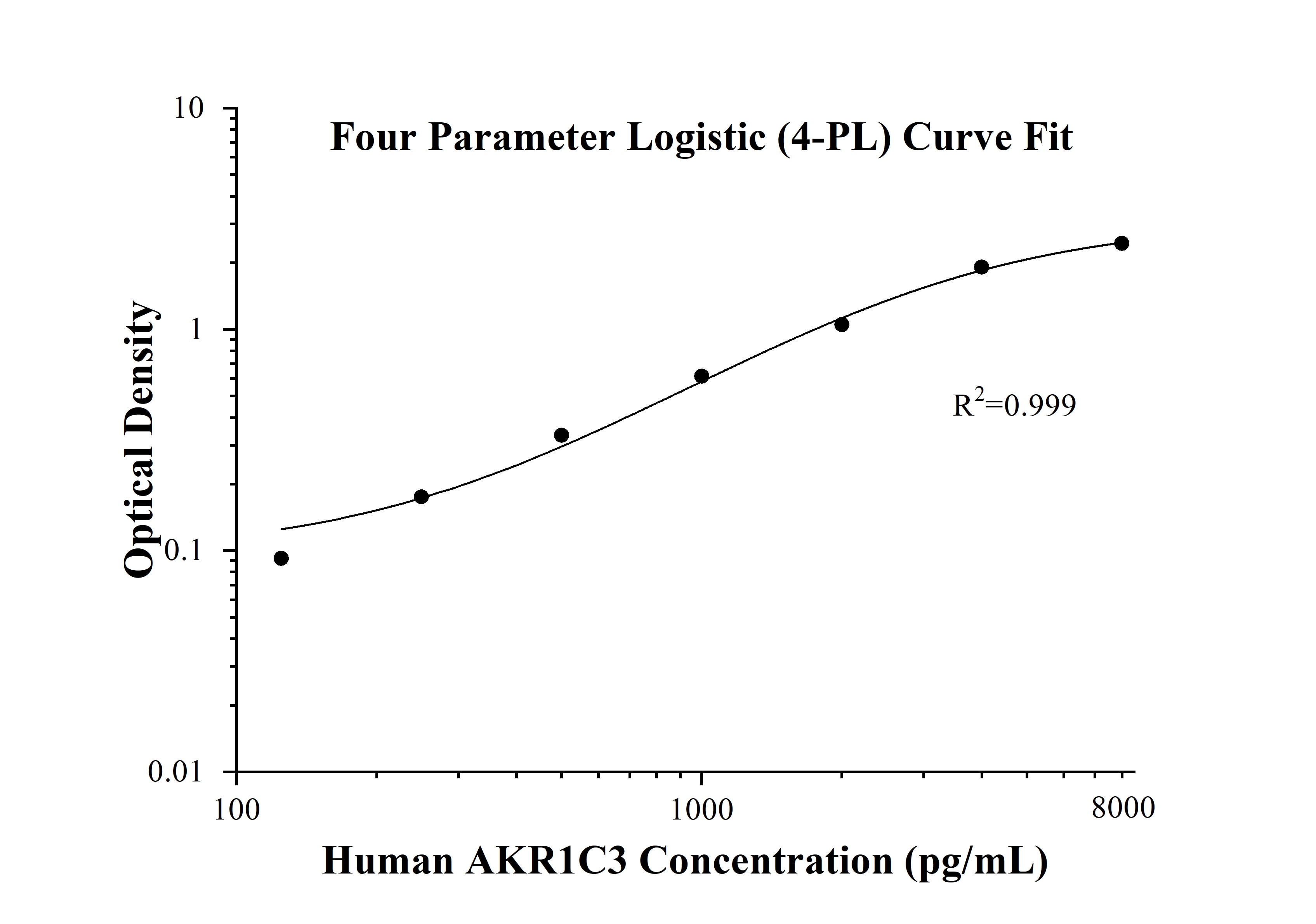
125-8000 pg/mL
Reactivity
Human
Cat no : KE00825
Synonyms
17-beta-HSD 5, 17-beta-hydroxysteroid dehydrogenase type 5, 3-alpha-HSD type 2, 3-alpha-HSD type II, brain, 3-alpha-hydroxysteroid dehydrogenase type 2
Validation Data Gallery
Product Information
KE00825 is a solid phase sandwich Enzyme Linked-Immuno-Sorbent Assay (Sandwich ELISA). The human AKR1C3 ELISA kit is to be used to detect and quantify protein levels of endogenous human AKR1C3. The assay recognizes human AKR1C3. An antibody specific for human AKR1C3 has been pre-coated onto the microwells. The human AKR1C3 protein in samples is captured by the coated antibody after incubation. Following extensive washing, another horseradish peroxidase (HRP)-conjugated antibody specific for human AKR1C3 is added to detect the captured human AKR1C3 protein. For signal development, followed by Tetramethyl-benzidine (TMB) reagent. Solution containing sulfuric acid is used to stop color development and the color intensity which is proportional to the quantity of bound protein is measurable at 450 nm with the correction wavelength set at 630 nm.
| Product name | Human AKR1C3 ELISA Kit |
| Tests | 1 X 96 well plate |
| Sample type | Cell lysate |
| Assay type | Sandwich |
| Sensitivity | 1.1 pg/mL |
| Range | 125-8000 pg/mL |
| Reactivity | Human |
| Tested applications | Sandwich ELISA |
| Gene ID (NCBI) | 8644 |
Recovery
| Sample Type | Average | Range |
|---|---|---|
| Cell lysate | 78% | 77%-80% |
IntraAssay
| Sample | n | mean ( pg/mL) | SD | CV% |
|---|---|---|---|---|
| 1 | 8 | 3,996.8 | 109.6 | 2.7 |
| 2 | 8 | 1,093.2 | 42.1 | 3.9 |
| 3 | 8 | 328.1 | 7.5 | 2.3 |
InterAssay
| Sample | n | mean ( pg/mL) | SD | CV% |
|---|---|---|---|---|
| 1 | 16 | 4,028.8 | 126.1 | 3.1 |
| 2 | 16 | 1,058.0 | 48.1 | 4.5 |
| 3 | 16 | 323.8 | 12.8 | 3.9 |
Background Information
Aldo-Keto Reductase Family 1 Member C3 (AKR1C3), also known as type 5 17β-hydroxysteroid dehydrogenase (17β-HSD5) or prostaglandin F (PGF) synthase, functions as a pivotal enzyme in androgen biosynthesis. The overexpression of AKR1C3 serves as an oncogenic factor, promoting carcinoma cell proliferation, invasion, and metastasis, and is correlated with unfavorable prognosis and overall survival in carcinoma patients. Inhibiting AKR1C3 has demonstrated potent efficacy in suppressing tumor progression and overcoming treatment resistance.
Properties
| Storage Instructions | All the reagents are stored at 2-8℃ for 6 months or -20℃ for 12 months. Refer to the protocol for further storage instructions. |
| Synonyms | 17-beta-HSD 5, 17-beta-hydroxysteroid dehydrogenase type 5, 3-alpha-HSD type 2, 3-alpha-HSD type II, brain, 3-alpha-hydroxysteroid dehydrogenase type 2 |