
Validation Data Gallery
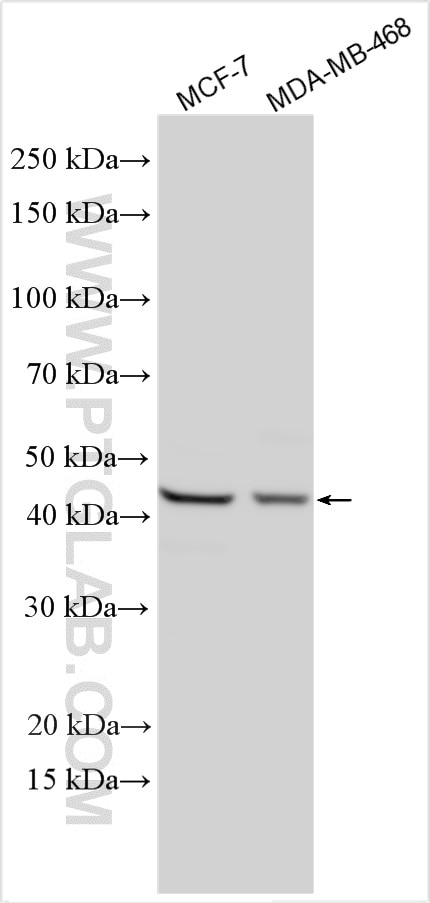
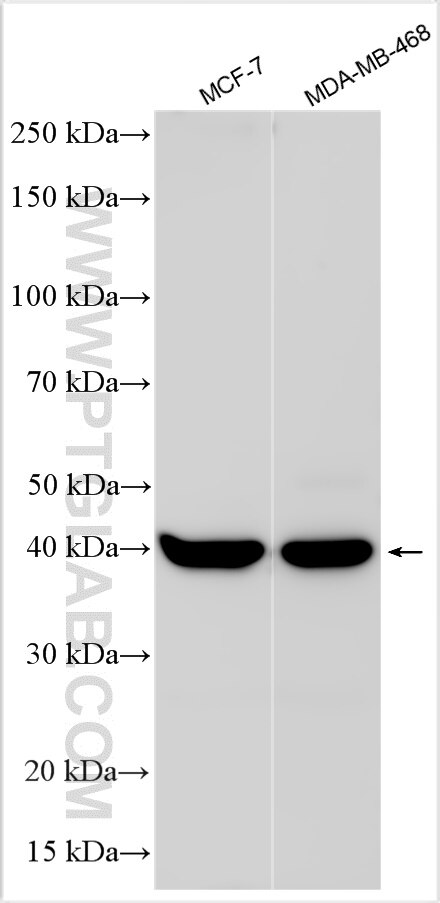
Tested Applications
| Positive WB detected in | MCF-7 cells, MDA-MB-468 cells |
Recommended dilution
| Application | Dilution |
|---|---|
| Western Blot (WB) | WB : 1:500-1:2000 |
| It is recommended that this reagent should be titrated in each testing system to obtain optimal results. | |
| Sample-dependent, Check data in validation data gallery. | |
Published Applications
| KD/KO | See 3 publications below |
| WB | See 9 publications below |
| IF | See 25 publications below |
| CoIP | See 2 publications below |
Product Information
13917-1-AP targets HORMAD1 in WB, IF, CoIP, ELISA applications and shows reactivity with human, mouse, rat samples.
| Tested Reactivity | human, mouse, rat |
| Cited Reactivity | human, mouse |
| Host / Isotype | Rabbit / IgG |
| Class | Polyclonal |
| Type | Antibody |
| Immunogen |
CatNo: Ag4914 Product name: Recombinant human HORMAD1 protein Source: e coli.-derived, PGEX-4T Tag: GST Domain: 1-394 aa of BC047406 Sequence: MATAQLQRTPMSALVFPNKISTEHQSLVLVKRLLAVSVSCITYLRGIFPECAYGTRYLDDLCVKILREDKNCPGSTQLVKWMLGCYDALQKKYLRMVVLAVYTNPEDPQTISECYQFKFKYTNNGPLMDFISKNQSNESSMLSTDTKKASILLIRKIYILMQNLGPLPNDVCLTMKLFYYDEVTPPDYQPPGFKDGDCEGVIFEGEPMYLNVGEVSTPFHIFKVKVTTERERMENIDSTILSPKQIKTPFQKILRDKDVEDEQEHYTSDDLDIETKMEEQEKNPASSELEEPSLVCEEDEIMRSKESPDLSISHSQVEQLVNKTSELDMSESKTRSGKVFQNKMANGNQPVKSSKENRKRSQHESGRIVLHHFDSSSQESVPKRRKFSEPKEHI 相同性解析による交差性が予測される生物種 |
| Full Name | HORMA domain containing 1 |
| Calculated molecular weight | 45 kDa |
| Observed molecular weight | 45 kDa |
| GenBank accession number | BC047406 |
| Gene Symbol | HORMAD1 |
| Gene ID (NCBI) | 84072 |
| RRID | AB_2120844 |
| Conjugate | Unconjugated |
| Form | |
| Form | Liquid |
| Purification Method | Antigen affinity purification |
| UNIPROT ID | Q86X24 |
| Storage Buffer | PBS with 0.02% sodium azide and 50% glycerol{{ptg:BufferTemp}}7.3 |
| Storage Conditions | Store at -20°C. Stable for one year after shipment. Aliquoting is unnecessary for -20oC storage. |
Background Information
HORMA domain-containing proteins regulate interactions between homologous chromosomes (homologs) during meiosis in a wide range of eukaryotes [PMID:21079677]. They also implicated in other processes related to crossover formation, including DSB formation, inhibition of promiscuous formation of the synaptonemal complex (SC), and the meiotic prophase checkpoint that monitors both DSB processing and SCs [PMID:19851446]. HORMAD1 first accumulates on the chromosomes during the leptotene to zygotene stages of meiotic prophase I. As germ cells progress into the pachytene stage, HORMAD1 disappears from the synapsed chromosomal regions. However, once the chromosomes desynapse during the diplotene stage, HORMAD1 again accumulates on the chromosome axis of the desynapsed homologs [PMID:19686734]. HORMAD1 exists as various isoform and the range of molecular weight of isoforms are sbout 36-45 kDa.
Protocols
| Product Specific Protocols | |
|---|---|
| WB protocol for HORMAD1 antibody 13917-1-AP | Download protocol |
| Standard Protocols | |
|---|---|
| Click here to view our Standard Protocols |
Publications
| Species | Application | Title |
|---|---|---|
Nature Co-transplantation of autologous Treg cells in a cell therapy for Parkinson's disease | ||
Exp Mol Med Structured illumination microscopy imaging reveals localization of replication protein A between chromosome lateral elements during mammalian meiosis. | ||
Nucleic Acids Res SCF ubiquitin E3 ligase regulates DNA double-strand breaks in early meiotic recombination. | ||
Nucleic Acids Res NAT10-mediated N4-acetylcytidine modification is required for meiosis entry and progression in male germ cells. | ||
Adv Sci (Weinh) HSF5 Deficiency Causes Male Infertility Involving Spermatogenic Arrest at Meiotic Prophase I in Humans and Mice |