
Validation Data Gallery
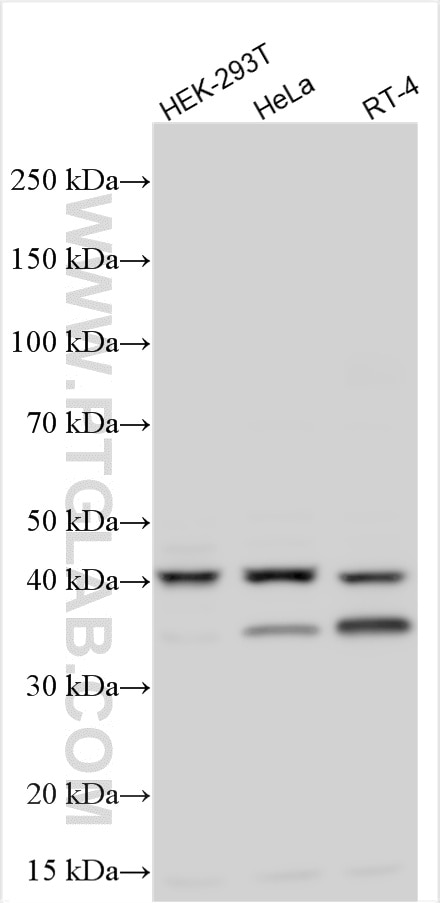
Tested Applications
Recommended dilution
| Application | Dilution |
|---|---|
| It is recommended that this reagent should be titrated in each testing system to obtain optimal results. | |
Product Information
32944-1-PBS targets GTPBP10 in WB, Indirect ELISA applications and shows reactivity with human, mouse samples.
| Tested Reactivity | human, mouse |
| Host / Isotype | Rabbit / IgG |
| Class | Polyclonal |
| Type | Antibody |
| Immunogen |
CatNo: Ag37974 Product name: Recombinant human GTPBP10 protein Source: e coli.-derived, PGEX-4T Tag: GST Domain: 1-387 aa of BC107714 Sequence: MVHCSCVLFRKYGNFIDKLRLFTRGGSGGMGYPRLGGEGGKGGDVWVVAQNRMTLKQLKDRYPGKRFVAGVGANSKISALKGSKGKDWEIPVPVGISVTDENGKIIGELNKENDRILVAQGGLGGKLLTNFLPLKGQKRIIHLDLKLIADVGLVGFPNAGKSSLLSCVSHAKPAIADYAFTTLKPELGKIMYSDFKQISVADLPGLIEGAHMNKGMGHKFLKHIERTRQLLFVVDISGFQLSSHTQYRTAFETIILLTKELELYKEELQTKPALLAVNKMDLPDAQDKFHELMSQLQNPKDFLHLFEKNMIPERTVEFQHIIPISAVTGEGIEELKNCIRKSLDEQANQENDALHKKQLLNLWISDTMSSTEPPSKHAVTTSKMDII 相同性解析による交差性が予測される生物種 |
| Full Name | GTP-binding protein 10 (putative) |
| Calculated molecular weight | 43, 34, 12 kDa |
| Observed molecular weight | 42, 34, 15 kDa |
| GenBank accession number | BC107714 |
| Gene Symbol | GTPBP10 |
| Gene ID (NCBI) | 85865 |
| RRID | AB_3742799 |
| Conjugate | Unconjugated |
| Form | |
| Form | Liquid |
| Purification Method | Antigen affinity Purification |
| UNIPROT ID | A4D1E9 |
| Storage Buffer | PBS only{{ptg:BufferTemp}}7.3 |
| Storage Conditions | Store at -80°C. |
Background Information
GTPBP10, a member of the conserved Obg family of P-loop small G proteins, is a mitochondrial protein. The absence of GTPBP10 leads to attenuated mtLSU and mtSSU levels and the virtual absence of the 55S monosome, which entirely prevents mitochondrial protein synthesis. GTPBP10 physically interacts with the 16S rRNA, but not with the 12S rRNA, and crosslinks with several mtLSU proteins. Additionally, GTPBP10 is indirectly required for efficient processing of the 12S-16S rRNA precursor transcript, which could explain the mtSSU accumulation defect (PMID: 30321378).