
Validation Data Gallery


Tested Applications
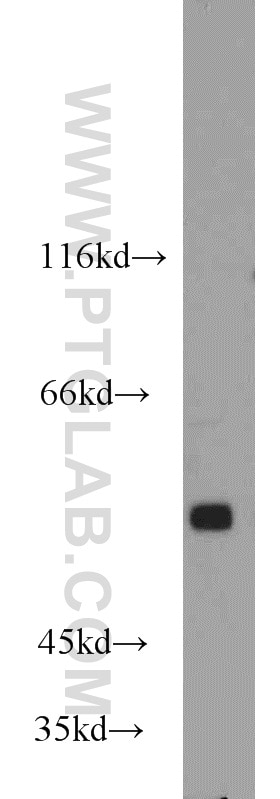
| Positive WB detected in | mouse brain tissue |
| Positive IHC detected in | mouse brain tissue Note: suggested antigen retrieval with TE buffer pH 9.0; (*) Alternatively, antigen retrieval may be performed with citrate buffer pH 6.0 |
| Positive IF-P detected in | mouse brain tissue |
| Positive IF/ICC detected in | HeLa cells |
Recommended dilution
| Application | Dilution |
|---|---|
| Western Blot (WB) | WB : 1:500-1:3200 |
| Immunohistochemistry (IHC) | IHC : 1:50-1:500 |
| Immunofluorescence (IF)-P | IF-P : 1:50-1:500 |
| Immunofluorescence (IF)/ICC | IF/ICC : 1:50-1:500 |
| It is recommended that this reagent should be titrated in each testing system to obtain optimal results. | |
| Sample-dependent, Check data in validation data gallery. | |
Published Applications
| KD/KO | See 3 publications below |
| WB | See 9 publications below |
| IF | See 5 publications below |
Product Information
14820-1-AP targets GPR37/Pael-R in WB, IHC, IF/ICC, IF-P, ELISA applications and shows reactivity with human, mouse samples.
| Tested Reactivity | human, mouse |
| Cited Reactivity | human, mouse |
| Host / Isotype | Rabbit / IgG |
| Class | Polyclonal |
| Type | Antibody |
| Immunogen |
CatNo: Ag6591 Product name: Recombinant human GPR37 protein Source: e coli.-derived, PGEX-4T Tag: GST Domain: 34-264 aa of BC040007 Sequence: SRNETCLGESCAPTVIQRRGRDAWGPGNSARDVLRARAPREEQGAAFLAGPSWDLPAAPGRDPAAGRGAEASAAGPPGPPTRPPGPWRWKGARGQEPSETLGRGNPTALQLFLQISEEEEKGPRGAGISGRSQEQSVKTVPGASDLFYWPRRAGKLQGSHHKPLSKTANGLAGHEGWTIALPGRALAQNGSLGEGIHEPGGPRRGNSTNRRVRLKNPFYPLTQESYGAYAV 相同性解析による交差性が予測される生物種 |
| Full Name | G protein-coupled receptor 37 (endothelin receptor type B-like) |
| Calculated molecular weight | 67 kDa |
| Observed molecular weight | 50-55 kDa |
| GenBank accession number | BC040007 |
| Gene Symbol | GPR37 |
| Gene ID (NCBI) | 2861 |
| RRID | AB_2232549 |
| Conjugate | Unconjugated |
| Form | |
| Form | Liquid |
| Purification Method | Antigen affinity purification |
| UNIPROT ID | O15354 |
| Storage Buffer | PBS with 0.02% sodium azide and 50% glycerol{{ptg:BufferTemp}}7.3 |
| Storage Conditions | Store at -20°C. Stable for one year after shipment. Aliquoting is unnecessary for -20oC storage. |
Background Information
The orphan G protein-coupled receptor GPR37, also known as PAELR (parkin-associated endothelin receptor-like receptor) or ETBR-LP-1 (endothelin B receptor-like protein 1), is a 613 aa, multi-pass membrane protein predominantly expressed in the brain. It is a substrate of parkin (PARK2). When overexpressed in cells, GPR37 tends to become insoluble, unfolded, and ubiquitinated in vivo. Accumulation of the unfolded protein may lead to dopaminergic neuronal death in juvenile Parkinson disease (JPD). This antibody recognizes endogenous GPR37, which migrates as an approximately 50-55 kDa band in SDS-PAGE (PMID:17519329).
Protocols
| Product Specific Protocols | |
|---|---|
| IF protocol for GPR37/Pael-R antibody 14820-1-AP | Download protocol |
| IHC protocol for GPR37/Pael-R antibody 14820-1-AP | Download protocol |
| WB protocol for GPR37/Pael-R antibody 14820-1-AP | Download protocol |
| Standard Protocols | |
|---|---|
| Click here to view our Standard Protocols |
Publications
| Species | Application | Title |
|---|---|---|
Cell Stem Cell Human PSC-derived sinoatrial node-cardiac plexus assembloids model innervation-associated maturation of pacemaker systems. | ||
Phytomedicine Chlorogenic acid enhances alveolar macrophages phagocytosis in acute respiratory distress syndrome by activating G protein-coupled receptor 37 (GPR 37)
| ||
Proc Natl Acad Sci U S A GPR37 and GPR37L1 are receptors for the neuroprotective and glioprotective factors prosaptide and prosaposin. | ||
Oncogene GPR37 promotes colorectal cancer liver metastases by enhancing the glycolysis and histone lactylation via Hippo pathway | ||
Am J Hum Genet Bi-allelic loss-of-function variants in JKAMP cause a neurodevelopmental syndrome associated with dysregulation of GPR37 trafficking. | ||
Cancer Cell Int LTCONS_00014107-miR-29b-2-3p-GPR37 axis promotes heat stimulation induced esophageal carcinogenesis. |