
Validation Data Gallery
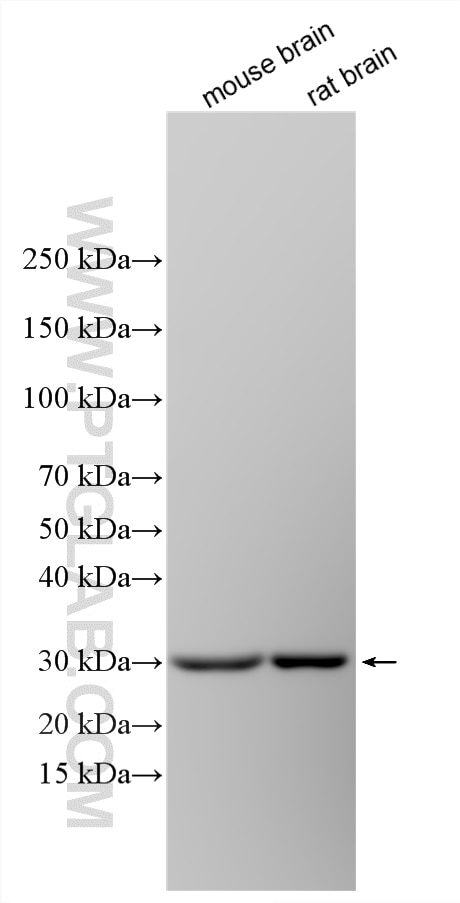
Tested Applications
Recommended dilution
| Application | Dilution |
|---|---|
| It is recommended that this reagent should be titrated in each testing system to obtain optimal results. | |
Product Information
34328-1-PBS targets FOLR2 in WB, Indirect ELISA applications and shows reactivity with mouse, rat samples.
| Tested Reactivity | mouse, rat |
| Host / Isotype | Rabbit / IgG |
| Class | Polyclonal |
| Type | Antibody |
| Immunogen |
CatNo: Eg7561 Product name: Recombinant mouse FOLR2 protein Source: mammalian cells-derived, V37 Tag: C-rFc Domain: 21-227 aa of NM_008035.2 Sequence: RDRTDLLNVCMDAKHHKTKPGPEDKLHDQCSPWKKNACCSVNTSQELHKADSRLYFNWDHCGKMEPACKSHFIQDSCLYECSPNLGPWIQQVDQSWRKERFLDVPLCKEDCHQWWEACRTSFTCKRDWHKGWDWSSGINKCPNTAPCHTFEYYFPTPASLCEGLWSHSYKVSNYSRGSGRCIQMWFDSTQGNPNEDVVKFYASFMTS 相同性解析による交差性が予測される生物種 |
| Full Name | folate receptor 2 (fetal) |
| Calculated molecular weight | 29 kDa |
| Observed molecular weight | 30 kDa |
| GenBank accession number | NM_008035.2 |
| Gene Symbol | Folr2 |
| Gene ID (NCBI) | 14276 |
| RRID | AB_3743191 |
| Conjugate | Unconjugated |
| Form | |
| Form | Liquid |
| Purification Method | Antigen affinity Purification |
| UNIPROT ID | Q05685 |
| Storage Buffer | PBS only{{ptg:BufferTemp}}7.3 |
| Storage Conditions | Store at -80°C. |
Background Information
Folate receptor beta (FOLR2, also known as FR-β) is a glycosylphosphatidylinositol (GPI)-anchored cell surface folate-binding protein that mediates high-affinity uptake of reduced folates and folate conjugates. In mice, Folr2 is predominantly expressed in subsets of tissue-resident macrophages and monocyte/macrophage-lineage cells, rather than in most epithelial compartments. It is particularly enriched in alternatively activated (M2-like) macrophages, tumor-associated macrophages (TAMs), and macrophage populations associated with tissue remodeling, immune regulation, and chronic inflammation. Through facilitating folate internalization and reflecting a specialized macrophage activation state, FOLR2 is widely used as a marker for immunoregulatory macrophages in contexts such as tumor microenvironment, fibrosis, wound healing, and inflammatory disease.