
Validation Data Gallery
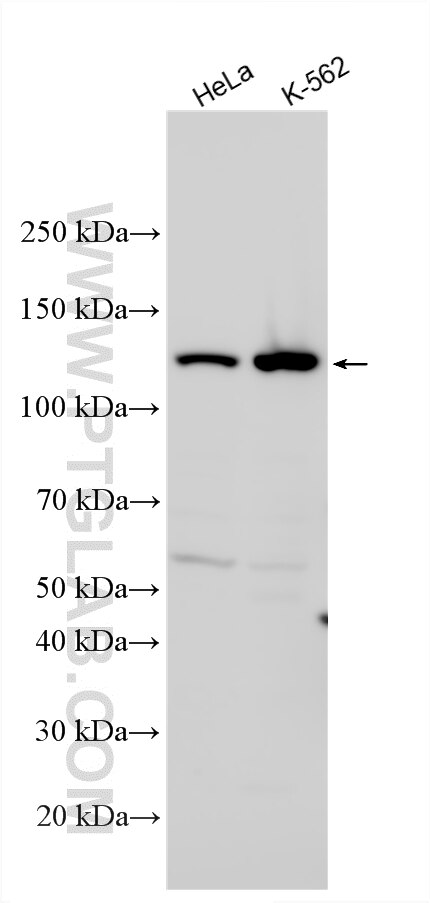
Tested Applications
Recommended dilution
| Application | Dilution |
|---|---|
| It is recommended that this reagent should be titrated in each testing system to obtain optimal results. | |
Product Information
33972-1-PBS targets FHOD1 in WB, Indirect ELISA applications and shows reactivity with human samples.
| Tested Reactivity | human |
| Host / Isotype | Rabbit / IgG |
| Class | Polyclonal |
| Type | Antibody |
| Immunogen |
CatNo: Ag38590 Product name: Recombinant human FHOD1 protein Source: e coli.-derived, PGEX-4T Tag: GST Domain: 1-150 aa of NM_013241.2 Sequence: MAGGEDRGDGEPVSVVTVRVQYLEDTDPFACANFPEPRRAPTCSLDGALPLGAQIPAVHRLLGAPLKLEDCALQVSPSGYYLDTELSLEEQREMLEGFYEEISKGRKPTLILRTQLSVRVNAILEKLYSSSGPELRRSLFSLKQIFQEDK 相同性解析による交差性が予測される生物種 |
| Full Name | formin homology 2 domain containing 1 |
| Calculated molecular weight | 127kDa,1164aa |
| Observed molecular weight | 125 kDa |
| GenBank accession number | NM_013241.2 |
| Gene Symbol | FHOD1 |
| Gene ID (NCBI) | 29109 |
| RRID | AB_3743128 |
| Conjugate | Unconjugated |
| Form | |
| Form | Liquid |
| Purification Method | Antigen affinity Purification |
| UNIPROT ID | Q9Y613 |
| Storage Buffer | PBS only{{ptg:BufferTemp}}7.3 |
| Storage Conditions | Store at -80°C. |
Background Information
FHOD1 (Formin homology 2 domain-containing protein 1) is a member of the Diaphanous-related formins (DRFs), a family of proteins characterized by the presence of a GTP-binding domain (GBD), formin homology (FH) 1 and FH2 domains, a coiled-coil motif, and a diaphanous autoregulatory domain (DAD). Accumulating evidence indicates that FHOD1 not only modulates intracellular signaling pathways in tumor cells but also influences multiple components of the tumor microenvironment (TME), including T cells, B cells, cancer-associated fibroblasts (CAFs), and various cytokines. Dysregulated expression and functional impairment of FHOD1 have been implicated in the development of tumor immunosuppression. Specifically, FHOD1 interferes with the function of chemokine receptors responsible for guiding immune cell trafficking to tumor sites, thereby compromising the efficient infiltration of immune cells into the TME. This deficiency limits the capacity of immune cells to target and eliminate tumor cells. Furthermore, FHOD1 aberrantly activates intracellular signaling pathways within immune cells, impairing their ability to recognize and respond to tumor cells effectively. Consequently, FHOD1 contributes to an immunosuppressive TME, creating a permissive environment for tumor progression and metastasis (PMID: 40364836).