
Validation Data Gallery
Tested Applications
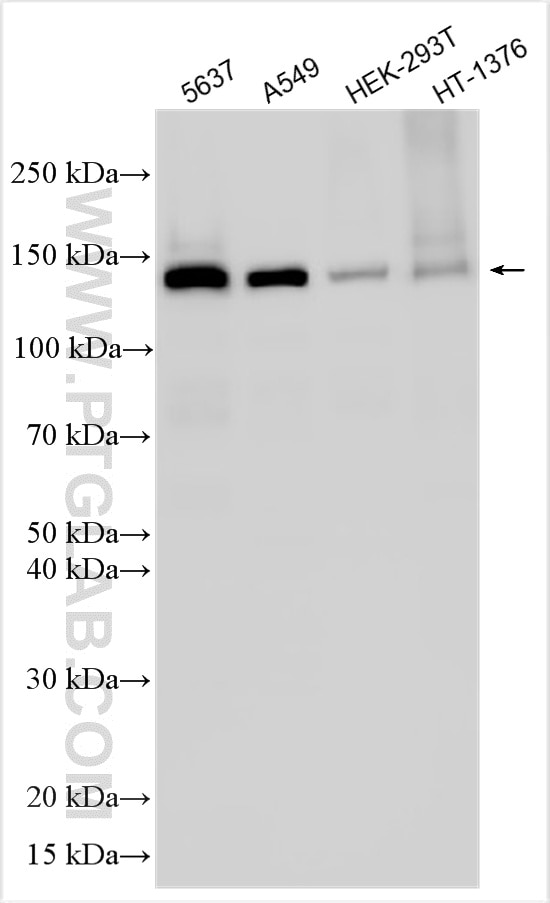
| Positive WB detected in | 5637 cells, A549 cells, HEK-293T cells, HT-1376 cells |
Recommended dilution
| Application | Dilution |
|---|---|
| Western Blot (WB) | WB : 1:5000-1:50000 |
| It is recommended that this reagent should be titrated in each testing system to obtain optimal results. | |
| Sample-dependent, Check data in validation data gallery. | |
Product Information
31974-1-AP targets FAM83H in WB, ELISA applications and shows reactivity with human samples.
| Tested Reactivity | human |
| Host / Isotype | Rabbit / IgG |
| Class | Polyclonal |
| Type | Antibody |
| Immunogen |
CatNo: Ag37139 Product name: Recombinant human FAM83H protein Source: e coli.-derived, PGEX-4T Tag: GST Domain: 1000-1179 aa of BC033256 Sequence: RRLSLGQGDSTEAATEERGPRARLSSATANALYSSNLRDDTKAILEQISAHGQKHRAVPAPSPGPTHNSPELGRPPAAGVLAPDMSDKDKCSAIFRSDSLGTQGRLSRTLPASAEERDRLLRRMESMRKEKRVYSRFEVFCKKEEASSPGAGEGPAEEGTRDSKVGKFVPKILGTFKSKK 相同性解析による交差性が予測される生物種 |
| Full Name | family with sequence similarity 83, member H |
| Calculated molecular weight | 127 kDa |
| Observed molecular weight | 140 kDa |
| GenBank accession number | BC033256 |
| Gene Symbol | FAM83H |
| Gene ID (NCBI) | 286077 |
| RRID | AB_3742503 |
| Conjugate | Unconjugated |
| Form | |
| Form | Liquid |
| Purification Method | Antigen affinity Purification |
| UNIPROT ID | Q6ZRV2 |
| Storage Buffer | PBS with 0.02% sodium azide and 50% glycerol{{ptg:BufferTemp}}7.3 |
| Storage Conditions | Store at -20°C. Stable for one year after shipment. Aliquoting is unnecessary for -20oC storage. |
Background Information
FAM83H was first discovered during extensive computational analysis of the human genomic sequence [PMID: 18252228] and reported to be essential in dental enamel formation [PMID: 26142250, PMID: 21127961]. Mutation of FAM83H is the main etiological factor for human autosomal dominant hypocalcified amelogenesis imperfecta. Moreover, recently, research into FAM83H has focused on its roles in the development and progression of human cancers. However, there are controversial reports for the role of FAM83H in human cancers. Earlier reports, which used microarray analysis, showed higher FAM83H expression in ovarian cancers compared with normal ovarian tissue [PMID: 21617380]. In addition, higher expression of the FAM83H gene is presented in the cancers of lung, breast, colon, liver, ovary, pancreas, and stomach [PMID: 28078827]. The roles of FAM83H in the progression of human cancers involve changes in the proliferation and invasiveness of cancer cells. In colon cancer cells, overexpression of FAM83H is suggested to be involved in the progression of cancer cells by disorganizing keratin cytoskeleton structures [PMID: 23902688, PMID: 27681590]. In addition, FAM83H increases proliferation of prostatic cancer cells [PMID: 26512949], hepatocellular carcinoma cells [PMID: 28607447], and clear cell renal cell carcinoma cells [PMID: 30723706]. In hepatocellular carcinoma cells, activation of the MYC-FAM83H pathway increases the proliferation and invasion activity of cancer cells [PMID: 28607447]. Moreover, higher expression of FAM83H is associated with an increased recurrence rate of prostatic cancer patients and shorter survival of uterine cancer [PMID: 28078827], hepatocellular carcinoma [PMID: 28607447], and clear cell renal cell carcinoma patients [PMID: 21057535]. These findings suggest that FAM83H has a vital role in tumorigenesis and progression of human malignant tumors, and might be involved in the progression of various types of human cancers. However, the expression of FAM83H is down-regulated in astrocytoma and oligodendroglioma of the brain, and higher expression of FAM83H is associated with favorable prognosis of glioma and head and neck cancer patients [PMID: 28078827]. Therefore, there is a possibility that the role of FAM83H might be different according to the type of cells and further study is needed [PMID: 21057535].
Protocols
| Product Specific Protocols | |
|---|---|
| WB protocol for FAM83H antibody 31974-1-AP | Download protocol |
| Standard Protocols | |
|---|---|
| Click here to view our Standard Protocols |