
Validation Data Gallery
Tested Applications
Recommended dilution
| Application | Dilution |
|---|---|
| It is recommended that this reagent should be titrated in each testing system to obtain optimal results. | |
Product Information
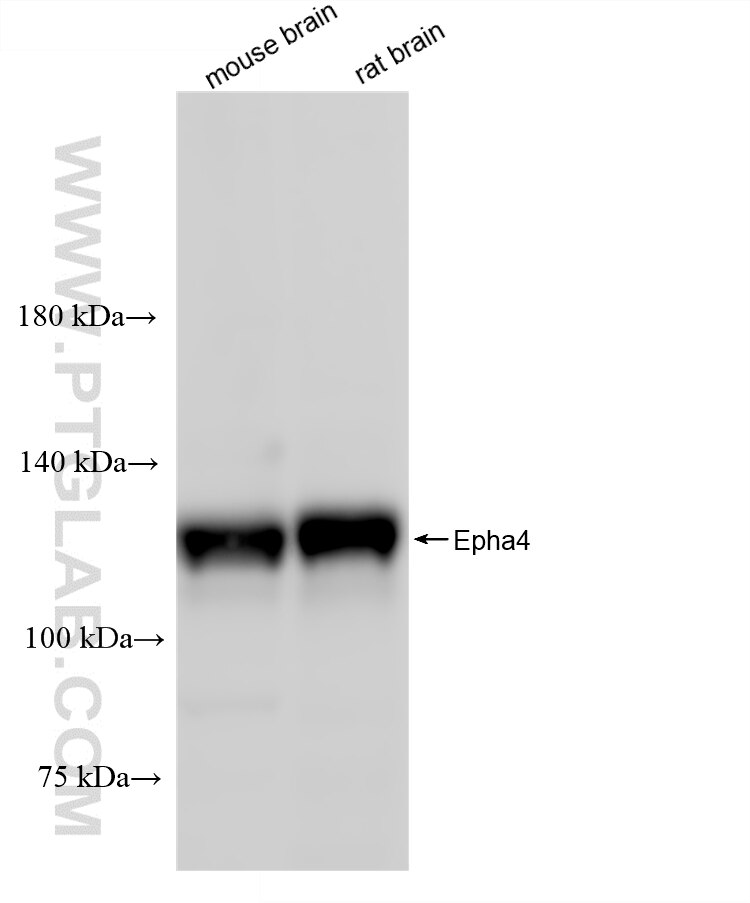
88021-1-PBS targets Epha4 in WB, Indirect ELISA applications and shows reactivity with mouse, rat samples.
| Tested Reactivity | mouse, rat |
| Host / Isotype | Rabbit / IgG |
| Class | Recombinant |
| Type | Antibody |
| Immunogen |
CatNo: Eg8776 Product name: Recombinant mouse Epha4 protein Source: mammalian cells-derived, V37 Tag: C-rFc Domain: 20-547 aa of NM_007936.3 Sequence: VTGSRVYPANEVTLLDSRSVQGELGWIASPLEGGWEEVSIMDEKNTPIRTYQVCNVMEASQNNWLRTDWITREGAQRVYIEIKFTLRDCNSLPGVMGTCKETFNLYYYESDNDKERFIRESQFGKIDTIAADESFTQVDIGDRIMKLNTEIRDVGPLSKKGFYLAFQDVGACIALVSVRVFYKKCPLTVRNLAQFPDTITGADTSSLVEVRGSCVNNSEEKDVPKMYCGADGEWLVPIGNCLCNAGHEEQNGECQACKIGYYKALSTDASCAKCPPHSYSVWEGATSCTCDRGFFRADNDAASMPCTRPPSAPLNLISNVNETSVNLEWSSPQNTGGRQDISYNVVCKKCGAGDPSKCRPCGSGVHYTPQQNGLKTTRVSITDLLAHTNYTFEIWAVNGVSKYNPSPDQSVSVTVTTNQAAPSSIALVQAKEVTRYSVALAWLEPDRPNGVILEYEVKYYEKDQNERSYRIVRTAARNTDIKGLNPLTSYVFHVRARTAAGYGDFSEPLEVTTNTVPSRIIGDGANST 相同性解析による交差性が予測される生物種 |
| Full Name | Eph receptor A4 |
| Calculated molecular weight | 110 kDa |
| Observed molecular weight | 120 kDa |
| GenBank accession number | NM_007936.3 |
| Gene Symbol | Epha4 |
| Gene ID (NCBI) | 13838 |
| Conjugate | Unconjugated |
| Form | |
| Form | Liquid |
| Purification Method | Protein A purification |
| UNIPROT ID | Q03137-1 |
| Storage Buffer | PBS only{{ptg:BufferTemp}}7.3 |
| Storage Conditions | Store at -80°C. |
Background Information
EPH receptor A4 (EPHA4) is a member of the Eph receptor family of receptor tyrosine kinases (RTKs) that interacts with both ephrin-A and ephrin-B ligands, making it one of the most versatile Eph receptors. In mice, Epha4 is highly expressed in the central nervous system, particularly during development, where it regulates axon guidance, neuronal pathfinding, synaptic plasticity, and neural circuit formation. EPHA4 mediates contact-dependent bidirectional signaling, often inducing cell repulsion and boundary formation, which is critical for proper tissue patterning. Beyond development, EPHA4 continues to function in the adult CNS, contributing to synaptic remodeling and neuronal regeneration responses.