
Validation Data Gallery
Tested Applications
Recommended dilution
| Application | Dilution |
|---|---|
| It is recommended that this reagent should be titrated in each testing system to obtain optimal results. | |
Product Information
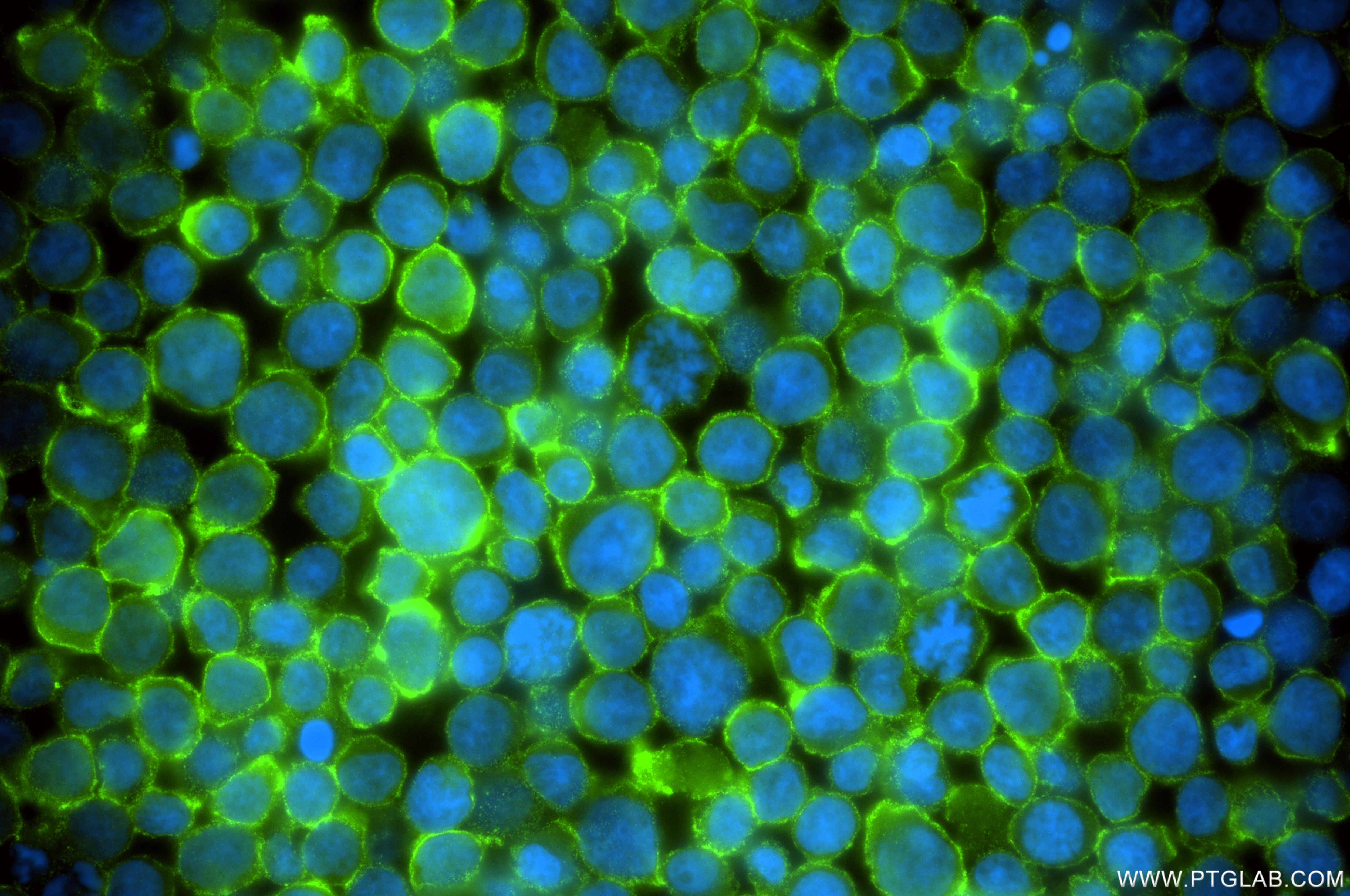
85025-6-PBS targets Dysadherin in WB, IF/ICC, Indirect ELISA applications and shows reactivity with human samples.
| Tested Reactivity | human |
| Host / Isotype | Rabbit / IgG |
| Class | Recombinant |
| Type | Antibody |
| Immunogen |
CatNo: Eg5715 Product name: Recombinant human FXYD5/Dysadherin protein Source: mammalian cells-derived, V37 Tag: C-rFc Domain: 22-145 aa of NM_001164605.2 Sequence: QTLKDTTSSSSADSTIMDIQVPTRAPDAVYTELQPTSPTPTWPADETPQPQTQTQQLEGTDGPLVTDPETHKSTKAAHPTDDTTTLSERPSPSTDVQTDPQTLKPSGFHEDDPFFYDEHTLRKR 相同性解析による交差性が予測される生物種 |
| Full Name | FXYD domain containing ion transport regulator 5 |
| Calculated molecular weight | 19 kDa |
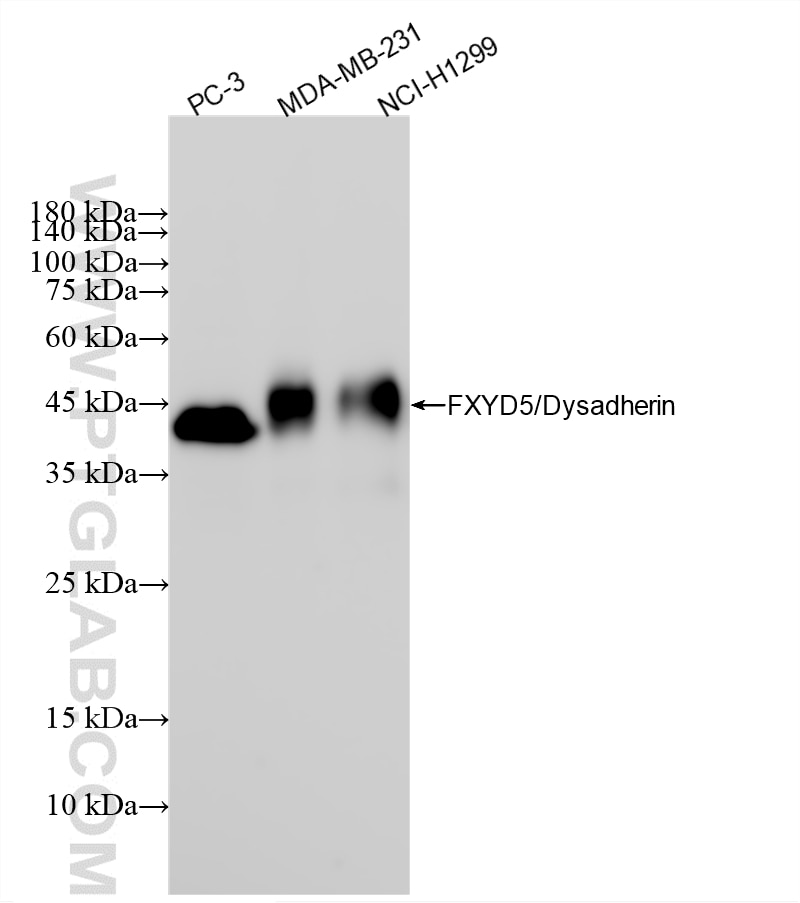
| Observed molecular weight | 35-55 kDa |
| GenBank accession number | NM_001164605.2 |
| Gene Symbol | Dysadherin |
| Gene ID (NCBI) | 53827 |
| RRID | AB_3743948 |
| Conjugate | Unconjugated |
| Form | |
| Form | Liquid |
| Purification Method | Protein A purification |
| UNIPROT ID | Q96DB9 |
| Storage Buffer | PBS only{{ptg:BufferTemp}}7.3 |
| Storage Conditions | Store at -80°C. |
Background Information
Dysadherin (also known as FXYD5) is a cancer-related transmembrane glycoprotein, belonging to FXYD family. It is overexpressed on the surface of many tumor cells, and promotes the movement, migration and metastasis of tumor cells by reducing E-cadherin(E- cadherin) dependent intercellular adhesion. Its main function also includes regulating the activity of na, k-ATPase. It is also a typical "abnormal migration" protein-its SDS-PAGE apparent molecular weight (35-55 kDa) is much higher than the theoretical calculation value (~20 kDa). This difference is mainly caused by extensive O- glycosylation modification, which is particularly important in cancer research, because tumor cells often show a higher degree of glycosylation (50-55 kDa), which may be related to their metastasis promoting function(PMID: 17442482;41535258).