
Validation Data Gallery
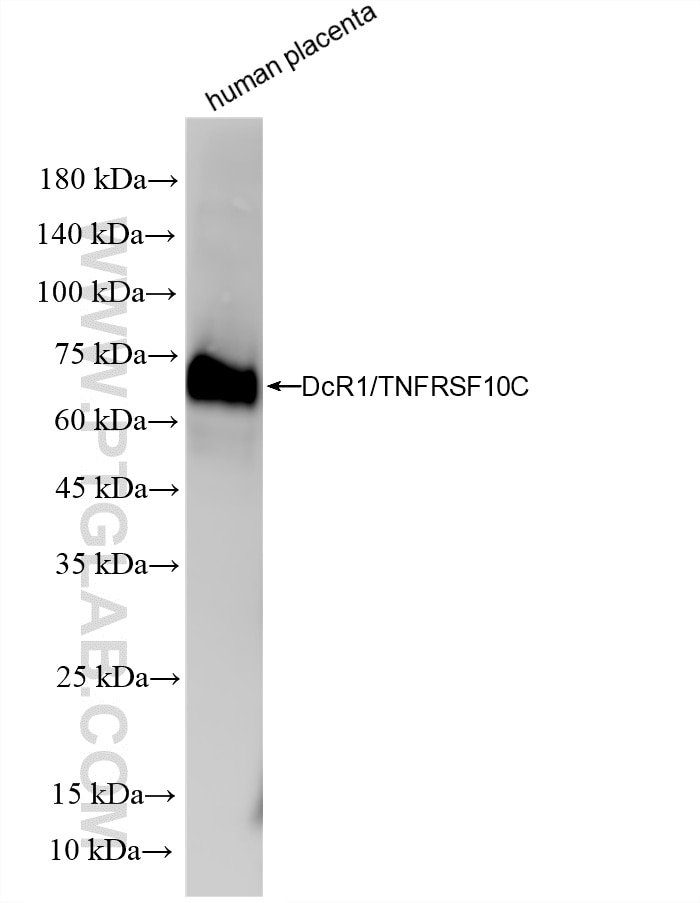
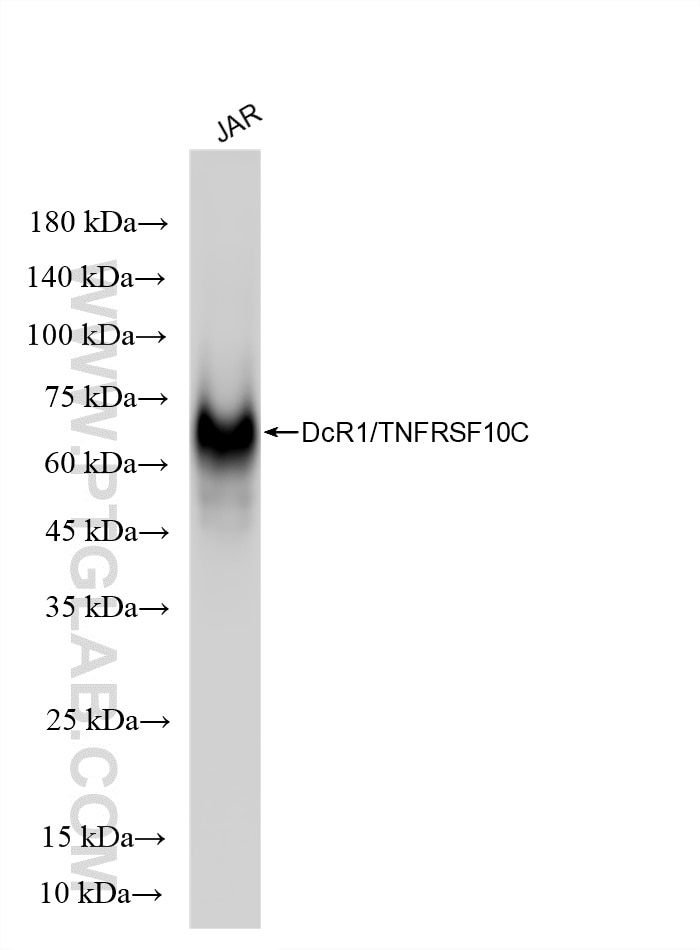
Tested Applications
Recommended dilution
| Application | Dilution |
|---|---|
| It is recommended that this reagent should be titrated in each testing system to obtain optimal results. | |
Product Information
86886-1-PBS targets DcR1/TNFRSF10C in WB, Indirect ELISA applications and shows reactivity with human samples.
| Tested Reactivity | human |
| Host / Isotype | Rabbit / IgG |
| Class | Recombinant |
| Type | Antibody |
| Immunogen |
CatNo: Eg4677 Product name: Recombinant Human DcR1/TNFRSF10C protein (rFc Tag) Source: mammalian cells-derived, V37 Tag: C-rFc Domain: 26-235 aa of NM_003841.5 Sequence: ATTARQEEVPQQTVAPQQQRHSFKGEECPAGSHRSEHTGACNPCTEGVDYTNASNNEPSCFPCTVCKSDQKHKSSCTMTRDTVCQCKEGTFRNENSPEMCRKCSRCPSGEVQVSNCTSWDDIQCVEEFGANATVETPAAEETMNTSPGTPAPAAEETMNTSPGTPAPAAEETMTTSPGTPAPAAEETMTTSPGTPAPAAEETMITSPGTP 相同性解析による交差性が予測される生物種 |
| Full Name | tumor necrosis factor receptor superfamily, member 10c, decoy without an intracellular domain |
| Calculated molecular weight | 27 kDa |
| Observed molecular weight | 60-75 kDa |
| GenBank accession number | NM_003841.5 |
| Gene Symbol | DcR1 |
| Gene ID (NCBI) | 8794 |
| RRID | AB_3745187 |
| Conjugate | Unconjugated |
| Form | |
| Form | Liquid |
| Purification Method | Protein A purification |
| UNIPROT ID | O14798 |
| Storage Buffer | PBS only{{ptg:BufferTemp}}7.3 |
| Storage Conditions | Store at -80°C. |
Background Information
Decoy receptor 1 (DcR1), also known as TNFRSF10C, CD263, TRAIL-R3, or TRID, is a member of the TNF-receptor superfamily. DcR1 is a receptor for the cytotoxic ligand TRAIL. In contrast to DR4/TRAIL-R1 and DR5/TRAIL-R2, DcR1 is a glycosylphosphatidylinositol (GPI)-linked membrane molecule that lacks a cytoplasmic region, including the death domain (PMID: 9314565; 9242611). DcR1 is not capable of inducing apoptosis and is thought to function as an antagonistic receptor that protects cells from TRAIL-induced apoptosis (PMID: 9242610). The apparent molecular weight of DcR1 is larger than the calculated molecular weight of 27 kDa, suggesting the presence of extensive post-translational modifications and/or unusual structural motifs (PMID: 9373179).