
Validation Data Gallery
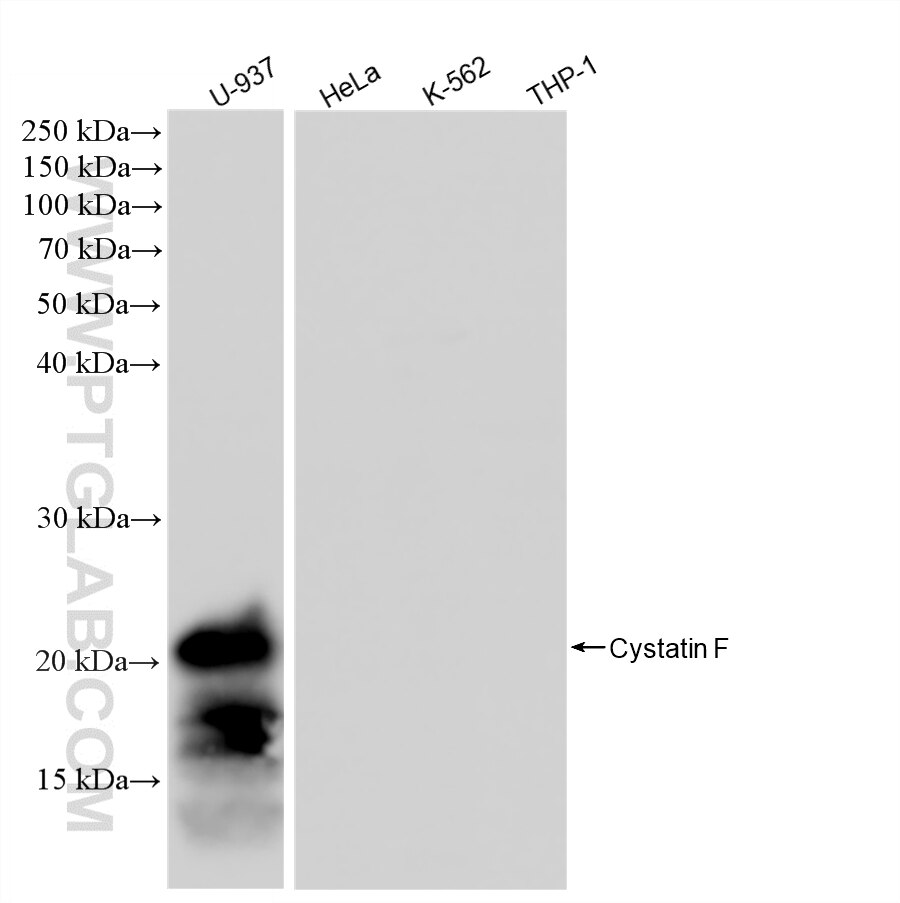
Tested Applications
Recommended dilution
| Application | Dilution |
|---|---|
| It is recommended that this reagent should be titrated in each testing system to obtain optimal results. | |
Product Information
87771-1-PBS targets Cystatin F in WB, Indirect ELISA applications and shows reactivity with human samples.
| Tested Reactivity | human |
| Host / Isotype | Rabbit / IgG |
| Class | Recombinant |
| Type | Antibody |
| Immunogen |
CatNo: Eg8049 Product name: Recombinant human Cystatin F protein Source: mammalian cells-derived, pHZ-KIsec-N-rFc Tag: N-rFc Domain: 20-145 aa of BC015507 Sequence: GPSPDTCSQDLNSRVKPGFPKTIKTNDPGVLQAARYSVEKFNNCTNDMFLFKESRITRALVQIVKGLKYMLEVEIGRTTCKKNQHLRLDDCDFQTNHTLKQTLSCYSEVWVVPWLQHFEVPVLRCH 相同性解析による交差性が予測される生物種 |
| Full Name | cystatin F (leukocystatin) |
| Calculated molecular weight | 167 aa, 19 kDa |
| Observed molecular weight | 16-25 kDa |
| GenBank accession number | BC015507 |
| Gene Symbol | Cystatin F |
| Gene ID (NCBI) | 8530 |
| RRID | AB_3745745 |
| Conjugate | Unconjugated |
| Form | |
| Form | Liquid |
| Purification Method | Protein A purification |
| UNIPROT ID | O76096 |
| Storage Buffer | PBS only{{ptg:BufferTemp}}7.3 |
| Storage Conditions | Store at -80°C. |
Background Information
Cystatin F (also known as CST7, CMAP or leucocyte cystatin) is an endogenous cysteine protease inhibitor belonging to type II cystatin superfamily. Covalently linked homodimer is formed through C26-C63 disulfide bonds, which is the main form of its secretion. It contains N- glycosylation sites (Asn62 and Asn115), and glycosylation modification determines its intracellular localization-high mannose type guides it to target lysosomes, and complex sugar chain type promotes secretion. The active form is monomer, and the dimer needs to be activated in lysosomal reduction environment, and the 15 amino acids at the N-terminal are removed by cathepsin V to become a completely active form. Mainly expressed in peripheral blood cells (such as cytotoxic lymphocytes, eosinophils, neutrophils, mast cells) and spleen.