
Validation Data Gallery
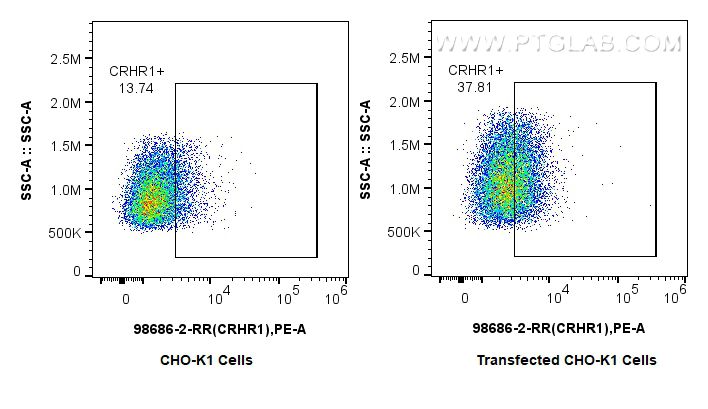
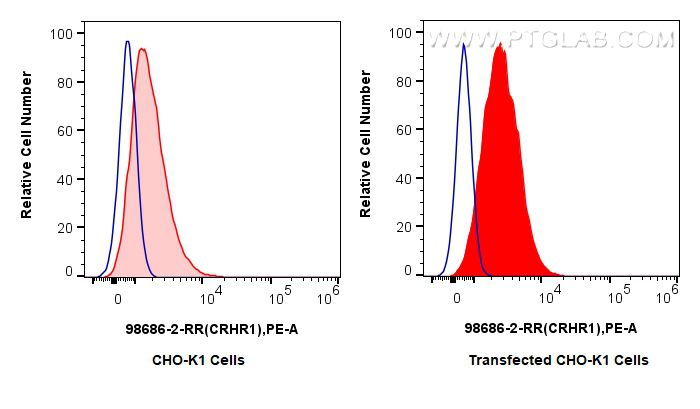
Tested Applications
Recommended dilution
| Application | Dilution |
|---|---|
| This reagent has been tested for flow cytometric analysis. It is recommended that this reagent should be titrated in each testing system to obtain optimal results. | |
Product Information
98686-2-PBS targets CRHR1 in FC applications and shows reactivity with human samples.
| Tested Reactivity | human |
| Host / Isotype | Rabbit / IgG |
| Class | Recombinant |
| Type | Antibody |
| Immunogen |
Peptide 相同性解析による交差性が予測される生物種 |
| Full Name | corticotropin releasing hormone receptor 1 |
| Calculated molecular weight | 48 kDa |
| GenBank accession number | NM_004382 |
| Gene Symbol | CRHR1 |
| Gene ID (NCBI) | 1394 |
| Conjugate | Unconjugated |
| Form | |
| Form | Liquid |
| Purification Method | Protein A purification |
| UNIPROT ID | P34998 |
| Storage Buffer | PBS only{{ptg:BufferTemp}}7.3 |
| Storage Conditions | Store at -80°C. |
Background Information
Corticotropin-releasing hormone (CRH, also known as Corticotropin-releasing factor, CRF) is a 41 amino acid peptide hormone and a key regulator of the stress response. CRH and the related urocortin peptides (UCN, UCN2 and UCN3) mediate their actions through two mammalian receptor subtypes, CRHR1 and CRHR2 (PMID: 23863939). CRHR1 (also known as CRFR1) exhibits high affinity towards CRH and UCN but low affinity towards UCN2 and no affinity towards UCN3 (PMID: 22684850). The activity of this receptor is mediated by G proteins which activate adenylyl cyclase. Widely distributed throughout the brain, CRHR1 critically controls behavioral adaptation to stress and is causally linked to emotional disorders (PMID: 21885734). Alternative splicing results in multiple transcript variants encoding distinct isoforms of CRHR1.