
Validation Data Gallery
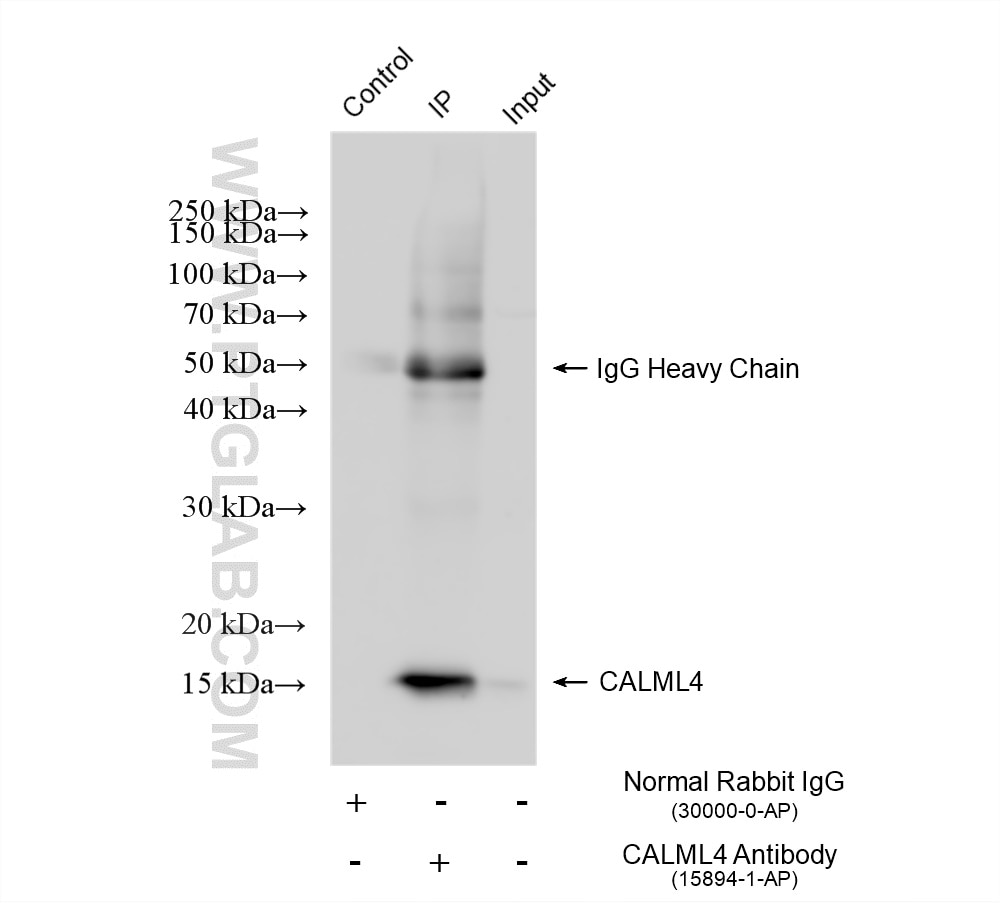
Tested Applications
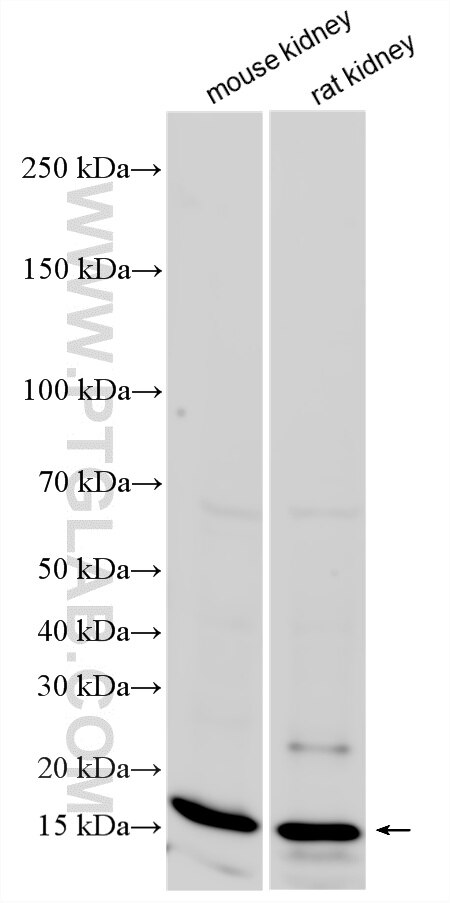
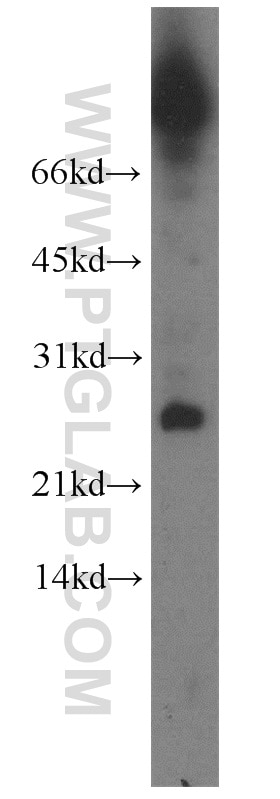
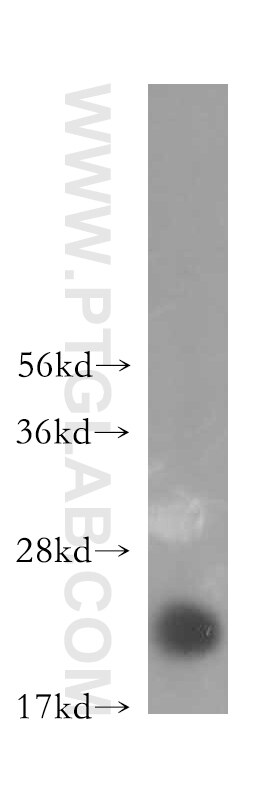
| Positive WB detected in | mouse kidney tissue, human colon tissue, mouse thymus tissue, rat kidney tissue |
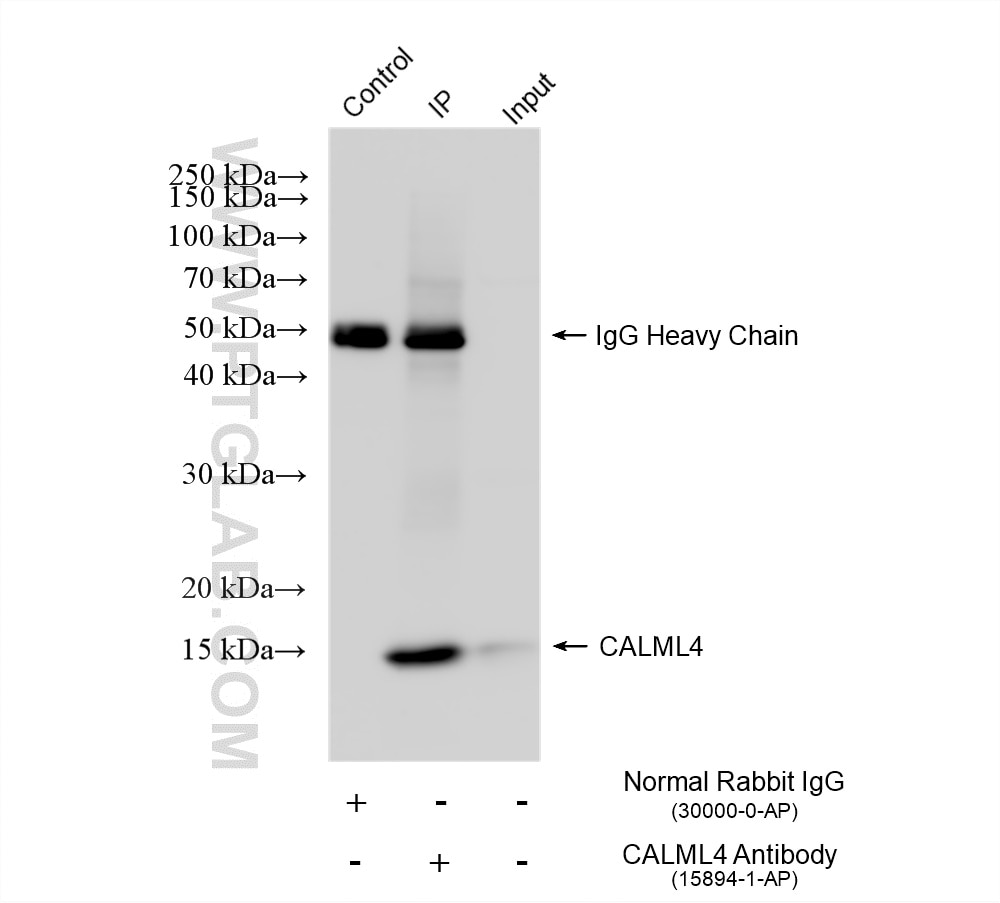
| Positive IP detected in | rat kidney tissue, mouse kidney tissue |
Recommended dilution
| Application | Dilution |
|---|---|
| Western Blot (WB) | WB : 1:2000-1:10000 |
| Immunoprecipitation (IP) | IP : 0.5-4.0 ug for 1.0-3.0 mg of total protein lysate |
| It is recommended that this reagent should be titrated in each testing system to obtain optimal results. | |
| Sample-dependent, Check data in validation data gallery. | |
Published Applications
| KD/KO | See 1 publications below |
| WB | See 3 publications below |
| IF | See 1 publications below |
Product Information
15894-1-AP targets CALML4 in WB, IF, IP, ELISA applications and shows reactivity with human, mouse, rat samples.
| Tested Reactivity | human, mouse, rat |
| Cited Reactivity | human, rat |
| Host / Isotype | Rabbit / IgG |
| Class | Polyclonal |
| Type | Antibody |
| Immunogen |
CatNo: Ag8705 Product name: Recombinant human CALML4 protein Source: e coli.-derived, PGEX-4T Tag: GST Domain: 49-196 aa of BC009516 Sequence: QPRPQNEYKECFSLYDKQQRGKIKATDLMVAMRCLGASPTPGEVQRHLQTHGIDGNGELDFSTFLTIMHMQIKQEDPKKEILLAMLMVDKEKKGYVMASDLRSKLTSLGEKLTHKEVDDLFREADIEPNGKVKYDEFIHKITLPGRDY 相同性解析による交差性が予測される生物種 |
| Full Name | calmodulin-like 4 |
| Calculated molecular weight | 196 aa, 22 kDa |
| Observed molecular weight | 17 kDa |
| GenBank accession number | BC009516 |
| Gene Symbol | CALML4 |
| Gene ID (NCBI) | 91860 |
| RRID | AB_2069462 |
| Conjugate | Unconjugated |
| Form | |
| Form | Liquid |
| Purification Method | Antigen affinity purification |
| UNIPROT ID | Q96GE6 |
| Storage Buffer | PBS with 0.02% sodium azide and 50% glycerol{{ptg:BufferTemp}}7.3 |
| Storage Conditions | Store at -20°C. Stable for one year after shipment. Aliquoting is unnecessary for -20oC storage. |
Background Information
CALML4 (Calmodulin-Like Protein 4) is a small EF-hand protein encoded by the CALML4 gene located at human chromosome 15q23, which functions primarily as a myosin light chain within the intermicrovillar adhesion complex (IMAC) essential for epithelial brush border differentiation, where it binds to the neck region of the motor protein MYO7B to mediate microvilli organization and length control. Structurally, the longest isoform comprises 196 amino acids with a bilobed EF-hand architecture (N-lobe and C-lobe) and calcium‑binding capacity, although five alternatively spliced isoforms exist, some lacking an intact N-lobe. CALML4 is broadly expressed, with highest levels in the colon and duodenum, and is localized at the distal tips of intestinal microvilli. Clinically, common genetic variants in CALML4 have been investigated for their association with antidepressant efficacy in major depressive disorder, while its role in brush border assembly underscores its physiological importance in intestinal epithelia.
Protocols
| Product Specific Protocols | |
|---|---|
| IP protocol for CALML4 antibody 15894-1-AP | Download protocol |
| WB protocol for CALML4 antibody 15894-1-AP | Download protocol |
| Standard Protocols | |
|---|---|
| Click here to view our Standard Protocols |
Publications
| Species | Application | Title |
|---|---|---|
ACS Chem Neurosci Tetrahydropalmatine Regulates BDNF through TrkB/CAM Interaction to Alleviate the Neurotoxicity Induced by Methamphetamine. | ||
J Biol Chem The small EF-hand protein CALML4 functions as a critical myosin light chain within the intermicrovillar adhesion complex.
|