
Validation Data Gallery
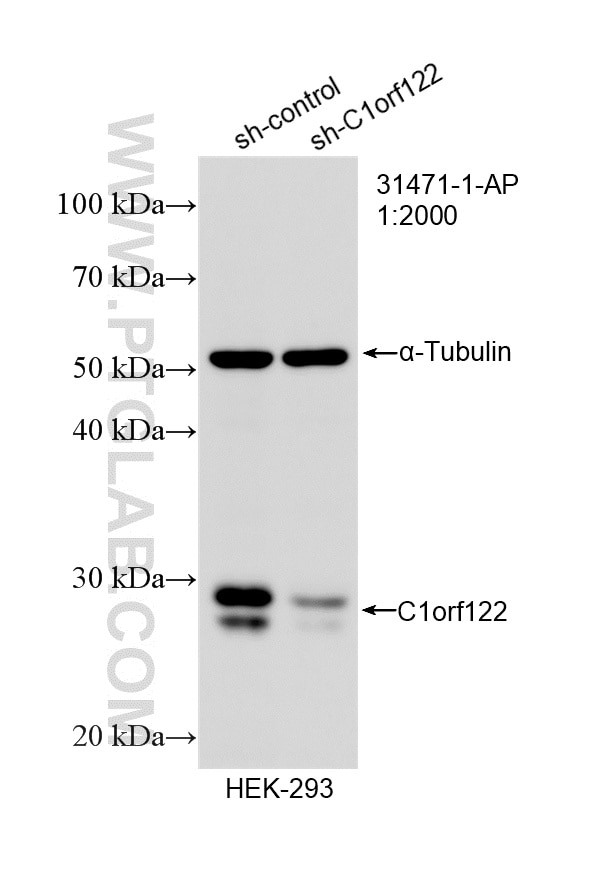
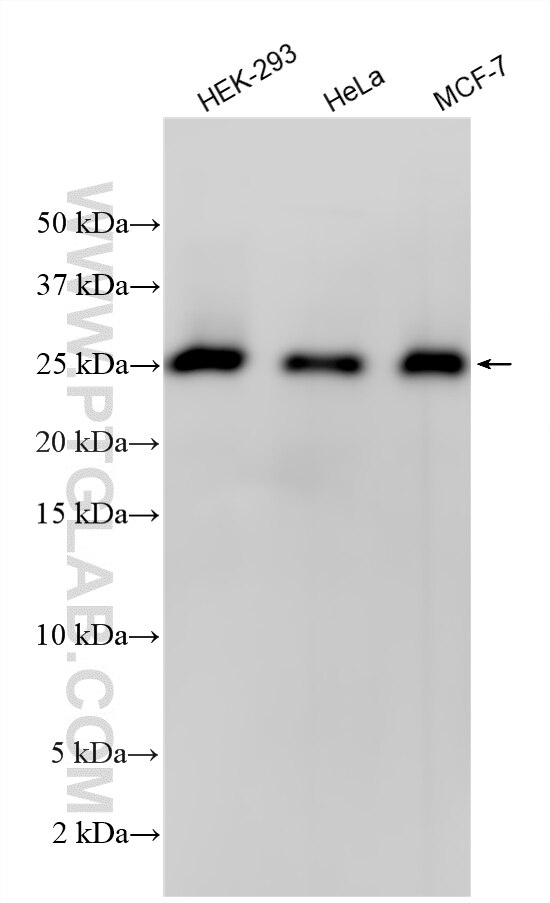
Tested Applications
Recommended dilution
| Application | Dilution |
|---|---|
| It is recommended that this reagent should be titrated in each testing system to obtain optimal results. | |
Product Information
31471-1-PBS targets C1orf122 in WB, Indirect ELISA applications and shows reactivity with human samples.
| Tested Reactivity | human |
| Host / Isotype | Rabbit / IgG |
| Class | Polyclonal |
| Type | Antibody |
| Immunogen |
CatNo: Ag35685 Product name: Recombinant human C1orf122 protein Source: e coli.-derived, PGEX-4T Tag: GST Domain: 1-110 aa of NM_198446.2 Sequence: MEWGPGSDWSRGEAAGVDRGKAGLGLGGRPPPQPPREERAQQLLDAVEQRQRQLLDTIAACEEMLRQLGRRRPEPAGGGNVSAKPGAPPQPAVSARGGFPKDAGDGAAEP 相同性解析による交差性が予測される生物種 |
| Full Name | chromosome 1 open reading frame 122 |
| Calculated molecular weight | 11kDa,110aa |
| Observed molecular weight | 25 kDa |
| GenBank accession number | NM_198446.2 |
| Gene Symbol | C1orf122 |
| Gene ID (NCBI) | 127687 |
| RRID | AB_3742434 |
| Conjugate | Unconjugated |
| Form | |
| Form | Liquid |
| Purification Method | Antigen affinity Purification |
| UNIPROT ID | Q6ZSJ8 |
| Storage Buffer | PBS only{{ptg:BufferTemp}}7.3 |
| Storage Conditions | Store at -80°C. |
Background Information
C1orf122 (also known as ALAESM) is a lysosomal transmembrane protein and a member of the α/β hydrolase superfamily. It catalyzes the deacylation of cardiolipin to generate monolysocardiolipin (MLCL) within cells, serving as a key node in the mitochondrial cardiolipin remodeling pathway. Clinical multi-omics studies have revealed its significant overexpression in more than ten types of tumors, including hepatocellular carcinoma, glioma, and gastric cancer, which is closely associated with shorter patient survival, immune infiltration, and activation of DNA damage repair pathways. In vitro experiments have confirmed that it promotes cancer cell proliferation and migration by inhibiting apoptosis, inducing epithelial-mesenchymal transition (EMT), and activating the PI3K/AKT/GSK3β-SRPK1 axis. It is regarded as a potential independent prognostic biomarker and therapeutic target.