
Validation Data Gallery
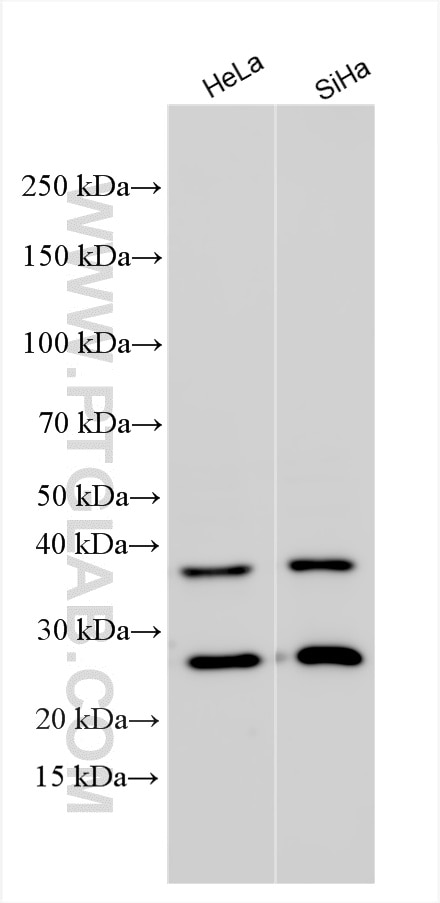
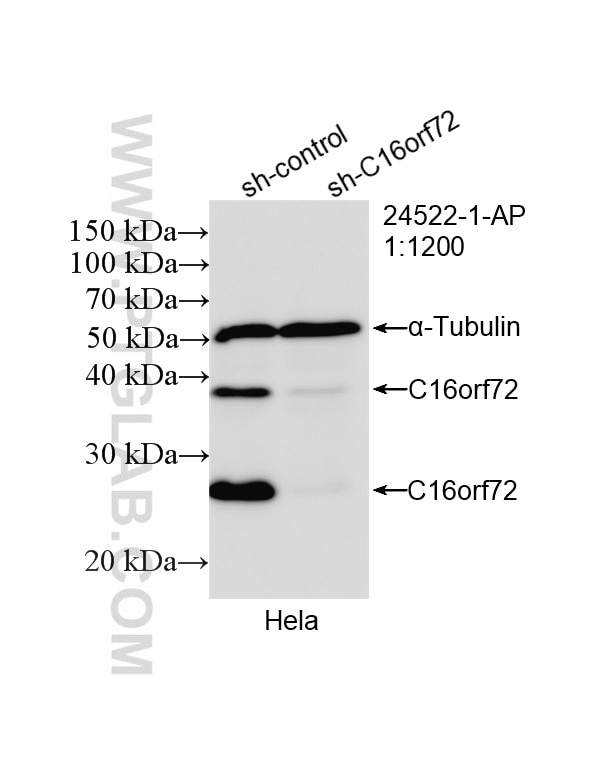
Tested Applications
| Positive WB detected in | HeLa cells, SiHa cells |
Recommended dilution
| Application | Dilution |
|---|---|
| Western Blot (WB) | WB : 1:500-1:3000 |
| It is recommended that this reagent should be titrated in each testing system to obtain optimal results. | |
| Sample-dependent, Check data in validation data gallery. | |
Published Applications
| KD/KO | See 1 publications below |
| WB | See 1 publications below |
| IF | See 1 publications below |
Product Information
24522-1-AP targets C16orf72 in WB, IF, ELISA applications and shows reactivity with human, mouse samples.
| Tested Reactivity | human, mouse |
| Cited Reactivity | human |
| Host / Isotype | Rabbit / IgG |
| Class | Polyclonal |
| Type | Antibody |
| Immunogen |
CatNo: Ag21585 Product name: Recombinant human C16orf72 protein Source: e coli.-derived, PGEX-4T Tag: GST Domain: 1-275 aa of BC113570 Sequence: MEERKEEGEAEIQEHGPEHWFSKWERQCLAEAEQDEQLPPELQEEAAAAAQPEHKQQKLWHLFQNSATAVAQLYKDRVCQQPGLSLWVPFQNAATAVTNLYKESVDTHQRSFDIGIQIGYQRRNKDVLAWVKKRRRTIRREDLISFLCGKVPPPRNSRAPPRLTVVSPNRATSTETSSSVETDLQPFREAIALHGLSGAMASISVRSSTPGSPTHVSSGSNASRRRNGLHDVDLNTFISEEMALHLDNGGTRKRTSAQCGDVITDSPTHKRNRMI 相同性解析による交差性が予測される生物種 |
| Full Name | chromosome 16 open reading frame 72 |
| Calculated molecular weight | 275 aa, 31 kDa |
| Observed molecular weight | 35 kDa, 25 kDa |
| GenBank accession number | BC113570 |
| Gene Symbol | C16orf72 |
| Gene ID (NCBI) | 29035 |
| RRID | AB_2879587 |
| Conjugate | Unconjugated |
| Form | |
| Form | Liquid |
| Purification Method | Antigen affinity purification |
| UNIPROT ID | Q14CZ0 |
| Storage Buffer | PBS with 0.02% sodium azide and 50% glycerol{{ptg:BufferTemp}}7.3 |
| Storage Conditions | Store at -20°C. Stable for one year after shipment. Aliquoting is unnecessary for -20oC storage. |
Background Information
C16orf72, also known as HAPSTR1 (HUWE1‑associated protein‑modifying stress responses 1) and TAPR1 (telomere attrition and p53 response 1), is a highly conserved protein‑coding gene located at chromosome 16p13.2. Its encoded protein functions as a stress‑response coordinator, acting as a rheostat that dampens excessive p53 activation upon telomere dysfunction or DNA damage, thereby protecting cells from inappropriate senescence or apoptosis. In addition, C16orf72 is recruited to chromatin under replication stress and participates in the DNA damage response, helping to prevent replication catastrophe. It also exhibits synthetic lethality with telomerase reverse transcriptase (TERT), implicating it in telomere maintenance. Although not listed in conventional cancer gene databases, murine insertional mutagenesis supports its role as a cancer driver, and its elevated expression is associated with poor prognosis in head and neck cancer. Furthermore, copy‑number variations at this locus have been linked to neurodevelopmental conditions such as autism spectrum disorder and schizophrenia. Ongoing research continues to elucidate its precise molecular mechanisms, with the aim of uncovering its potential as a therapeutic target in cancer and other diseases.. The MW of C16orf72 is 35 kDa and 25 kDa in our detection.
Protocols
| Product Specific Protocols | |
|---|---|
| WB protocol for C16orf72 antibody 24522-1-AP | Download protocol |
| Standard Protocols | |
|---|---|
| Click here to view our Standard Protocols |
Publications
| Species | Application | Title |
|---|---|---|
Aging (Albany NY) An LRPPRC-HAPSTR1-PSMD14 interaction regulates tumor progression in ovarian cancer | ||
Mol Cell Molecular mechanism of HUWE1-HAPSTR1-USP7-mediated ubiquitin chain amplification on nuclear proteins.
|