
Recombinant Human CLEC-2/CLEC1B protein (rFc Tag)
Species
Human
Purity
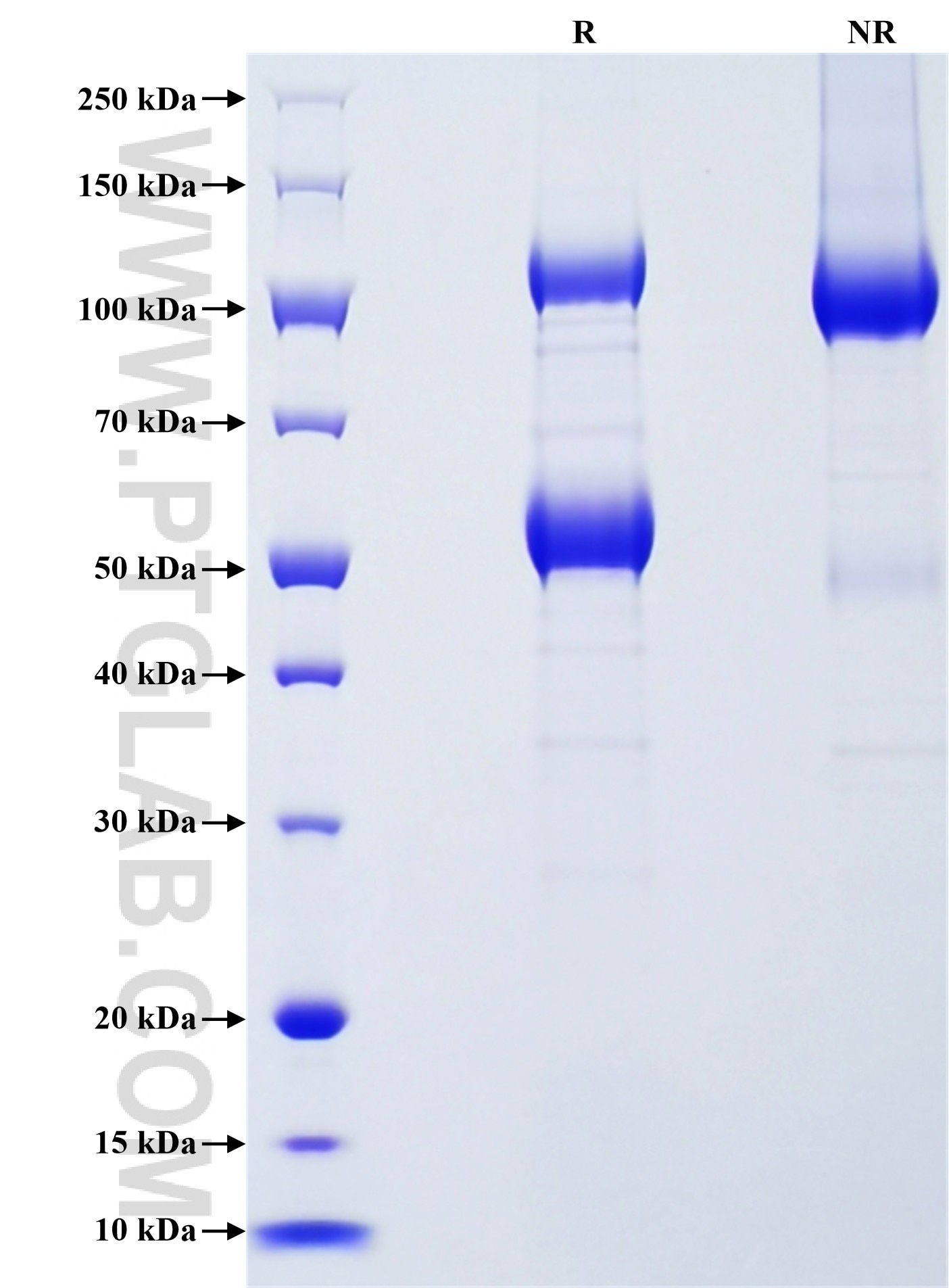
>90 %, SDS-PAGE
Tag
rFc Tag
Activity
not tested
Cat no : Eg4774
Validation Data Gallery
Product Information
| Purity | >90 %, SDS-PAGE |
| Endotoxin | <0.1 EU/μg protein, LAL method |
| Activity |
Not tested |
| Expression | HEK293-derived Human CLEC-2 protein Ser55-Pro229 (Accession# Q9P126-1) with a rabbit IgG Fc tag at the C-terminus. |
| GeneID | 51266 |
| Accession | Q9P126-1 |
| PredictedSize | 46.3 kDa |
| SDS-PAGE | 50-60 kDa and 100-120 kDa, reducing (R) conditions |
| Formulation | Lyophilized from 0.22 μm filtered solution in PBS, pH 7.4. Normally 5% trehalose and 5% mannitol are added as protectants before lyophilization. |
| Reconstitution | Briefly centrifuge the tube before opening. Reconstitute at 0.1-0.5 mg/mL in sterile water. |
| Storage Conditions |
It is recommended that the protein be aliquoted for optimal storage. Avoid repeated freeze-thaw cycles.
|
| Shipping | The product is shipped at ambient temperature. Upon receipt, store it immediately at the recommended temperature. |
Background
C-type lectin-like receptor 2 (CLEC2, also known as CLEC1B) is a type II transmembrane receptor of the C-type lectin superfamily, which are characterized by one or more C-type lectin-like domains (CTLDs). CLEC2 contains a single YXXL/hemi-ITAM (immuno-receptor tyrosine-based activation motif) within its cytoplasmic domain. CLEC-2 is highly expressed on platelets and megakaryocytes and at low levels on other hematopoietic cells, including dendritic cells, neutrophils, monocytes, and macrophages. The first identified ligand for CLEC2 was the platelet-aggregating snake venom protein rhodocytin, and podoplanin has been established as an endogenous ligand for CLEC2. CLEC2 is involved in thrombosis/hemostasis, tumor metastasis, and lymphangiogenesis. CLEC2 can be glycosylated and has been detected as 32- and 40-kDa forms in platelets with varying degrees of glycosylation.
References:
1. Colonna M, et al. (2000) Eur J Immunol. 30(2):697-704.
2. Meng D, et al. (2021) Front Immunol. 12:688643.
3. Mourão-Sá D, et al. (2011) Eur J Immunol. 41(10):3040-3053.
4. Wu X, et al. (2015) EBioMedicine. 2(3):214-224.
5. Suzuki-Inoue K, et al. (2010) J Biol Chem. 285(32):24494-24507.
6. Suzuki-Inoue K, et al. (2006) Blood. 107(2):542-549.
7. Gitz E, Pollitt AY, et al. (2014) Blood. 124(14):2262-2270.
8. Suzuki-Inoue K, et al. (2011) J Thromb Haemost. 9 Suppl 1:44-55.