
Recombinant Human Entactin protein (rFc Tag)
Species
Human
Purity
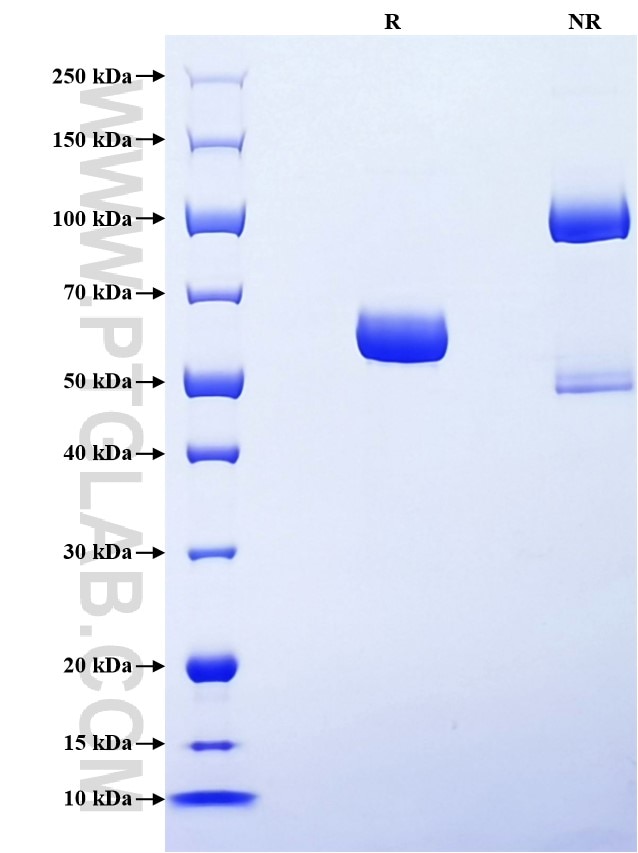
>90 %, SDS-PAGE
Tag
rFc Tag
Activity
not tested
Cat no : Eg3912
Validation Data Gallery
Product Information
| Purity | >90 %, SDS-PAGE |
| Endotoxin | <0.1 EU/μg protein, LAL method |
| Activity |
Not tested |
| Expression | HEK293-derived Human Entactin protein Asp385-Asn670 (Accession# P14543-1) with a rabbit IgG Fc tag at the N-terminus |
| GeneID | 4811 |
| Accession | P14543-1 |
| PredictedSize | 58.8 kDa |
| SDS-PAGE | 55-65 kDa, reducing (R) condition |
| Formulation | Lyophilized from 0.22 μm filtered solution in PBS, pH 7.4. Normally 5% trehalose and 5% mannitol are added as protectants before lyophilization. |
| Reconstitution | Briefly centrifuge the tube before opening. Reconstitute at 0.1-0.5 mg/mL in sterile water. |
| Storage Conditions |
It is recommended that the protein be aliquoted for optimal storage. Avoid repeated freeze-thaw cycles.
|
| Shipping | The product is shipped at ambient temperature. Upon receipt, store it immediately at the recommended temperature. |
Background
Nidogen 1 (Entactin), first identified from a basement membrane-secreting cell line and the murine EHS tumor, is together with perlecan, laminin, and collagen IV, a ubiquitous component of basement membranes. Nidogen-1 is made by mesenchymal cells and is incorporated into the epithelial BM. It is a sulfated glycoprotein of 150 kDa with three globular domains, G1, G2 and G3, and contains binding sites for other ECM molecules.
References:
1. Murshed M, et al. (2000). Mol Cell Biol. Sep;20(18):7007-7012.
2. Pujuguet P, et al. (2000). J Cell Sci. Mar;113 ( Pt 5)(Pt 5):849-858.
3. Vasudevan A, et al. (2010). Hippocampus. May;20(5):608-20.