
Recombinant Mouse SLPI protein (rFc Tag)
Species
Mouse
Purity
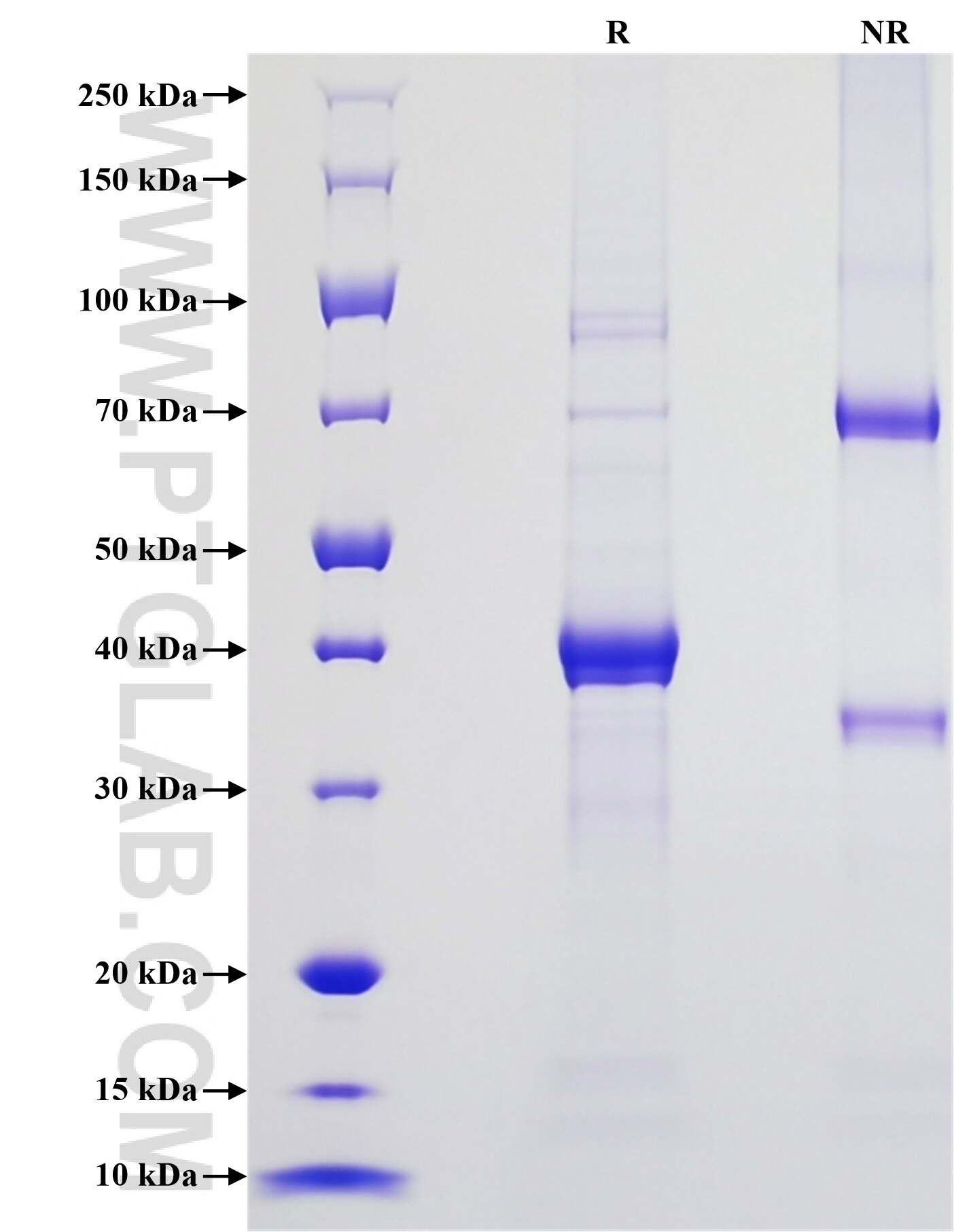
>90 %, SDS-PAGE
Tag
rFc Tag
Activity
not tested
Cat no : Eg2905
Validation Data Gallery
Product Information
| Purity | >90 %, SDS-PAGE |
| Endotoxin | <0.1 EU/μg protein, LAL method |
| Activity |
Not tested |
| Expression | HEK293-derived Mouse SLPI protein Gly26-Met131 (Accession# P97430) with a rabbit IgG Fc tag at the C-terminus. |
| GeneID | 20568 |
| Accession | P97430 |
| PredictedSize | 37.3 kDa |
| SDS-PAGE | 38-43 kDa, reducing (R) conditions |
| Formulation | Lyophilized from 0.22 μm filtered solution in PBS, pH 7.4. Normally 5% trehalose and 5% mannitol are added as protectants before lyophilization. |
| Reconstitution | Briefly centrifuge the tube before opening. Reconstitute at 0.1-0.5 mg/mL in sterile water. |
| Storage Conditions |
It is recommended that the protein be aliquoted for optimal storage. Avoid repeated freeze-thaw cycles.
|
| Shipping | The product is shipped at ambient temperature. Upon receipt, store it immediately at the recommended temperature. |
Background
Secretory leukocyte protease inhibitor (SLPI) is also named as Antileukoproteinase (ALP), BLPI, HUSI-1, WAP4, WFDC4 and mucus proteinase inhibitor (MPI). The SLPI is a multifunctional protein involved in the modulation of immunological response and the inhibition of protease activities. SLPI acts as an inhibitor of proteases, exerts antibacterial properties, and suppresses the transcription of proinflammatory genes through the nuclear factor-kappa B (NF-κB) pathway. SLPI is as a serine protease inhibitor and also as a critical mediator that is involved in the PTH-mediated shift to the osteoblastic phase. Slpi induction in osteoblasts enhances its differentiation, and increases osteoblast-osteoclast contact, thereby suppressing osteoclastic function. SLPI is an evolutionarily conserved, pleiotropic protein expressed at mucosal surfaces, mainly by epithelial cells. SLPI maintains homeostasis at barrier tissues by preventing tissue destruction and regulating the threshold of inflammatory immune responses, while protecting the host from infection. However, as recent studies demonstrate that overexpression of SLPI increases the metastatic potential of epithelial tumors. The role of this protein as a regulatory agent has been implicated in various types of cancer.
References:
1.Qu W,Zhang X,Liu SS, et al. Pathol Res Pract. 2023;248:154633.
2.Carter, Kymberley et al. Int J Lab Hematol vol. 29,2 (2007): 92-110.
3.Nugteren, Sandrine et al. Cytokine Growth Factor Rev vol. 59, (2021): 22-35.