Recombinant Mouse MerTK protein (rFc Tag) (HPLC verified)
Species
Mouse
Purity
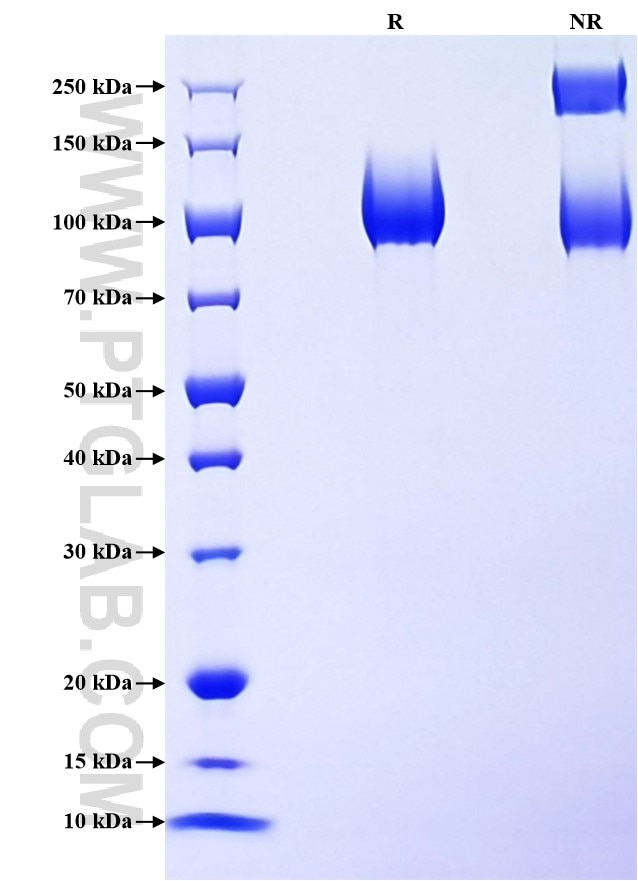
>90 %, SDS-PAGE
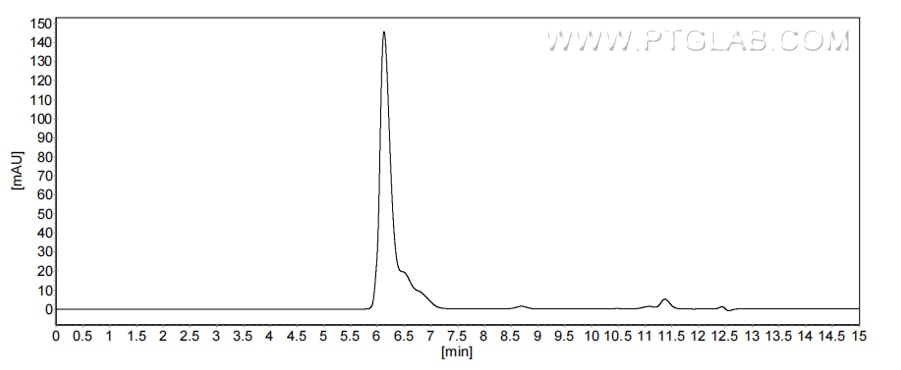
>90%, SEC-HPLC
Tag
rFc Tag
Activity
not tested
Cat no : Eg2866
Validation Data Gallery
Product Information
| Purity | >90 %, SDS-PAGE >90%, SEC-HPLC |
| Endotoxin | <0.1 EU/μg protein, LAL method |
| Activity |
Not tested |
| Expression | HEK293-derived Mouse MerTK protein Glu23-Phe498 (Accession# Q60805) with a rabbit IgG Fc tag at the C-terminus. |
| GeneID | 17289 |
| Accession | Q60805 |
| PredictedSize | 78.2 kDa |
| SDS-PAGE | 90-110 kDa, reducing (R) conditions |
| Formulation | Lyophilized from 0.22 μm filtered solution in PBS, pH 7.4. Normally 5% trehalose and 5% mannitol are added as protectants before lyophilization. |
| Reconstitution | Briefly centrifuge the tube before opening. Reconstitute at 0.1-0.5 mg/mL in sterile water. |
| Storage Conditions |
It is recommended that the protein be aliquoted for optimal storage. Avoid repeated freeze-thaw cycles.
|
| Shipping | The product is shipped at ambient temperature. Upon receipt, store it immediately at the recommended temperature. |
Background
MerTK (Mer tyrosine kinase), also known as RP38, c-Eyk, c-mer, and Tyro12, was first cloned from a human B lymphoblastoid expression library (PMID:8086340) and is one of the TAM (Tyro-3, Axl, and MerTK) receptor tyrosine kinase (RTK) family (PMID:23833304). Although this RTK, like others, can promote tumor cell proliferation to some extent, MERTK primarily lends tumor cells crucial survival advantages while promoting invasion, migration and metastasis, drug resistance, and, in the innate immune system, suppressing anti-tumor immunity (PMID:32417270). The multiple MERTK species observed are likely due to posttranslational modifications (PMID: 23585477).
References:
1. Graham DK. et al. (1994). Cell Growth Differ. 5(6):647-57.
2. Cummings CT. et al. (2013). Clin Cancer Res. 1;19(19):5275-80.
3. Huelse JM. et al. (2020). Pharmacol Ther. 213:107577.
4.  Schlegel J. et al. (2013). J Clin Invest. 123(5):2257-67.