
Recombinant Human CD93 protein (rFc Tag)
Species
Human
Purity
>80 %, SDS-PAGE
Tag
rFc Tag
Activity
not tested
Cat no : Eg2794
Validation Data Gallery
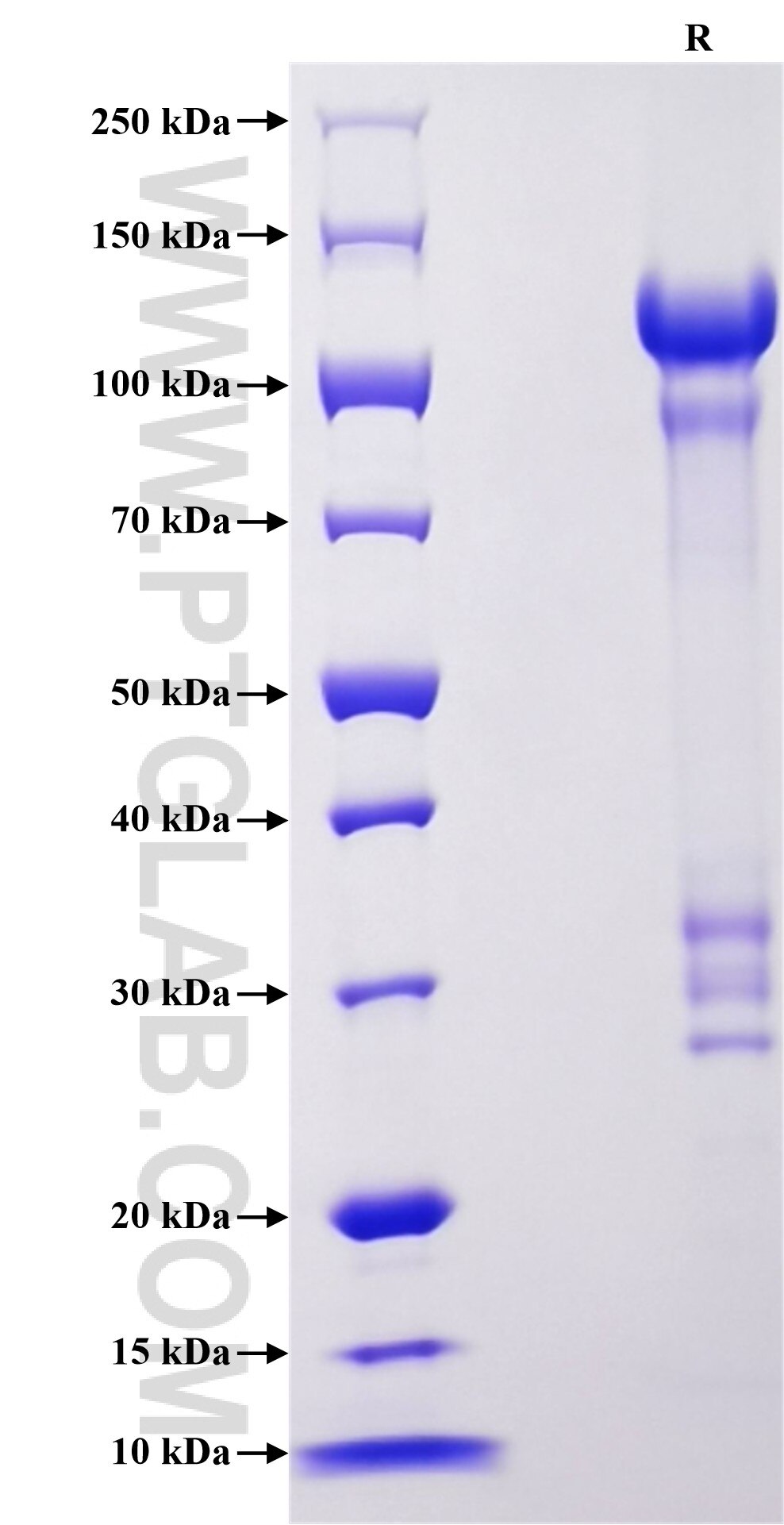
Product Information
| Purity | >80 %, SDS-PAGE |
| Endotoxin | <0.1 EU/μg protein, LAL method |
| Activity |
Not tested |
| Expression | HEK293-derived Human CD93 protein Ala24-Lys580 (Accession# Q9NPY3) with a rabbit IgG Fc tag at the C-terminus. |
| GeneID | 22918 |
| Accession | Q9NPY3 |
| PredictedSize | 83.7 kDa |
| SDS-PAGE | 87-140 kDa, reducing (R) conditions |
| Formulation | Lyophilized from 0.22 μm filtered solution in PBS, pH 7.4. Normally 5% trehalose and 5% mannitol are added as protectants before lyophilization. |
| Reconstitution | Briefly centrifuge the tube before opening. Reconstitute at 0.1-0.5 mg/mL in sterile water. |
| Storage Conditions |
It is recommended that the protein be aliquoted for optimal storage. Avoid repeated freeze-thaw cycles.
|
| Shipping | The product is shipped at ambient temperature. Upon receipt, store it immediately at the recommended temperature. |
Background
CD93 (also known as complement protein 1 q subcomponent receptor C1qR1 or C1qRp), is a transmembrane glycoprotein, that belongs to the C-type lectin domain (CTLD) group 14 family of transmembrane glycoproteins together with thrombomodulin, CLEC14A, and CD248. This protein family has a similar ectodomain architecture and is involved in several cell processes including angiogenesis, inflammation, and cell adhesion. CD93 is predominantly co-expressed on tumor and stromal cells, such as endothelial cells, cancer-associated fibroblasts(CAFs), neutrophils, T cells, macrophages, M1 and M2 macrophages. Several immune-related signaling pathways were enriched based on CD93 expression, including immune cell activation and migration, focal adhesion, leukocyte transendothelial migration, oxidative phosphorylation, and complement.
References:
1. Tossetta, Giovanni et al. Cells vol. 12,13 (2023): 1778.
2. Khan, Kabir A et al. The FEBS journal vol. 286,17 (2019): 3299-3332.
3. Guo, Aiyuan et al. Frontiers in immunology vol. 13 (2022): 907182.