
Recombinant Mouse BST2 protein (rFc Tag)
Species
Mouse
Purity
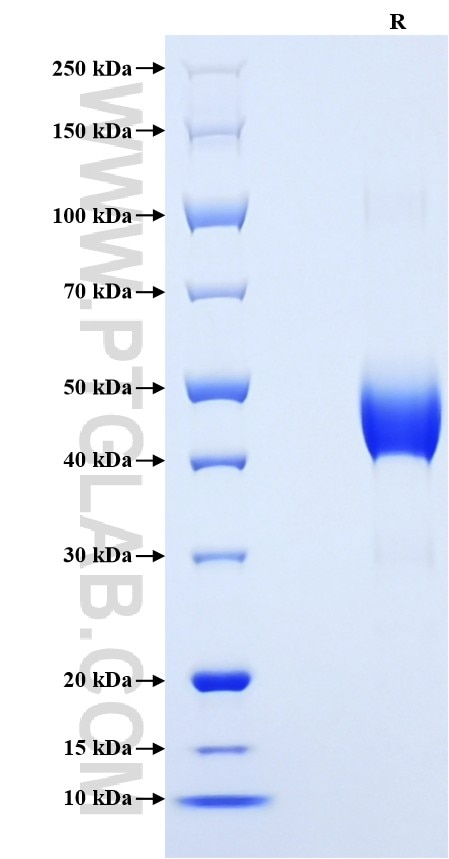
>90 %, SDS-PAGE
Tag
rFc Tag
Activity
not tested
Cat no : Eg2669
Validation Data Gallery
Product Information
| Purity | >90 %, SDS-PAGE |
| Endotoxin | <0.1 EU/μg protein, LAL method |
| Activity |
Not tested |
| Expression | HEK293-derived Mouse BST2 protein Thr52-Ser152 (Accession# Q8R2Q8) with a rabbit IgG Fc tag at the C-terminus. |
| GeneID | 69550 |
| Accession | Q8R2Q8 |
| PredictedSize | 37.0 kDa |
| SDS-PAGE | 40-50 kDa, reducing (R) conditions |
| Formulation | Lyophilized from 0.22 μm filtered solution in PBS, pH 7.4. Normally 5% trehalose and 5% mannitol are added as protectants before lyophilization. |
| Reconstitution | Briefly centrifuge the tube before opening. Reconstitute at 0.1-0.5 mg/mL in sterile water. |
| Storage Conditions |
It is recommended that the protein be aliquoted for optimal storage. Avoid repeated freeze-thaw cycles.
|
| Shipping | The product is shipped at ambient temperature. Upon receipt, store it immediately at the recommended temperature. |
Background
BST2 protein, also known as CD317, is a membrane protein involved in various biological processes. It plays a crucial role in restricting viral release, particularly for enveloped viruses like HIV-1. Additionally, BST2 is implicated in immune regulation, being involved in the function of plasmacytoid dendritic cells. In cancer biology, BST2 expression is associated with tumor progression and metastasis, making it a potential therapeutic target. Its involvement in multiple pathways highlights its significance in virology, immunology, and oncology.
References:
1. Mahauad-Fernandez, Wadie D, and Chioma M Okeoma. Immunity, inflammation and disease vol. 4,1 (2015): 4-23.
2. Kong, Ning et al. Autophagy vol. 16,10 (2020): 1737-1752.
3. Zhao, Yifei et al. Frontiers in cellular and infection microbiology vol. 12 (2022): 979091.
4. Zhao, Yifei et al. Journal of virology vol. 96,2 (2022): e0161021.
5.Yu, Honglian et al. Oncology reports vol. 51,3 (2024): 45.